Niche Case Study: The "Product vs. Brand" Conundrum
Why do consumers willingly pay a $5 premium for a Starbucks coffee when any caffeinated beverage performs the exact same basic function?
1. The Anatomy of the Conundrum
At the level of pure product function, a $1.50 cup of gas-station drip coffee and a $6.00 Starbucks Venti Latte are nearly identical. Both deliver:
- A measured dose of caffeine (a central nervous system stimulant)
- A warm (or cold) liquid vehicle
- A bitter alkaloid solution extracted from roasted coffee beans
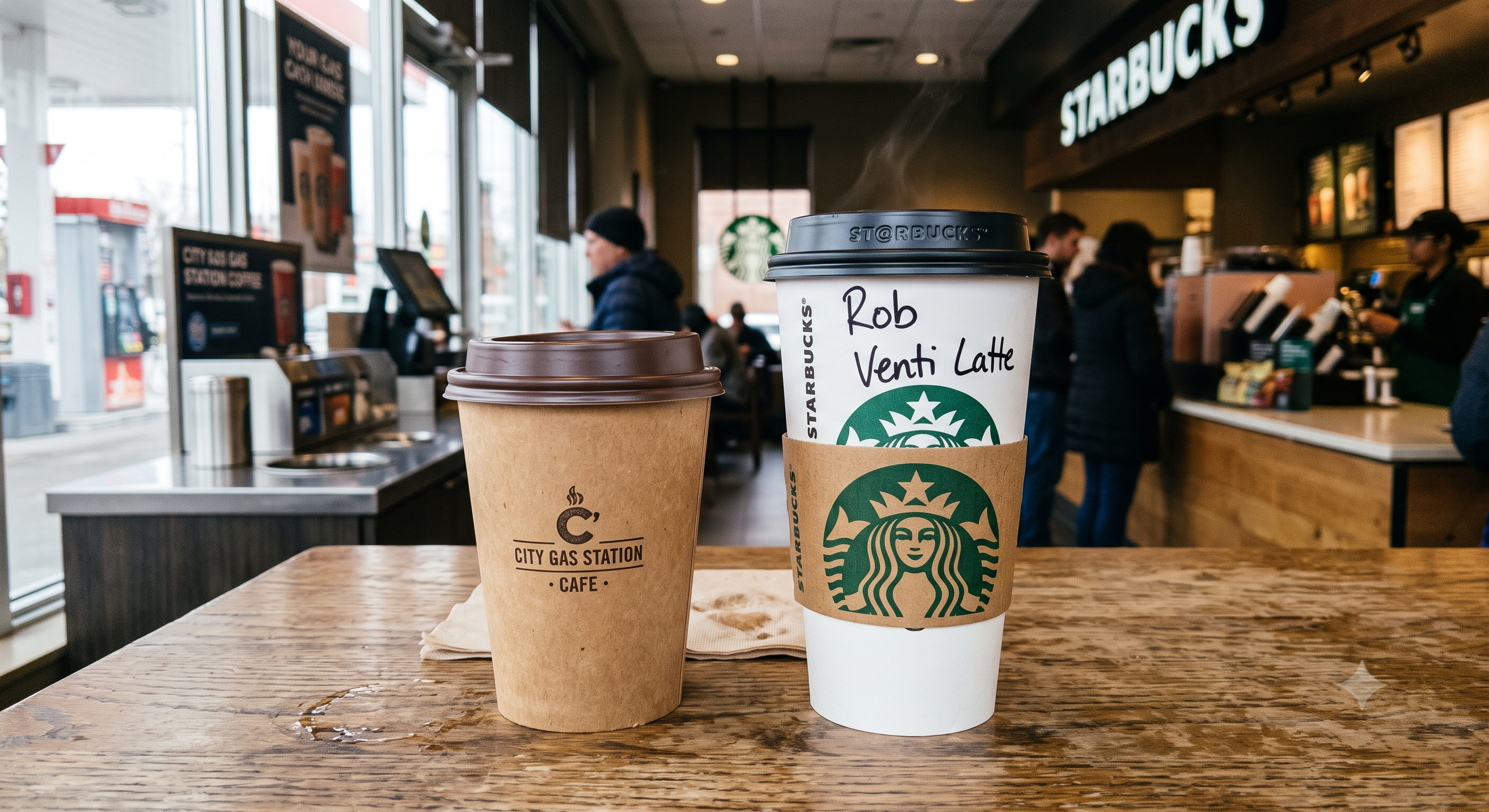
By any strictly utilitarian metric, the gap between the two is negligible. Yet the market sustains a ~300% price premium for the branded product. This is not an anomaly — it is the central mechanism of modern consumer capitalism.
The conundrum reveals a fundamental truth: consumers do not buy products; they buy brands. A product satisfies a biological or functional need. A brand satisfies a psychological or social need. The $5 premium is the price of meaning, identity, and belonging — not caffeine. [1]
2. The Corporate Lesson: Product Function vs. Brand Equity
The Product (Commodity Layer)
At its most basic level, a product is a solution to a functional problem. It is defined by its utility, its ingredients, and its performance metrics. In the case of coffee:
| Functional Dimension | Generic Coffee | Starbucks Coffee |
|---|---|---|
| Caffeine delivery | ✅ Yes | ✅ Yes |
| Temperature | ✅ Hot liquid | ✅ Hot liquid |
| Taste profile | Bitter, acidic | Bitter, acidic (variable) |
| Price point | $1.00–$2.00 | $4.00–$7.00 |
| Functional parity | Identical | Identical |
At the commodity level, the two are functionally indistinguishable. The $5 premium is not paying for caffeine — it is paying for something else entirely.
The Brand (Psychological Layer)
A brand is not a product. A brand is a relationship — a constellation of associations, emotions, and identity signals that the consumer purchases alongside the physical good. [1:1] Where the product satisfies a biological need (thirst, energy), the brand satisfies a psychological need (belonging, status, identity coherence).
| Dimension | Product (Commodity) | Brand (Equity) |
|---|---|---|
| Core question answered | "Does it work?" | "Who am I when I use it?" |
| Value driver | Utility, price, availability | Meaning, identity, emotional resonance |
| Consumer relationship | Transactional (use and discard) | Relational (loyalty, identification) |
| Competitive moat | Price & distribution | Emotional attachment & trust |
| Risk of substitution | High (any caffeine source will do) | Low (the brand experience is irreplaceable) |
| Pricing power | Elastic (demand drops as price rises) | Inelastic (premium is accepted, even expected) |
3. The Anatomy of the Premium: Why $5 for Starbucks?
The $5 premium is not a single charge — it is a bundle of psychological, social, and environmental value propositions that the consumer implicitly evaluates before purchase.
3.1 The "Third Place" — Environmental Equity
Starbucks does not sell coffee; it sells a sanctioned respite — a "third place" between home and work where the consumer is neither host nor employee. The premium pays for:
- Climate-controlled seating with Wi-Fi access
- The absence of obligation (no one expects you to buy more than one drink)
- A predictable, standardized environment in any city worldwide
3.2 Identity Signaling — The Veblen Dynamic
Starbucks operates as a mass-affordable Veblen good — the premium price signals a certain level of disposable income and cultural awareness. [1:2] Carrying a Starbucks cup is a subtle status marker: it says "I can afford a $6 beverage as a casual daily ritual," which is itself a class signal. The green mermaid logo functions as a wearable badge of participation in a global, aspirational lifestyle.
3.3 The Gestalt of the Macchiato
As explored in 🌿Gestalt Psychology-The Mechanics of the Whole, a Starbucks beverage is a Gestalt — a whole that is "other" than the sum of its parts. [2] The consumer is not paying for espresso, milk, and syrup. They are paying for the emergent experience: the ritual of ordering in a specific language ("Venti," "Grande"), the anticipation, the barista calling their name, the first sip from a cup bearing the iconic siren logo. The raw ingredients are commodities; the Gestalt is a brand.
%20(27).gif)
When you order a "Venti Iced Caramel Macchiato," you are essentially ordering a Gestalt. You pay for, anticipate, and consume a unified, magical experience that you identify with a single conceptual label. [2:1]
Individually, none of the ingredients are a Macchiato. It is only when the barista actively processes, combines, and layers them — and importantly, when you apply the conceptual label "Macchiato" to the cup — that the whole emerges. [2:2]
3.4 The Veblen Dynamic
Starbucks operates at the intersection of the Bandwagon Effect and a softened Veblen dynamic. [1:3] The premium price does not function as pure conspicuous consumption (as with a Ferrari), but it does signal a baseline level of disposable income. The consumer is buying into a tribe — the global tribe of people who "get" the Starbucks experience. This is the Bandwagon Effect in action: demand increases as adoption increases, because the choice is socially validated. [1:4]
4. The Corporate Lesson: Product vs. Brand Equity
4.1 The Product Layer
A product is defined by its functional attributes. It answers the question: Does it work? For coffee, the product layer includes:
- Caffeine content (mg)
- Temperature
- Volume
- Price per ounce
At this layer, all caffeinated beverages are substitutable commodities. The consumer has no reason to be loyal. Price is the primary differentiator.
4.2 The Brand Layer
A brand is defined by its psychological and emotional attributes. It answers the question: Who am I when I use it? For Starbucks, the brand layer includes:
- Identity: The consumer of a Starbucks beverage is cosmopolitan, urban, and discerning.
- Ritual: The ordering process (size names, customization) creates a sense of expertise and belonging.
- Consistency: A Starbucks latte in Tokyo tastes identical to one in New York — reliability is itself a luxury.
- Status: The logo is a public signal of participation in a global consumer class.
4.3 The Key Insight
A product satisfies a need. A brand satisfies an identity.
The $5 premium is the price of the identity transaction. The consumer is not buying caffeine; they are buying a momentary sense of who they are — or who they wish to be. [3]
5. Linguistic Focus: Advanced Market-Segment Adjectives & Corporate Business Collocations
5.1 Market-Segment Adjectives
| Adjective | Connotation | Typical Collocations |
|---|---|---|
| Iconic | Globally recognized, culturally embedded, timeless | iconic brand, iconic logo, iconic status |
| Aspirational | Desired by those not yet in the segment | aspirational brand, aspirational lifestyle, aspirational pricing |
| Premium | Higher quality, higher price, selective distribution | premium product, premium segment, premium positioning |
| Mass-market | Widely available, accessible pricing, broad appeal | mass-market brand, mass-market retail, mass-market appeal |
| Boutique | Small-scale, curated, exclusive | boutique brand, boutique experience, boutique offering |
| Heritage | Long-standing tradition, craftsmanship, authenticity | heritage brand, heritage label, heritage craftsmanship |
| Disruptive | Challenging established norms, innovative | disruptive brand, disruptive pricing, disruptive model |
| Commodity | Undifferentiated, price-driven, interchangeable | commodity product, commodity pricing, commodity trap |
| Lifestyle | Integrated into a broader identity system | lifestyle brand, lifestyle marketing, lifestyle integration |
| Niche | Targeted at a specific, narrow audience | niche brand, niche market, niche positioning |
5.2 Corporate Business Collocations
| Collocation | Meaning | Example |
|---|---|---|
| Brand equity | The commercial value derived from consumer perception | "Starbucks' brand equity allows it to command a premium." |
| Value proposition | The unique bundle of benefits offered to the consumer | "The value proposition extends beyond the beverage itself." |
| Market positioning | The strategic place a brand occupies in consumer minds | "Starbucks positioned itself as a 'third place,' not a coffee shop." |
| Price elasticity | The sensitivity of demand to price changes | "Premium brands exhibit lower price elasticity." |
| Brand loyalty | The tendency of consumers to repeatedly purchase the same brand | "Brand loyalty insulates Starbucks from commodity competition." |
| Competitive moat | A sustainable advantage that protects market share | "Emotional connection is Starbucks' deepest competitive moat." |
| Customer lifetime value (CLV) | The total revenue expected from a single customer account | "High CLV justifies the investment in brand experience." |
| Top-of-mind awareness | The first brand that comes to mind in a category | "Starbucks enjoys near-universal top-of-mind awareness." |
| Brand extension | Using an established brand name for a new product category | "Starbucks' brand extension into packaged coffee and ready-to-drink." |
| Point of parity vs. point of difference | Features shared with competitors vs. unique differentiators | "Caffeine delivery is a point of parity; the third-place experience is a point of difference." |
6. AI Overview: Comparison Matrix — Product Functions vs. Brand Perceptions
| Functional Dimension | Product (Commodity Coffee) | Brand (Starbucks) | Premium Justification |
|---|---|---|---|
| Caffeine delivery | ✅ Delivers stimulant | ✅ Delivers stimulant | $0 — functional parity |
| Temperature control | ✅ Hot liquid | ✅ Hot liquid | $0 — functional parity |
| Taste | Bitter, variable | Consistent, customizable | $0.50 — quality & consistency premium |
| Packaging | Plain cup, generic lid | Iconic cup with logo, sleeve, custom lid | $0.50 — aesthetic & signaling premium |
| Environment | Counter, takeaway, or car | Curated "third place" with seating, music, Wi-Fi | $1.50 — environmental premium |
| Ritual | Pour, pay, go | Order by size name, barista interaction, name-calling | $1.00 — experiential premium |
| Identity signal | None (invisible consumption) | Logo visible to others; status marker | $1.00 — social signaling premium |
| Consistency guarantee | Variable across locations | Identical experience globally | $0.50 — reliability premium |
| Total premium | — | — | ~$5.00 |
7. Deeper Connections to Your Vault
This case study intersects with several existing notes in your digital garden:
- 🌿Gestalt Psychology-The Mechanics of the Whole — The Starbucks Macchiato as a Gestalt, deconstructed into its five Skandha-analogous components. [2:3]
- 🌿Snob Effect vs. Veblen Goods vs. Bandwagon Effect — The Veblen, Snob, and Bandwagon effects that underpin premium brand pricing. [1:5]
- 🌿Consumer's Trap-Digital Marketing as a Vector of Delusion (Moha) — How marketing exploits craving (Taṇhā) and constructs artificial desire through brand narratives. [3:1]
- 🌳Epistemology of Preference-Avijjā, Māna, and the Emptiness of Aesthetic Taste in Buddhist Philosophy — The deeper philosophical question: is the preference for a branded coffee any different from aesthetic snobbery? Both are expressions of Māna (conceit) and Avijjā (ignorance) — the belief that one's choice reflects an objective truth about quality rather than a conditioned, empty preference. [4]
- 🌿Avijjā and Aesthetics-The Arrogance of Objective Preference — The "Starbucks vs. generic coffee" preference as a microcosm of the same ego-fortification mechanism. [5]
📊 Ready to teach this concept? Jump to the master depository for the complete lesson layout, outcomes matrix, and student worksheets:
👉 Brand vs. Product | Identifying Key Brand Characteristics
8. Discussion Questions
- The Ethical Question: Is the $5 premium a form of exploitation (charging more for something that costs nearly the same to produce) or a legitimate exchange (the consumer freely pays for the emotional experience)?
- The Buddhist Question: If brand preference is a manifestation of Taṇhā (craving) and Māna (conceit), is there such a thing as "ethical branding"? Or is all brand differentiation ultimately a vector of delusion? [3:2]
- The Strategic Question: Can a commodity product (e.g., generic coffee) ever build brand equity, or is the premium always tied to non-functional attributes?
- The Linguistic Question: How do the market-segment adjectives above (iconic, aspirational, boutique) function as upāya (skillful means) in marketing communication? Do they inform or manipulate?
Sources
🌿Snob Effect vs. Veblen Goods vs. Bandwagon Effect ↩︎ ↩︎ ↩︎ ↩︎ ↩︎ ↩︎
🌿Consumer's Trap-Digital Marketing as a Vector of Delusion (Moha) ↩︎ ↩︎ ↩︎
🌳Epistemology of Preference-Avijjā, Māna, and the Emptiness of Aesthetic Taste in Buddhist Philosophy ↩︎
🌿Avijjā and Aesthetics-The Arrogance of Objective Preference ↩︎