🌿theory x and y and dharma
In Buddhism, Dharma refers to the ultimate truth, the teachings of the Buddha, and the laws governing the mind and reality. At its core, Buddhism is a psychological framework aimed at moving from suffering (Dhuman/Dukkha) to liberation (Nirvana).
Here is how Theory X and Theory Y map onto Buddhist concepts of human nature, mindsets, and the path to awakening.
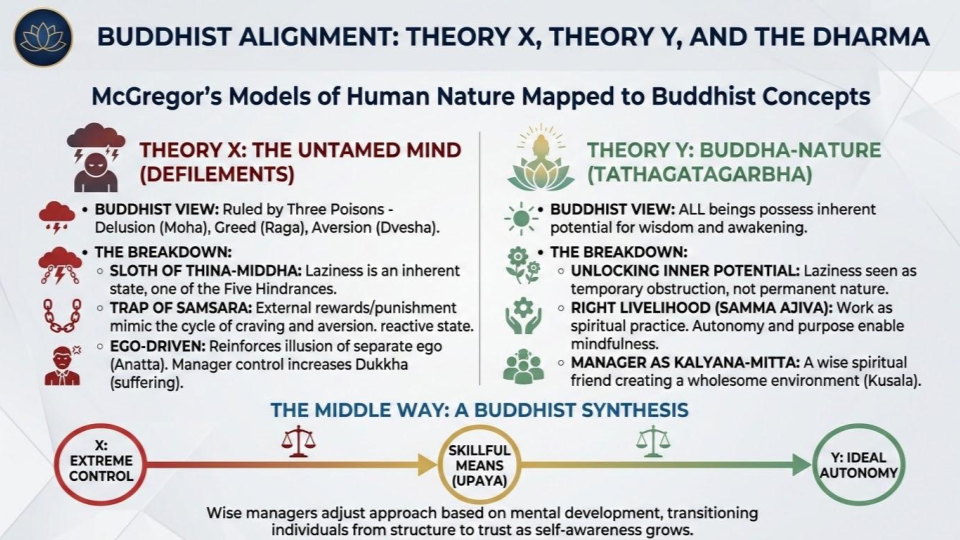
1. Theory X and the Untamed Mind (Defilements)
Theory X assumes humans must be controlled, directed, and threatened with punishment to get them to work. In Buddhist psychology, this describes a mind that is entirely ruled by the Three Poisons (Kleshas): Delusion (Moha), Greed/Attachment (Raga), and Aversion (Dvesha).
The Buddhist Breakdown:
- The Sloth of Thina-Middha: Theory X views workers as inherently lazy. In Buddhism, Thina-Middha (sloth and torpor) is one of the Five Hindrances to mental progress. A Theory X manager assumes employees are permanently stuck in this unwholesome mental state.
- The Trap of Samsara (Carrot & Stick): Relying on external punishments and rewards to force behavior mimics the cycle of Samsara. It operates purely on the level of craving (working only for money) and aversion (working only to avoid getting fired). It keeps the worker trapped in a reactive, survival-driven state of mind.
- Ego-Driven Management: Theory X creates an adversarial environment (Us vs. Them), reinforcing the illusion of a separate, permanent ego (Anatta). The manager seeks to control, which only increases friction and suffering (Dukkha) for everyone involved.
2. Theory Y and Buddha-Nature (Tathagatagarbha)
Theory Y assumes that people are inherently self-motivated, creative, and eager to grow if given the right conditions. This aligns beautifully with the Mahayana Buddhist concept of Buddha-Nature—the absolute truth that all sentient beings possess the inherent potential for supreme wisdom, compassion, and awakening.
The Buddhist Breakdown:
- Unlocking Inner Potential: Theory Y does not see laziness as a permanent human trait. Instead, it views laziness as a temporary obstruction, much like clouds covering the sun. The inherent nature of the mind is bright, active, and capable.
- Right Livelihood (Samma Ajiva): Part of the Noble Eightfold Path is Right Livelihood. Theory Y environments allow work to become an extension of spiritual practice. When workers are given autonomy and purpose, their labor ceases to be a toxic chore and becomes a way to practice mindfulness, ethics, and community service.
- The Manager as a Kalyana-mitta (Spiritual Friend): A Theory Y leader acts less like a dictator and more like a Kalyana-mitta—a wise guide who creates a wholesome environment (Kusala) that allows others to flourish. They understand that by removing the conditions for fear, the natural human capacity for cooperation and creativity will emerge.
The Middle Way: A Buddhist Synthesis
Buddhism teaches the Middle Way—the path of moderation between extremes. If we look at management through this lens, we see how a Buddhist approach might balance or evolve McGregor's ideas:
X: Extreme Control/Rigidity <---> The Middle Way: Skillful Means <---> Y: Ideal Autonomy
While Theory Y is the spiritual ideal, a Buddhist manager uses Upaya (Skillful Means). They recognize that not everyone is at the same stage of mental development.
- For an employee heavily clouded by delusion or laziness (Theory X state), a wise leader might temporarily introduce clearer boundaries, firm structures, and immediate feedback (mindful discipline).
- As the employee develops self-awareness, mindfulness, and intrinsic motivation, the leader pulls back, transitioning them into a Theory Y environment of trust, freedom, and self-direction.
Ultimately, while Theory X treats humans like animals to be tamed, Theory Y aligns with the Buddhist Dharma by treating humans as Buddhas-in-the-making, capable of self-regulation, growth, and ultimate freedom.