🌿Brian Eno's Artistic Vision and the Philosophy of Ambient Music
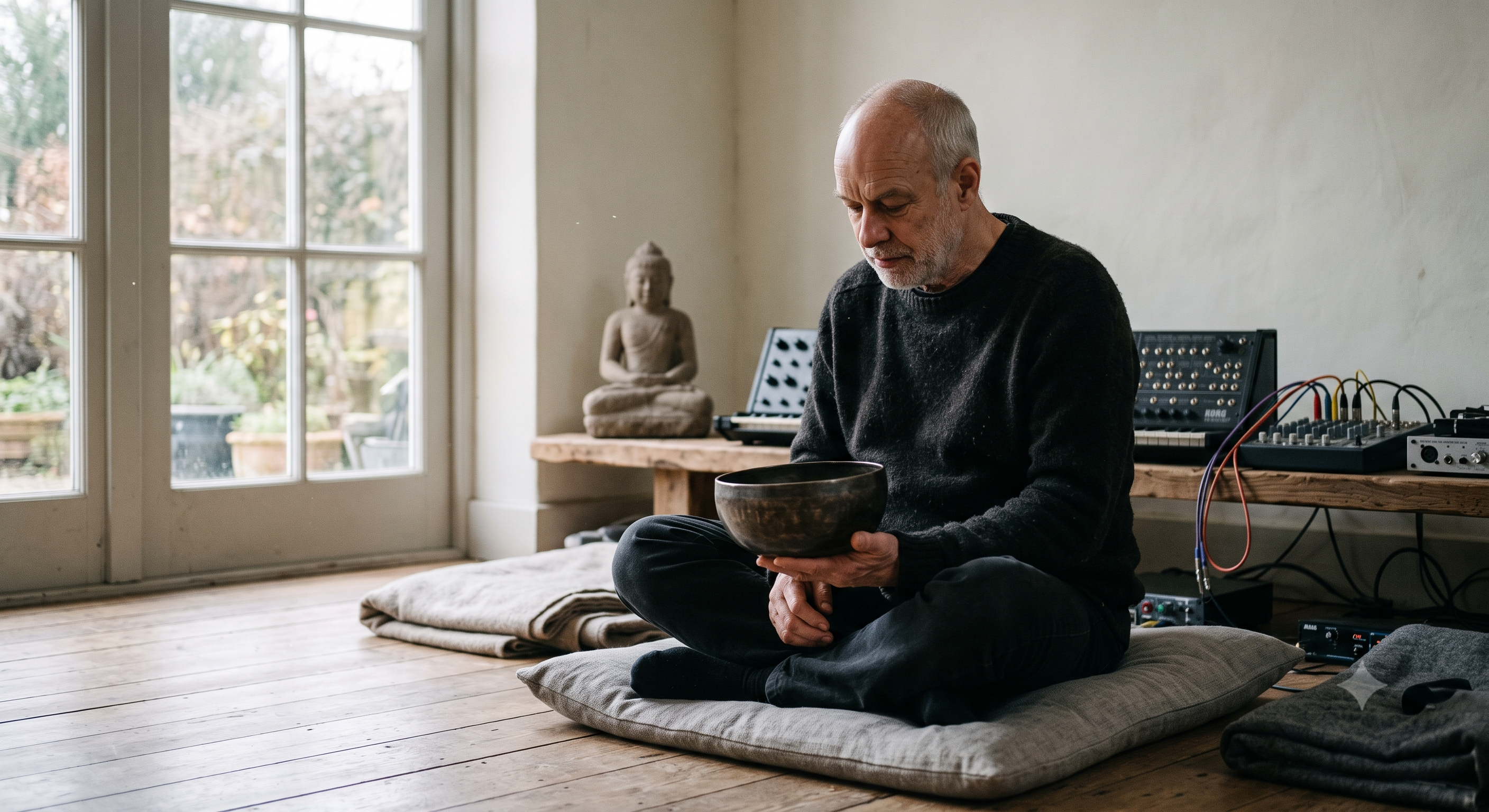
Brian Eno’s artistic philosophy, as detailed in our note, exhibits striking conceptual parallels with core tenets of Buddhist thought, even if Eno does not explicitly frame his work in those terms. The resonance lies in how both systems deconstruct the "architect" (the ego-driven self) in favor of a relational, process-oriented understanding of reality.
Key Convergences
- The Rejection of the "Architect" (Anatta): Eno’s fundamental rejection of the artist as an omnipotent "architect" who dictates every detail mirrors the Buddhist doctrine of Anatta (No-Self). Just as Buddhism posits that there is no independent, unchanging "CEO" of the mind, Eno views the composer not as a sovereign creator, but as a "gardener" who sets up conditions for a system to emerge [1]. Both perspectives shift the focus from a static, self-existent entity to a dynamic, interdependent process.
- Dependent Origination and Systemic Autonomy: Eno’s reliance on generative systems—where music arises from the interaction of tape loops or algorithms—is a practical application of Pratītyasamutpāda (Dependent Origination). In this view, nothing exists in isolation; phenomena (or musical patterns) arise, persist, and cease in dependence upon a web of causes, conditions, and relationships [2]. Eno’s "river metaphor," where the system remains structurally permanent while being in constant flux, echoes the Buddhist understanding of reality as a ceaseless flow of phenomena [1:1].
- Defocusing the Ego: Eno’s ambient ethos, which aims to "defocus the ego" and accommodate all levels of listening attention, aligns with the meditative practice of cultivating awareness without grasping [1:2]. By minimizing narrative hooks and aggressive elements, the music encourages a state of "deep listening" that promotes spatial awareness and allows the listener's ego to recede—a state often sought in Buddhist mindfulness practices to dismantle the illusion of a separate, rigid self [^3].
- Embracing Contingency and "Errors": Eno’s use of Oblique Strategies to honor "errors" as structural opportunities reflects a non-judgmental acceptance of reality as it is. This mirrors the Buddhist practice of working with the present moment, regardless of whether it aligns with our preconceived desires or expectations [1:3].
The Divergence: Conventional vs. Ultimate
While Eno’s work operates primarily within the realm of conventional reality—creating beautiful, functional soundscapes to alter our experience of space—it implicitly points toward the "ultimate" realization of emptiness (śūnyatā). By forcing the cinematic medium out of its fixed, final state, the documentary Eno transforms the archive into a living, generative ecosystem, demonstrating that even complex, "definitive" narratives are, in fact, empty of inherent, static existence [1:4].
In summary, while Eno’s note describes an aesthetic and technical approach to music and film, it functions as a profound, practical exploration of relational ontology. It mirrors the Buddhist path by moving away from the reified, ego-centric "architect" and toward a participatory, interdependent engagement with the world.