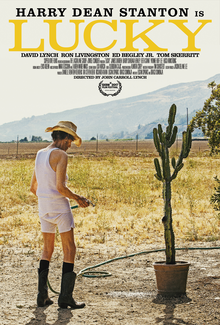
Lucky (2017) is essentially a cinematic meditation on death, impermanence, and the nature of the self — core Buddhist concerns. The film follows Lucky (Harry Dean Stanton), a 90-year-old atheist living in a small desert town, who confronts his own mortality after a minor health scare. What makes it so quietly profound is how it embodies Buddhist ideas without ever preaching them.
Here are the key Buddhist themes I see in the film:
1. Impermanence (Anicca) — The entire film is a meditation on mortality. Lucky's daily routine — the same diner, the same crossword, the same bar — is a fragile structure against the backdrop of time's passage. His fainting spell shatters the illusion of permanence, and the rest of the film is him coming to terms with the fact that everything passes.
2. Emptiness (Śūnyatā) and No-Self (Anattā) — Lucky is an atheist, but he's not a nihilist. He's stripped away belief systems — religion, family ties, grand narratives — and what remains is a man who has, in a sense, seen through the constructed nature of the self. His quiet acceptance mirrors the Buddhist insight that the self is a convenient designation, not a fixed entity.
3. The Desert as a Symbol of the Void — The film's setting in the Arizona desert is perfect. The vast, empty landscape mirrors the Buddhist concept of śūnyatā — not a terrifying nothingness, but an open, spacious field of possibility. Lucky walks through it, sits with it, and eventually finds a kind of peace in it.
4. The Old Man and the Tortoise — The running motif of the tortoise that escapes its enclosure and wanders into the desert is a beautiful metaphor. The tortoise doesn't need the enclosure — it's perfectly adapted to the vast, open desert. Similarly, Lucky has shed the enclosures of social roles, belief systems, and attachments, and is simply being in the world.
5. The Atheist Who Lives Like a Zen Monk — Lucky explicitly says he's an atheist, yet his life is a living embodiment of Zen: simple routines, minimal possessions, acceptance of what comes, and a quiet dignity in the face of death. This aligns with the secular Buddhist tradition — the idea that the Dharma's liberating core can be decoupled from religious metaphysics [1].
It's a film that doesn't talk about Buddhism but shows it — through silence, through presence, through the quiet acceptance of impermanence. The final shot of Lucky walking into the desert, into the void, is one of the most graceful cinematic depictions of facing death I've seen.