🌳mechanics of self creation
🌳The Neural Substrates of the Two Truths
🌳digital dharma
The connection between seed consciousness, the Default Mode Network (DMN), discursive thought, and our inner narrative is essentially the mechanics of how the brain constructs a cohesive "self."
By mapping the phenomenology of Buddhist psychology onto modern cognitive neuroscience, we can trace exactly how latent memories surface, fragment, and assemble into our sense of identity. Here is how these concepts interact as a single system.
1. Seed Consciousness (The Latent Substrate)
In the Yogacara tradition, the alaya-vijnana—or storehouse consciousness—represents the foundational layer of the psyche.
-
It operates as the silent repository of your psychological conditioning, storing the impressions or "seeds" of past actions, emotional responses, and inherited biases.
-
It is entirely unconscious. These seeds lie dormant until a specific trigger in your environment or internal state creates the right conditions for them to surface as active psychological material.
.gif)
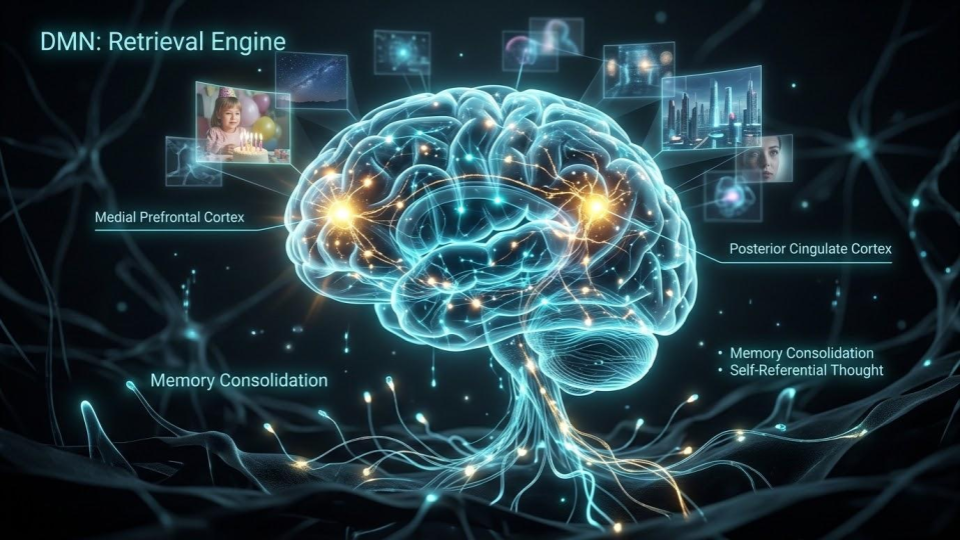
2. The Default Mode Network (The Neurological Engine)
Cognitive neuroscience identifies the DMN as a network of brain regions that becomes highly active when our attention is withdrawn from immediate, external tasks.
-
It serves as the biological infrastructure for self-referential processing, social cognition, and mental time travel (recalling the past or simulating the future).
-
When your focus shifts inward, the DMN acts as the retrieval mechanism. It draws upon your latent "seeds," translating those dormant, abstract impressions into active, conscious material.
3. Discursive Thought (The Associative Drift)
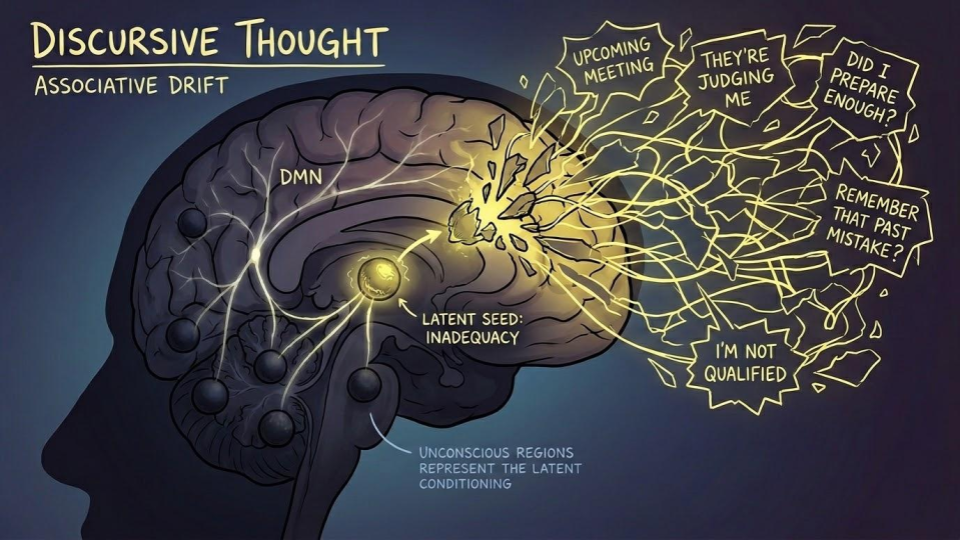
Discursive thought is the fragmented, continuous internal dialogue that occupies our baseline waking state.
-
Rather than deliberate, logical problem-solving, this is associative cognitive drift. It is the mind reacting to its own generated content.
-
Driven by the DMN pulling from your latent conditioning, discursive thought manifests as a sequence of rapid-fire associations, judgments, or anxieties. An unresolved "seed" of inadequacy, for example, surfaces and fractures into a dozen rapid, loosely connected thoughts about an upcoming meeting or a past conversation.
4. The Inner Narrative (The Autobiographical Synthesis)
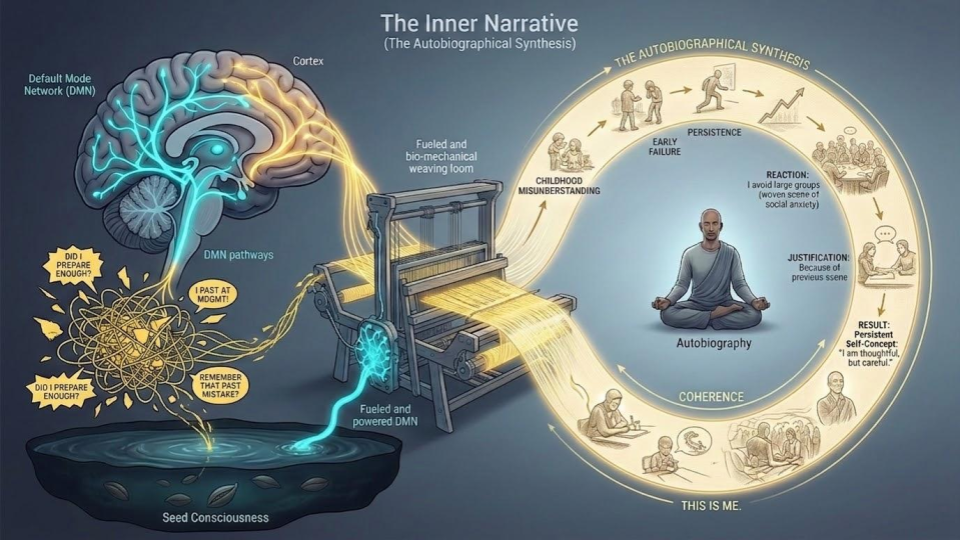
The inner narrative is the continuous, overarching storyline we identify as "me."
-
The human brain is fundamentally driven to maintain coherence. It cannot tolerate a chaotic, disconnected stream of discursive thoughts.
-
To create order, it synthesizes these associative fragments into a logical autobiography. It weaves your transient, discursive thoughts together into a rigid identity framework—a persistent self-concept that justifies your reactions, preferences, and aversions.
The Feedback Mechanism
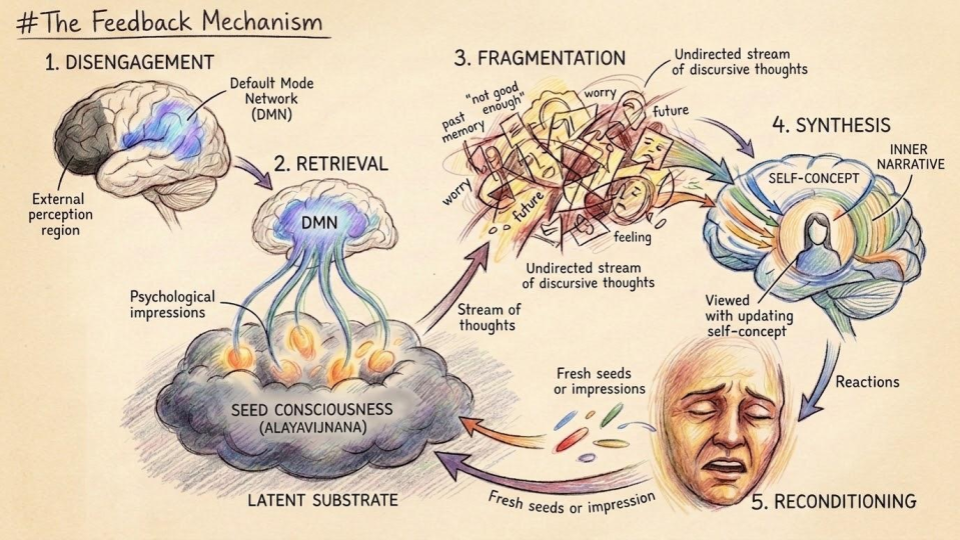
These four elements do not operate independently; they form a continuous, closed-loop system that reinforces the ego:
-
Disengagement: The brain disengages from immediate external focus, activating the DMN.
-
Retrieval: The DMN stimulates dormant conditioning, drawing material up from the seed consciousness.
-
Fragmentation: These raw psychological impressions enter conscious awareness as an undirected stream of discursive thoughts.
-
Synthesis: The brain organizes this chaotic associative drift into a coherent inner narrative, continuously updating your self-concept.
-
Reconditioning: Your emotional reactions to this newly synthesized narrative leave fresh psychological impressions, depositing new "seeds" into the latent substrate for future retrieval.
This framework explains the functional mechanics of focused-attention practices, such as mindfulness. By anchoring your attention to immediate sensory data in the present moment, you neurologically down-regulate the Default Mode Network. Without the DMN actively retrieving material, the seeds remain dormant, the associative drift of discursive thought stalls, and the heavy architecture of the inner narrative briefly drops away.