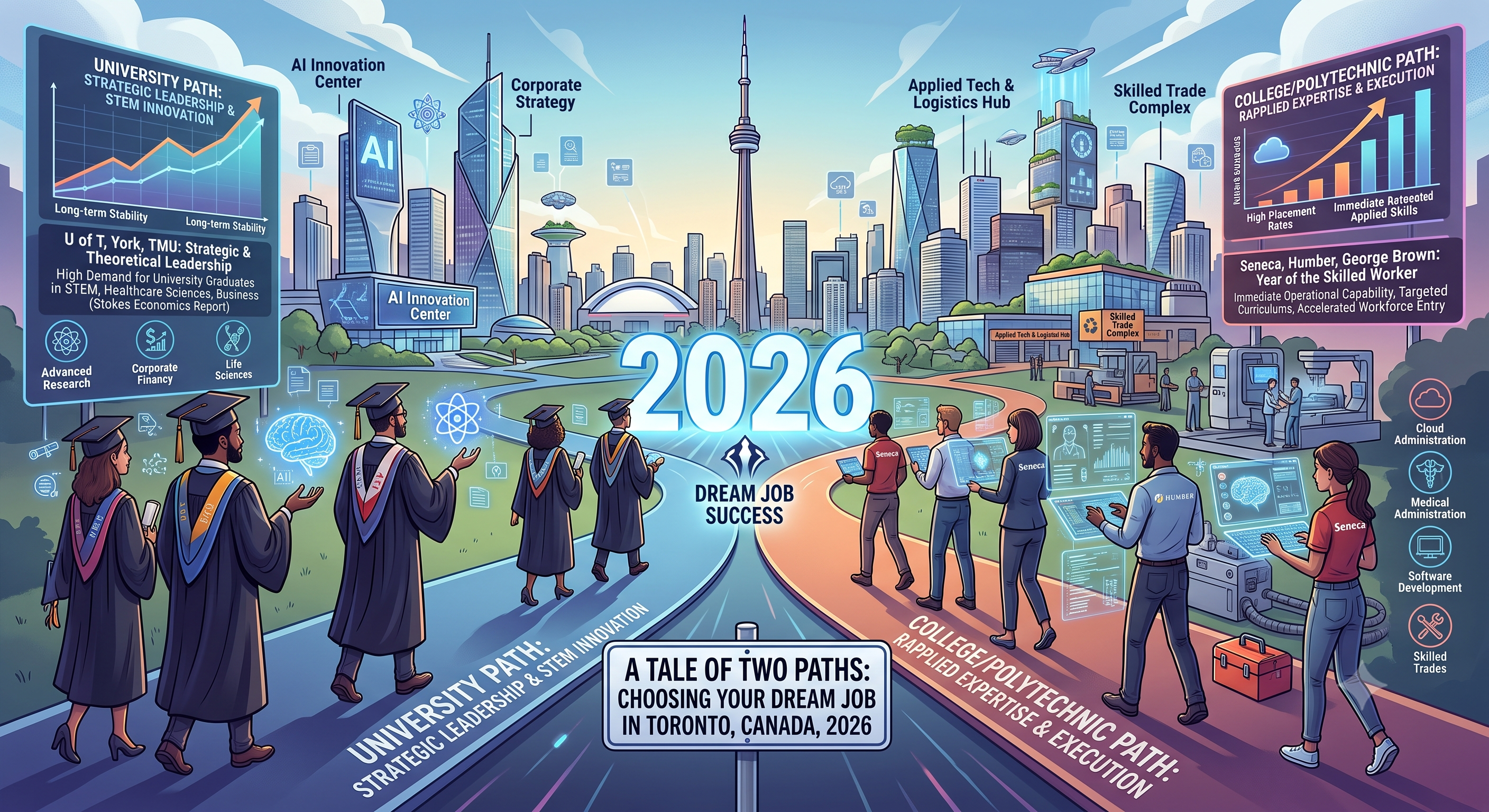
How To Realize Your Dream Job By Picking The Right Education Stream.
In the 2026 Toronto job market, choosing between college and university depends entirely on what your "dream job" entails. A 2026 Stokes Economics report reveals that Ontario requires over 1 million university graduates over the next decade, particularly to lead the AI revolution in STEM, corporate finance, and advanced health sciences. Conversely, 2026 has emerged as the "Year of the Skilled Worker," where Toronto employers heavily prioritize applied skills, rendering college and polytechnic diplomas (e.g., from Seneca, Humber, or George Brown) superior for rapid, high-demand entry into specialized tech, healthcare administration, logistics, and the skilled trades.
Introduction: The Toronto Job Market Context (2026)
Navigating the post-secondary landscape in Toronto requires a granular understanding of current macroeconomic realities. As of the first quarter of 2026, the Greater Toronto Area (GTA) faces an unemployment rate of 7.9% amidst cooling labor force expansion, even though total full-time employment numbers across the province remain resilient. [1]
The traditional distinction between Toronto’s universities and colleges has evolved. Universities focus heavily on theory, research, and long-term strategic capabilities. Meanwhile, public colleges and polytechnics have adapted swiftly to deliver target-specific, immediate practical applications. Identifying which path secures your "dream job" requires analyzing structural labor demands across Ontario.
The University Route: Strategic Long-Term Value and the AI Shift
Toronto houses world-class universities, including the University of Toronto (U of T), York University, and Toronto Metropolitan University (TMU). In 2026, the university pathway remains the gold standard for high-level corporate, analytical, and technological leadership roles.
High-Demand Sectors for University Graduates
According to a landmark June 2026 study by Stokes Economics, Ontario will need more than 1 million university graduates between 2026 and 2035 to keep pace with evolving market needs. [2] The demand is heavily concentrated in three areas:
-
STEM and the AI Revolution: Over 212,000 graduates are required to architect, safely deploy, and manage AI systems, cybersecurity infrastructure, and life sciences innovations. [2:1]
-
Healthcare Sciences: Roughly 149,000 university-level health graduates are needed to fill structural gaps, representing nearly 44% of the current health workforce. [2:2]
-
Business, Finance, and Administration: Nearly 195,000 roles require advanced degrees for compliance, strategic corporate finance, and complex administration. [2:3]
Economic and Employment Stability
Data indicates that university graduates maintain a strong long-term macroeconomic buffer. The structural unemployment rate for university degree holders over time sits significantly lower (averaging 4.7%) compared to those without advanced tertiary credentials. [3]
The Prestige & Network Premium: For dream jobs embedded in high finance (Bay Street), corporate law, specialized engineering, or research and development, a university degree functions as a mandatory baseline credential rather than an option.
The College Route: Accelerated Practical Skills and the Skilled Worker Boom
Toronto's major public colleges—including George Brown College, Seneca Polytechnic, Humber Polytechnic, and Centennial College—offer certificate, diploma, and applied degree programs designed for rapid workforce integration.
The 2026 Applied Skills Imperative
The year 2026 is widely recognized by labor analysts as the "Year of the Skilled Worker" in Ontario. [4] As baby boomer retirements accelerate and businesses look to trim onboarding costs, employers increasingly favor immediate operational capability over broad academic theory.
Key advantages of the college pathway in 2026 include:
-
Targeted Curriculums: College programs skip extensive theoretical frameworks to focus on vocational mastery, using simulated labs and direct industry co-ops.
-
Aggressive Workforce Entry: Programs are often compressed into 6-to-24 month windows, allowing graduates to begin earning years ahead of university students. [5]
-
Upskilling and Flexibility: Over 31% of Ontario college students enroll part-time in 2026, utilizing modular education to upskill rapidly in response to shifts in local tech and administrative demands. [^6]
Sectors Dominating the College Market
College and career diplomas are capturing a massive market share of open positions in Toronto's logistics, medical administration, early childhood education, and IT support fields. [4:1] Within six months of graduation, practical diploma tracks yield robust employment rates (historically floating around 83% to 87% for optimized vocational paths). [5:1]
Comparative Analysis: Landing Your Dream Job
To decide which institution type guarantees your dream job in 2026, compare their structural profiles directly:
| Feature | Toronto Universities (e.g., U of T, York, TMU) | Toronto Colleges (e.g., Seneca, Humber, George Brown) |
|---|---|---|
| Primary Focus | Theoretical foundations, research, critical thinking, abstract problem-solving. | Applied technical skills, job-ready capabilities, hands-on training. |
| Time to Completion | 4+ years (Undergraduate Bachelor’s degree). | 6 months to 2-3 years (Diplomas/Advanced Certificates). |
| Financial Investment | Higher cumulative tuition debt; delayed entry into full-time earning. | Lower upfront tuition costs; accelerated entry to the workforce. |
| 2026 Market Pivot | Driving macro innovation, AI deployment strategy, and medical practice. | Filling immediate operational gaps in IT, healthcare support, and trades. |
| 6-Month Hiring Outlook | Highly variable based on discipline; requires internships/networking. [5:2] | Highly steady in targeted vocational niches due to active employer links. [5:3] |
The Hybrid Alternative: Many Toronto institutions now offer "collaborative degrees" or joint programs. Students can earn a university degree alongside a college diploma simultaneously, bridging the gap between theory and execution.
Strategic Verdict: Which Path Is Better in 2026?
The ideal path depends fundamentally on how you define your dream job:
-
Choose University if your dream job is a highly regulated profession (Doctor, Lawyer, Professional Engineer), an elite corporate trajectory on Bay Street, or a position pioneering technological innovation (AI researcher, data scientist). The 2026 Stokes Economics data proves that the long-term, structural macro-economy belongs heavily to university-educated innovators. [2:4]
-
Choose College if your dream job relies on specialized technical execution, rapid financial independence, or hands-on clinical and community impact (Cloud administrator, software developer, dental hygienist, skilled tradesperson). In the competitive 2026 landscape, employers hiring for execution value a candidate who can hit the ground running without requiring months of corporate training. [4:2]
[Ontario Government/Ontario Employment Report Q1 2026/https://www.ontario.ca/document/ontario-employment-reports/january-march-2026] ↩︎
[Alex Arsenych/CTV News: These are the fields in which Ontario will need the highest number of university graduates/https://www.ctvnews.ca/toronto/article/ontario-needs-more-than-1m-university-grads-over-next-decade-these-are-the-fields-with-the-biggest-demand/] ↩︎ ↩︎ ↩︎ ↩︎ ↩︎
[CP24/Ontario needs more than 1M university grads over next decade: report/https://www.cp24.com/local/toronto/2026/06/19/ontario-needs-more-than-1m-university-grads-over-next-decade-these-are-the-fields-with-the-biggest-demand/] ↩︎
[ABC Access Business College/Why 2026 Is the Year of the Skilled Worker in Ontario/https://abccollege.ca/why-2026-is-the-year-of-the-skilled-worker-in-ontario/] ↩︎ ↩︎ ↩︎
[Windsor Career College/Career Colleges in Ontario vs Community Colleges/Universities/https://windsorcareercollege.ca/blog/ontario-career-colleges-vs-community-colleges-universities] [^6]: [Higher Education Quality Council of Ontario/A Growing Applicant Pool: Supporting Part-time College Learners in Ontario/https://heqco.ca/tag/labour-market/] ↩︎ ↩︎ ↩︎ ↩︎