The Ethics of "Nutritional Pornography": The Controversy of the Heart Attack Grill
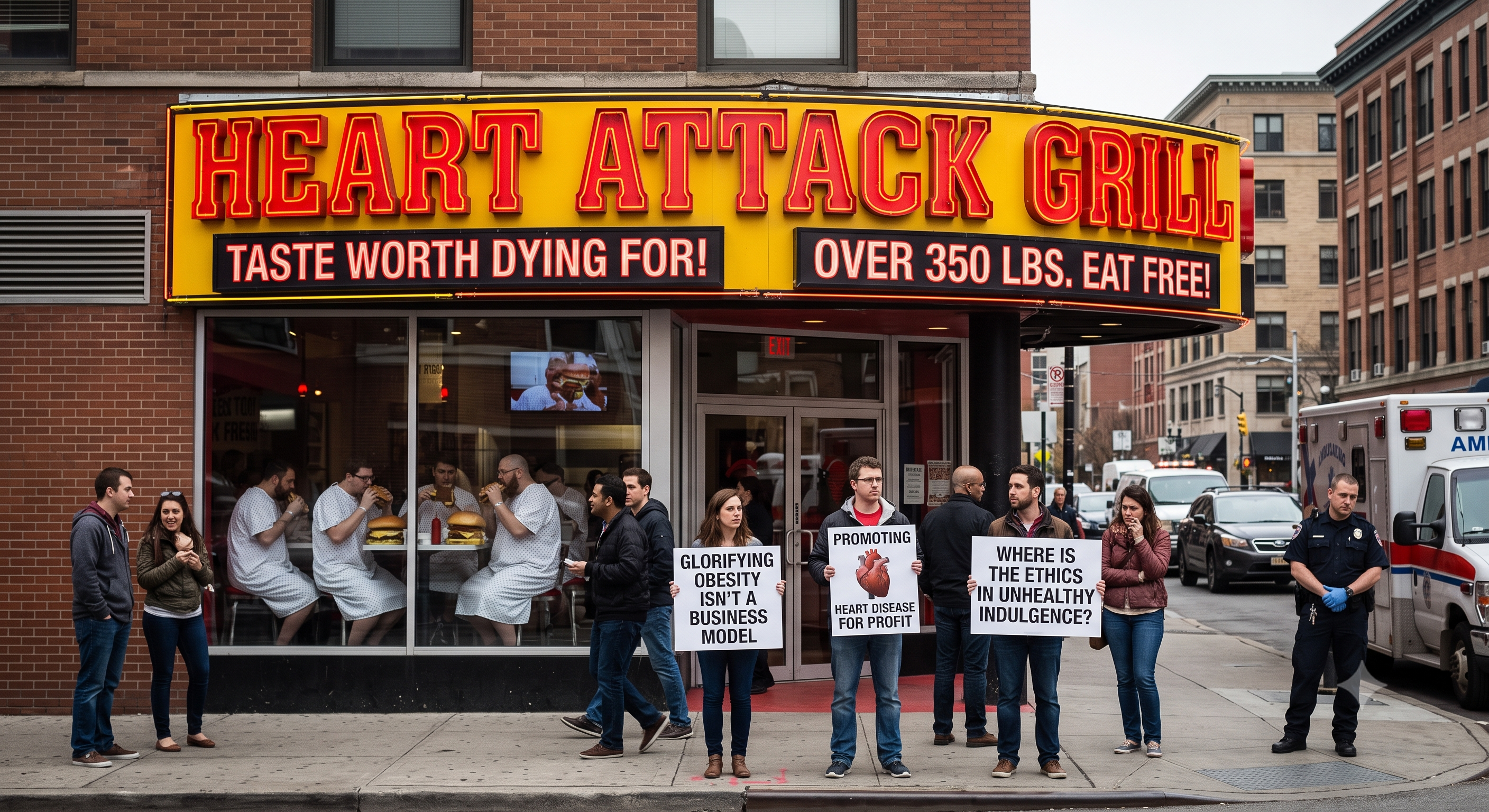
The Heart Attack Grill, a notorious Las Vegas-based novelty restaurant, has spent decades courting controversy by building a business model entirely around extreme overeating and health hazards. Boasting a "taste worth dying for" and offering free meals to patrons weighing over 350 pounds, the restaurant sits at the center of a fierce ethical debate. This research examines the moral implications of celebrating obesity and unhealthy eating, analyzed through the lens of individual autonomy, corporate responsibility, and the tragic real-world deaths of its spokespeople.
1. The Shock-Value Business Model
Founded in 2005 by Jon Basso (who styles himself "Dr. Jon"), the Heart Attack Grill has deliberately weaponized public health concerns as a marketing engine.[1] Operating under a medicalized parody theme, the restaurant features:
-
The Menu: Offerings range from the "Single Bypass Burger" to the massive, 20,000-calorie "Octuple Bypass Burger." Sides include "Flatliner Fries" cooked in pure lard, butterfat milkshakes, and unfiltered cigarettes.[1:1]
-
The Atmosphere: Waitresses dress in revealing "nurse" uniforms, and customers (referred to as "patients") must don hospital gowns and wristbands before ordering.[2]
-
The Gimmicks: Customers who fail to finish their meals receive public paddle-spankings from the "nurses." Conversely, those who successfully finish a multi-bypass burger are wheeled out to their cars in real wheelchairs.[3]
-
The Weight Incentive: Crucially, the establishment offers free, unlimited meals to anyone who weighs over 350 pounds, requiring patrons to step on a giant public scale to qualify.[2:1]
In May 2026, the restaurant announced its impending closure following the expiration of its lease, citing rising Las Vegas rents and "corporate greed."[1:2] However, its business model remains a landmark case study in marketing ethics and public health philosophy.
2. Real-World Medical Emergencies and Tragedies
The ethical debate surrounding the Heart Attack Grill is not merely theoretical. The restaurant’s history is marked by genuine medical emergencies and the premature deaths of those who served as its public faces:
Blair River (2011)
The restaurant’s official, 575-pound spokesperson, Blair River, died in March 2011 at the age of 29. While his cause of death was officially attributed to complications from flu-related pneumonia, critics argued his extreme weight—celebrated and incentivized by the restaurant—severely compromised his health.[1:3]
John Alleman (2013)
An unofficial spokesperson and daily regular nicknamed "Patient John" (whose caricature adorned the restaurant's menu) suffered a fatal heart attack in February 2013 while waiting at a bus stop directly in front of the establishment. He was 52 years old.[4] Basso called the death a "wake-up call" but refused to stop serving high-calorie food.[5]
In-Restaurant Cardiac Events
In February 2012, a man in his 40s suffered an actual cardiac arrest while attempting to finish a 6,000-calorie Triple Bypass Burger. Believing the unfolding crisis was a staged promotional stunt, onlookers took photos and videos of the man being wheeled out by paramedics instead of offering immediate aid.[2:2] Later that year, another female customer collapsed unconscious while eating a Double Bypass Burger.[1:4]
3. Ethical Analysis: Autonomy vs. Moral Responsibility
The controversy surrounding the Heart Attack Grill centers on a fundamental philosophical divide between libertarian autonomy and social public health responsibility.
                  ┌─────────────────────────────────────────┐
                  │      THE HEART ATTACK GRILL DEBATE       │
                  └────────────────────┬────────────────────┘
                                       │
                ┌──────────────────────┴──────────────────────┐
                ▼                                             ▼
┌──────────────────────────────┐              ┌──────────────────────────────┐
│     INDIVIDUAL AUTONOMY      │              │      PUBLIC HEALTH ETHICS    │
├──────────────────────────────┤              ├──────────────────────────────┤
│ • Radical transparency       │              │ • Exploitation of addiction  │
│ • Fully informed consent     │              │ • Degradation of dignity     │
│ • Personal liberty & choice  │              │ • Societal cost of obesity   │
└──────────────────────────────┘              └──────────────────────────────┘
3.1 The Case for Autonomy (The Restaurant's Defense)
Proponents of the Heart Attack Grill, including Basso himself, argue that the business model is highly ethical because it respects consumer agency and practices complete transparency:
-
Radical Transparency: Traditional fast-food corporations often engage in "health-washing"—using green marketing or adding token salads to their menus to obscure the negative impacts of their food. In contrast, the Heart Attack Grill features explicit warnings: "Caution: This establishment is bad for your health."[2:3] Patrons are fully informed, consenting adults who enter the premises with complete awareness of the risks.
-
Respect for Liberty: In a free society, individuals possess the moral and legal right to make self-destructive choices. Advocates of this view argue that denying adults the right to consume unhealthy food is an overreach of a "nanny state" that undermines personal responsibility.[6]
-
The Satirical Mirror: Basso has defended the establishment as a form of social commentary, calling his menu "nutritional pornography." He claims that by pushing fast food to its logical, absurd extreme, he is holding a mirror up to America’s toxic relationship with food, obesity, and corporate deceit.[2:4]
3.2 The Case for Moral Exploitation (The Public Health Critique)
Public health advocates, medical professionals, and organizations like the Physicians Committee for Responsible Medicine (PCRM) argue that the restaurant's model is fundamentally exploitative and socially harmful:
-
Targeting Vulnerable Populations: Offering free food to individuals weighing over 350 pounds is not "respecting autonomy"—it is predatory. Critics argue this practice directly targets individuals suffering from morbid obesity, food addiction, and underlying psychological struggles, actively incentivizing behaviors that could lead to death.[2:5]
-
Deontological Violations (Human Dignity): Under Kantian ethics, human beings must be treated as ends in themselves, never merely as a means to an end. By requiring obese patrons to weigh themselves on a giant scale to the cheers of crowds, the restaurant strips these individuals of their basic dignity, turning their life-threatening condition into public entertainment.[2:6]
-
Negative Externalities (Utilitarian Harm): Individual choices do not occur in a vacuum. Severe obesity and cardiovascular disease impose massive financial and logistical burdens on public healthcare infrastructure, raising medical insurance premiums and redirecting public resources.[6:1]
-
Desensitization of Public Consciousness: The 2012 heart attack incident highlights how the restaurant's dark satire has corroded public empathy.[3:1] When a real life-and-death emergency is treated as a corporate marketing stunt by onlookers, the line between harmless theatrical subversion and active, dangerous public desensitization is completely erased.
4. The Satirical Paradox: Sincere Critique or Cynical Commercialism?
The moral defense of the Heart Attack Grill rests heavily on its claim to be a satirical critique of the fast-food industry. However, this defense is undercut by the owner's own commercial objectives.
Basso’s public statements reveal a deeply contradictory stance. On one hand, he adopts the role of a concerned moralist:
"The end result of our eating habits is all around us. It's an obesity epidemic that is killing the world... Actually, I want to wake up one morning and open the door and have no one ever come in again, because maybe the world would have learned the truth."[2:7]
Yet, on the other hand, Basso has openly embraced pure, cynical capitalism:
"I'm here to tell you straight up that I'm here to make a buck... If I could put danger back into hamburgers, all the better."[5:1]
This tension suggests that "satire" and "honesty" are utilized primarily as bulletproof marketing shields. By presenting the business as an ironic joke, Basso deflects moral culpability for the health outcomes of his customers while simultaneously profiting off the very epidemic he claims to condemn.
National High School Ethics Bowl, "Heart Attack Grill Ethics Case" ↩︎ ↩︎ ↩︎ ↩︎ ↩︎ ↩︎ ↩︎ ↩︎
Las Vegas Review-Journal, "Real health emergency tips scales toward Heart Attack Grill" ↩︎ ↩︎
Macleans, "Heart Attack Grill spokesperson dies of heart attack" ↩︎
CBS News, "Heart Attack Grill spokesperson dies from heart attack, owner says" ↩︎ ↩︎
Reddit AskAnAmerican, "Why Does The Heart Attack Grill even exist???" ↩︎ ↩︎