🌿Henry David Thoreau and Wildness
"Wildness" is the absolute cornerstone of his worldview.
In his 1862 essay Walking, Thoreau famously wrote: "In Wildness is the preservation of the World."
This is often misquoted as "In wilderness is the preservation of the world," but that distinction is exactly what makes his philosophy so powerful. Here is what he meant by it.
Replica of Thoreau's cabin at Walden Pond. Source: Appalachian Mountain Club
Wildness vs. Wilderness
For Thoreau, wilderness is a physical place—a deep forest, a mountain peak, or an untamed jungle. Wildness, on the other hand, is a quality, a vital energy, or a state of being.
You can find wildness in a patch of weeds pushing through a city sidewalk, in the behavior of a fierce animal, or within the human mind. Wilderness is the location where wildness thrives best, but wildness is the actual life force itself.
The Antidote to "Tame" Society
Thoreau believed that human civilization was essentially an exercise in domestication. While society offers comfort and safety, it also demands conformity, routine, and a "taming" of our natural instincts. He saw his fellow citizens in Concord, Massachusetts, as living trapped, monotonous lives—"lives of quiet desperation," as he called them.
Wildness is the cure for that stagnation. It represents:
-
Absolute Freedom: Escaping the artificial constraints of social expectations, jobs, and politics.
-
Original Creativity: To think a truly new thought, Thoreau believed you had to tap into your untamed, instinctual mind, rather than just repeating the "stale doctrine" of civilized society.
-
Spiritual Vitality: He viewed wildness as a raw, divine energy that renews the human spirit.
A Need for Balance
Thoreau wasn't an absolute anarchist who thought we should all abandon society and live like wolves. He was a Harvard-educated writer who valued literature, culture, and friendship. What he argued for was balance.
He believed that a healthy human life (and a healthy society) requires keeping one foot in the civilized world and the other firmly planted in the wild. If we lose our connection to wildness, we lose our resilience, our creativity, and ultimately, our will to live deeply.
Here is how Thoreau's concept of Wildness mirrors and intersects with core Buddhist thought:
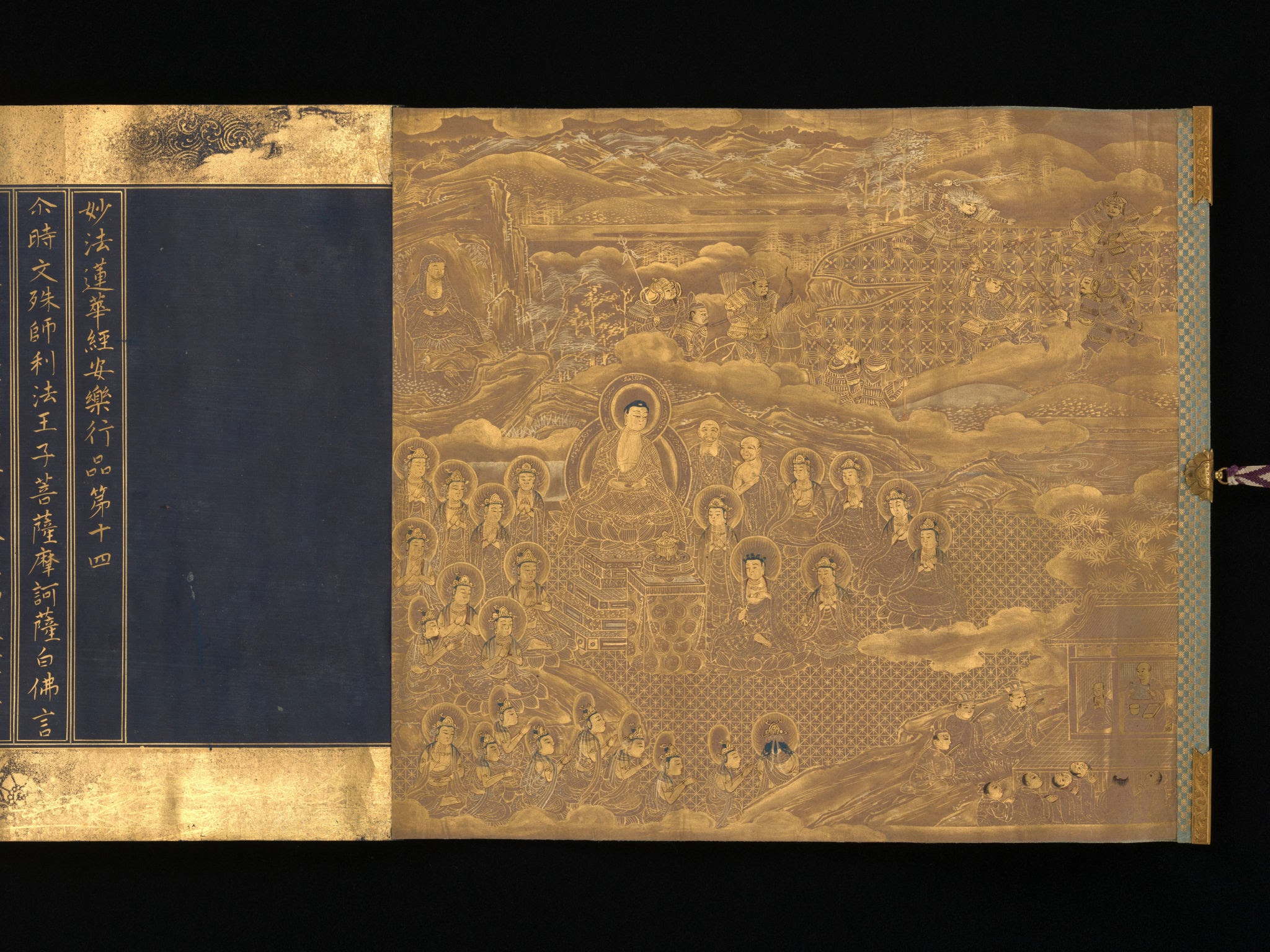
The connection between Thoreau's "Wildness" and Buddhism is not just a modern comparison—it is a direct, historical overlap. In fact, Thoreau was the very first person to publish a translation of a Buddhist scripture in the United States.
In 1844, at the age of 26, he translated a chapter of the Lotus Sutra (from French into English) for the Transcendentalist journal The Dial. The ideas he encountered in Eastern philosophy profoundly shaped his views on nature, society, and the human mind.
"Waking Up" to Reality
The word Buddha literally translates to "the awakened one." In Buddhism, the goal is enlightenment: waking up from the illusions, habits, and ignorance that cause suffering.
Thoreau’s quest for Wildness was essentially an American version of this awakening. He famously wrote in Walden, "We must learn to reawaken and keep ourselves awake, not by mechanical aids, but by an infinite expectation of the dawn." For Thoreau, society puts us to sleep with routine, materialism, and gossip. Tapping into our "Wildness" is how we snap out of the trance and see reality clearly.
Non-Attachment and Stripping Away the Artificial
A central tenet of Buddhism is non-attachment—the understanding that clinging to material wealth, status, and rigid ego leads to suffering.
Thoreau's experiment at Walden Pond was a practice in radical non-attachment. He went to the woods to strip away the unnecessary luxuries of 19th-century life to see what was actually essential. By abandoning the "tame" comforts of civilization, he believed a person could discover their true, unconditioned self. Both philosophies argue that true freedom comes not from having everything you want, but from needing very little.
Inner Wildness as "Buddha-Nature"
In Mahayana Buddhism (the tradition the Lotus Sutra belongs to), there is a concept called Buddha-nature—the idea that the potential for awakening is already inherently present within all living things. It isn't something you build; it is something you uncover.
Thoreau viewed "Wildness" in almost the exact same way. It wasn't something you had to travel to a jungle to find; it was a raw, vital energy already burning inside of you. Society covers it up with rules and manners, but it remains intact beneath the surface. When Thoreau says, "In Wildness is the preservation of the World," a Buddhist might say, "In recognizing our Buddha-nature is the liberation of all beings."
The Sacredness of the Present Moment
Zen Buddhism, in particular, places massive importance on mindfulness and direct, unmediated experience of the present moment—often found by observing the natural world.
Thoreau was a master of this. He didn't just study nature like a detached scientist; he practiced what we would now recognize as deep mindfulness. He would sit in the doorway of his cabin from sunrise till noon, just listening to the birds and watching the light change, describing it as a state of ecstatic, timeless peace. He wasn't just looking at the wild; he was meditating with it.