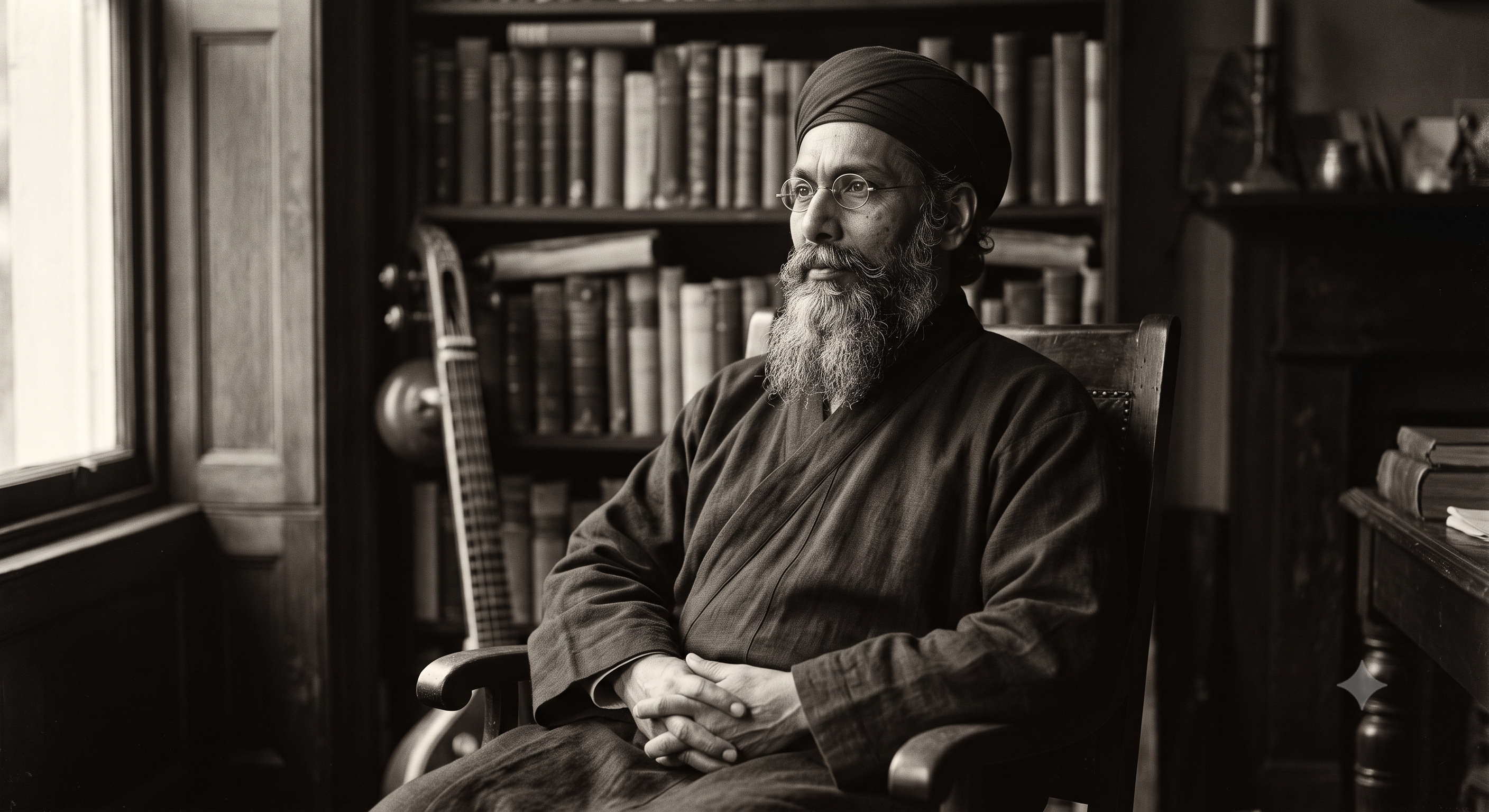
Hazrat Inayat Khan (1882–1927)
Hazrat Inayat Khan (1882–1927) was a pioneering Indian mystic, musician, and philosopher who introduced Universal Sufism to the Western world. Initially recognized as a master classical musician in India, he shifted his life's focus to spiritual instruction, founding the Sufi Order in London (1914) and later the International Sufi Movement. His teachings emphasized the underlying unity of all religious ideals, the sacred nature of music and vibration, and the inner realization of divine love decoupled from rigid sectarian dogmas.
Biography and Background
Early Life and Musical Heritage
Born on July 5, 1882, in Baroda, British India, Inayat Khan grew up in a household deeply steeped in both nobility and rigorous musical traditions. His maternal grandfather, Sangit Ratna Maulabakhsh Sholay Khan, was a highly celebrated Hindustani classical musician often called the "Beethoven of India," while his maternal grandmother was a descendant of Tipu Sultan of Mysore.
Inayat demonstrated precocious intelligence and musical capability. At age 14, he published Balasangitmala, a Hindustani music textbook designed to democratize music education, particularly for young women in Muslim households. Before the age of twenty, he was appointed a full professor at Gayanshala, the academy of music founded by his grandfather. He became a legendary virtuoso of the sarasvati vina and a highly sought-after classical singer. For Inayat, music was never a superficial performance; it was an avenue to experience the formless divine.
Transition from Musician to Mystic
As his musical renown grew across India, Inayat became increasingly disillusioned by the commercialization and competitive nature of the professional music world. He found that the industry's focus on egoistic rivalry clashed with his perception of music as a sacred art form.
His formal entry into mysticism occurred in Hyderabad under the tutelage of his spiritual master (Murshid), Sayyid Abu Hashim Madani. From Madani, Inayat received spiritual transmission and authority (ijazah) in four major traditional Sufi lineages: the Chishti, Suhrawardi, Qadiri, and Naqshbandi orders, with the music-loving Chishti lineage remaining his primary foundation. Before his passing, Madani famously commanded Inayat to travel to the West and harmonize the East and West through the "music of his soul."
Journey to the West
In 1910, Inayat Khan departed India for the United States alongside his brother Maheboob Khan and cousin Mohammed Ali Khan. They initially funded their travels by giving classical Indian music concerts and lectures. While in New York, he met Ora Ray Baker, who would become his wife and take the name Pirani Ameena Begum.
As World War I broke out, Inayat transitioned completely from public musical performances to spiritual lecturing, formally establishing "The Sufi Order" in London in 1914. After the war, his movement expanded rapidly across Europe and North America. He eventually established his permanent European headquarters and Sufi lodge (khanqah), known as Fazal Manzil, in Suresnes, France.
Core Philosophy: Universal Sufism
Universal Sufism represents a distinct universalist movement. While deeply rooted in the esoteric spiritual traditions of Islam, Inayat Khan deliberately decoupled his teachings from sectarian constraints to make them fully accessible to Western seekers of any background.
The Three Objectives of the Movement
Inayat Khan codified the mission of the International Sufi Movement into three foundational pillars:
-
To realize and spread the knowledge of Unity: To cultivate an awareness of the "Unity of Religious Ideals," love, and wisdom across humanity.
-
To discover the essence of all religions: To explore the hidden power of mysticism, human potential, and philosophy without disrupting individual customs or beliefs.
-
To bridge the East and West: To foster global brotherhood and sisterhood by establishing a reciprocal interchange of thoughts and ideas between the opposite poles of the world.
The Four Stages of Contemplative Study
Inayat Khan adapted traditional Sufi spiritual practices into a systematic "Inner School" composed of four developmental stages:
-
Concentration (Mujahada): Gathering and focusing mental and spiritual energy.
-
Contemplation (Muraqaba): Deeply reflecting upon divine attributes and cosmic principles.
-
Meditation (Mushahada): Silencing the egoic mind to listen to the inner, unstruck sound.
-
Realisation (Mu'ayyana): The direct experience of God-consciousness and spiritual liberty.
Major Teachings and Concepts
The Mysticism of Sound
"Music is a miniature of the harmony of the whole universe... Sound alone is free from form."
Perhaps Inayat Khan's most enduring contribution to spiritual philosophy is his discourse on the cosmic nature of sound, captured in his landmark text The Mysticism of Sound and Music. He asserted that the entire universe is composed of vibrations, and that everything—from the beating of a human heart to the rotation of celestial bodies—functions as a cosmic symphony. He taught that while visual arts present the danger of idolatry and distraction by bound forms, music is the ultimate "Divine Art" because it interacts directly with the formless soul.
Prerequisites of the Inner Life
In his teachings compiled in The Awakening of the Human Spirit, Inayat Khan outlined three distinct prerequisites for any individual wishing to sincerely walk the mystical path:
-
Absolute Valuation: The seeker must value inner spiritual awakening more than external wealth, power, rank, or temporary societal positions.
-
Dedication of Time: The seeker must actively carve out precious time from their daily routine to commit to silence, reflection, and practice.
-
Resolution of Earthly Karma: The seeker's mind must be unburdened by unresolved debts or mistreatment toward their fellow humans (parents, children, friends). If the heart is heavy with guilt or neglect of earthly duty, it cannot find the rest required for deep meditation.
Legacy and Impact
In 1926, Hazrat Inayat Khan decided to return to India. Weakened by decades of relentless lecturing and organizing, he contracted an illness and passed away on February 5, 1927, in New Delhi at the age of 44. His tomb (dargah) is located in the historic Nizamuddin West area of Delhi, serving as a site of pilgrimage and musical devotion.
His immediate family carried forward a remarkable, diverse legacy:
-
Noor Inayat Khan: His eldest daughter, who grew up playing the veena, became a highly celebrated British SOE secret agent ("The Spy Princess") during World War II, operating behind enemy lines in occupied France before being captured and executed by the Gestapo.
-
Pir Vilayat Inayat Khan: His eldest son, who succeeded him as the head of the Sufi Order International, broadly modernizing the teachings and integrating them with Western science and psychology.
-
Hidayat Inayat Khan: His son, a classical composer and conductor who helped lead the International Sufi Movement.
Today, Universal Sufism lives on through multiple lineages and organizations, including the Inayatiyya (led by his grandson, Pir Zia Inayat Khan) and the International Sufi Movement, continues to offer a blueprint for pluralistic, heart-centered mysticism.