The Spiritual & Dystopian Vision of Pete Townshend's 'Lifehouse'
Conceived in late 1970 as the multimedia successor to Tommy, Pete Townshend’s Lifehouse was a sci-fi rock opera that merged cutting-edge electronic experimentation, dystopian prophecy, and deep spiritual mysticism. Townshend envisioned music not merely as entertainment, but as a literal vehicle for divine transcendence. While the project collapsed under the weight of its own immense ambition—giving birth instead to the legendary album Who's Next—its underlying spiritualism remains one of the most profound artistic philosophies in rock history.
The Spiritual Pillars: Sound, Vibration, and the Divine
To understand the core of Lifehouse, one must look past the synthesizers and sci-fi tropes and examine the two primary spiritual influences that shaped Townshend’s world: the Indian spiritual master Meher Baba and the Sufi musician and philosopher Hazrat Inayat Khan.
Meher Baba: The Ocean and the Dissolution of Ego
Townshend became a devoted follower of Meher Baba in the late 1960s after a terrifying, drug-induced out-of-body experience. Meher Baba, who maintained lifelong silence from 1925 until his death in 1969, taught that the material world is an illusion (maya) and that the ultimate goal of the soul is self-realization—the dissolution of the individual ego into the infinite "Ocean of Love" that is God.
Meher Baba also predicted that before dropping his physical form, he would speak a "Word" that would shatter the silence and trigger an unprecedented wave of spiritual awakening across humanity. For Townshend, this spiritual "Word" was inherently musical. He believed that rock music, at its peak communal intensity, was a modern manifestation of this divine energy, capable of briefly dissolving the egos of thousands of concertgoers into a single, unified consciousness.
Hazrat Inayat Khan: The Universal Keynote
The physical mechanics of this spiritual awakening in Lifehouse were heavily inspired by Hazrat Inayat Khan’s The Mysticism of Sound. Khan proposed that the universe is made entirely of vibration, and that human beings, stars, and atoms all possess unique vibrational signatures.
Khan wrote about a "universal note"—a primal keynote to which all creation belongs. Townshend adapted this theory into a technical hypothesis: if one could gather the unique vibrational data of enough individuals and synthesize them together, they would sound the perfect cosmic chord, transporting humanity out of physical illusion and back into the Divine.
"I believe music is our only hope. I believe music can reflect who we really are – like a mirror... I believe that that music can help us open a door in the mirror... and on the other side, all our music will make a perfect symphony. I believe that perfect music... will reflect God."
— Pete Townshend, Lifehouse draft script
The Narrative: A Dystopian Musical Rapture
The plot of Lifehouse was incredibly prescient, predicting things like virtual reality, personal computers, the internet, and government-mandated lockdowns:
-
The Grid and Lifesuits: In a highly polluted, post-apocalyptic future, humanity survives inside pod-like "Lifesuits". They are entirely dependent on a central "Grid"—run by a totalitarian government—which feeds them intravenous nutrition and distraction through artificial, pre-programmed experiences. Rock music is strictly banned because of its power to awaken people.
-
Bobby the Hacker: A rebellious young composer named Bobby hacks into the Grid and sets up a subversive pirate broadcast. He invites people to abandon their suits, venture outside, and gather at an abandoned theater called the "Lifehouse" for a live musical festival.
-
The Synthesis of the Soul: Once inside the Lifehouse, Bobby collects personal, biological, and astrological data from the audience members (height, weight, horoscope, DNA) and feeds it into an advanced mainframe computer. The computer processes this data to generate a completely unique "song" for every individual.
-
The Musical Rapture: At the climax, Bobby combines all of these individual songs into one massive, perfect symphony. As the police and army storm the theater to shut the concert down, the "One Perfect Note" is struck. Everyone in the theater, along with millions of people watching from home who had dialed in through the Grid, suddenly experiences a spiritual Nirvana and vanishes into a higher plane of existence, leaving behind empty Lifesuits.
The History: The Ill-Fated Quest for Transcendence
While Lifehouse worked beautifully as an esoteric concept, bringing it to life in 1971 was an unmitigated disaster. Townshend wanted to execute the project not as a fictional movie, but as a real-life sociological experiment.
[The Who's Success with 'Tommy']
           │
           ▼
[Conception of 'Lifehouse' (Late 1970)] ──► [The Spiritual Concept: Sound as a Portal to God]
           │
           ▼
[The Young Vic Experiments (Spring 1971)] ──► [Failure: Audience & Band Confusion]
           │
           ▼
[Management Betrayal & Lambert's Sabotage] ──► [Severe Creative & Mental Strain]
           │
           ▼
[Townshend's Nervous Breakdown] ──► [Glyn Johns steps in to salvage the material]
                                               │
                                               ▼
                                  [Release of 'Who's Next' (1971)]
1. The Young Vic Experiments
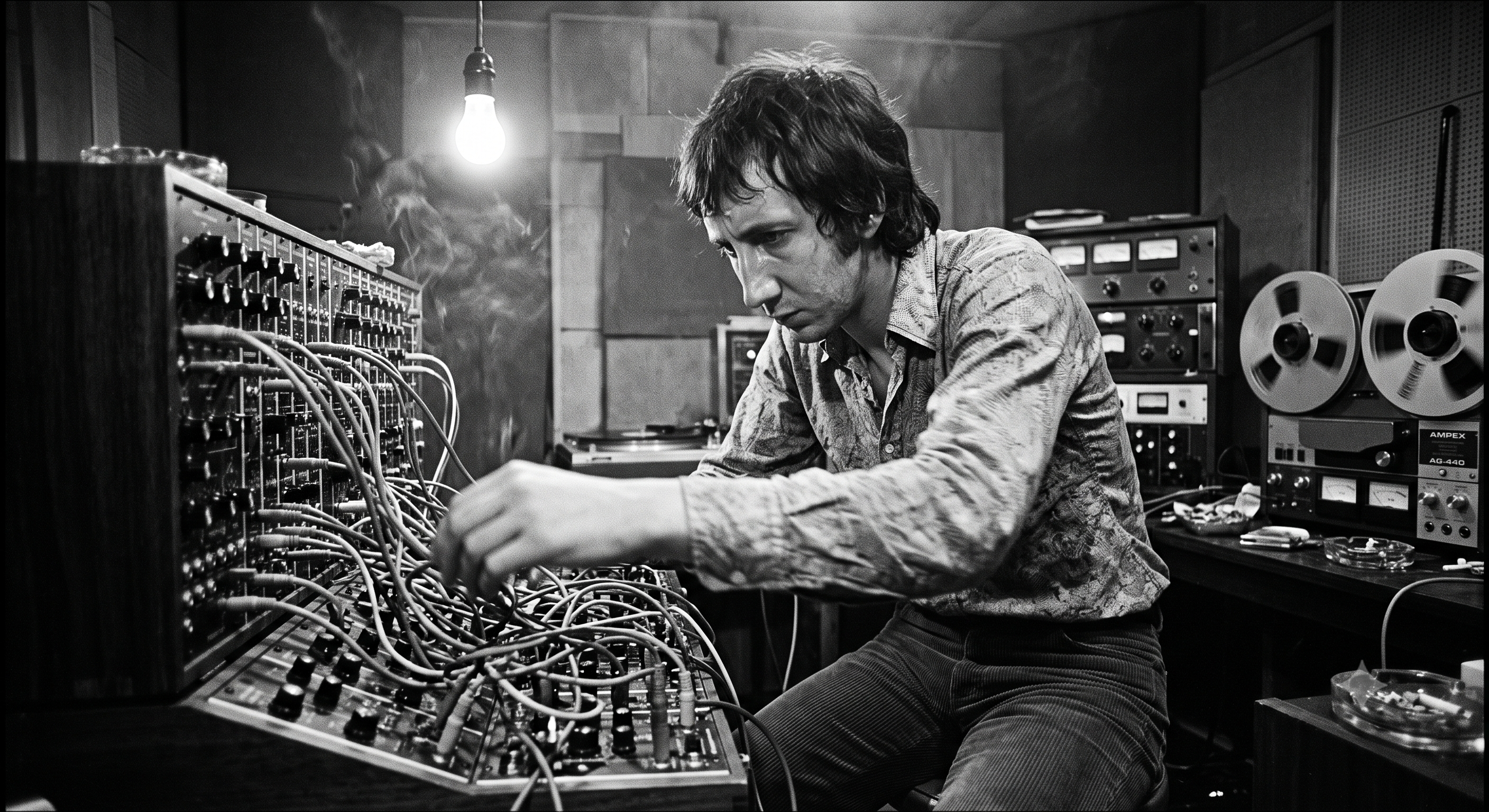
In early 1971, The Who took over London's Young Vic theatre. The plan was to bring in a recurring audience of local kids, analyze their personalities, and use the band's new VCS3 and ARP synthesizers to build songs directly around the crowd's energy.
The experiment failed immediately. The audience did not understand the dense conceptual setup; they simply wanted to hear The Who smash instruments and play "My Generation". The interactive feedback loops never materialized, and Townshend grew increasingly frustrated. During one show, when a heckler called him a "capitalist pig," Townshend lost control, dragged the man on stage, and physically beat him up.
2. The Band's Bewilderment
Townshend was trying to explain a complex, computerized, Sufi-inspired sci-fi concept to a group of working-class rockers.
-
Roger Daltrey, always the pragmatist, flatly told Townshend, "It'll never work."
-
John Entwistle mistakenly believed the band was expected to move into the Young Vic and live in a literal commune with the audience.
-
Keith Moon was completely checked out, retreating into heavy partying and groupies.
3. Management Betrayal & Sabotage
The final blow came from inside the camp. Townshend was under the impression that Universal Pictures was providing a massive budget to fund the Lifehouse film. However, the Who's co-manager and producer, Kit Lambert, was heavily suffering from heroin addiction and felt alienated because Townshend had rejected his film script for Tommy.
Lambert secretly sabotaged the project, telling Universal Pictures that Lifehouse was just a rehashing of Tommy and urging them to shelve it.
4. Collapse and the Birth of Who's Next
Isolated, drinking heavily, and buckling under the pressure of trying to turn an esoteric spiritual theory into reality, Townshend suffered a severe nervous breakdown, at one point contemplating jumping out of a 10th-floor hotel window in New York.
To save Townshend, engineer and producer Glyn Johns stepped in. Johns was brought to the studio, listened to the staggering collection of demos, and gave Townshend a dose of reality: Scrap the sci-fi story, abandon the film, and just put these incredible tracks on a single, straightforward rock record.
The result was Who's Next (1971), widely regarded as one of the greatest rock albums of all time.
Though the conceptual narrative was stripped away, the spiritual DNA of Lifehouse remained.
-
"Baba O'Riley" was named after Meher Baba and Terry Riley. Its famous pulsing synthesizer intro was built by programming Meher Baba's physical and spiritual chart data into a synthesizer.
-
"Bargain" is not a love song to a person, but an explicit expression of Meher Baba's concept of total self-surrender to God (even if it means losing oneself completely).
-
"Pure and Easy" (which didn't make the final album cut but was the musical anchor of Lifehouse) directly details the "one note" that contains all of human existence.
Legacy and Late Vindication
In 2000, Townshend finally released The Lifehouse Chronicles, a six-disc box set containing his original demos and a BBC radio play of the script.
Even more remarkably, in 2007, he launched the Lifehouse Method. This was an online software system where users plugged in personal parameters to generate a unique, mathematically tailored piece of electronic music. Thirty-six years after its conception, modern internet and web technology had finally advanced far enough to allow Townshend to realize his utopian dream.