Check his influence on Pete Townshend and The Who's album Quadrophenia
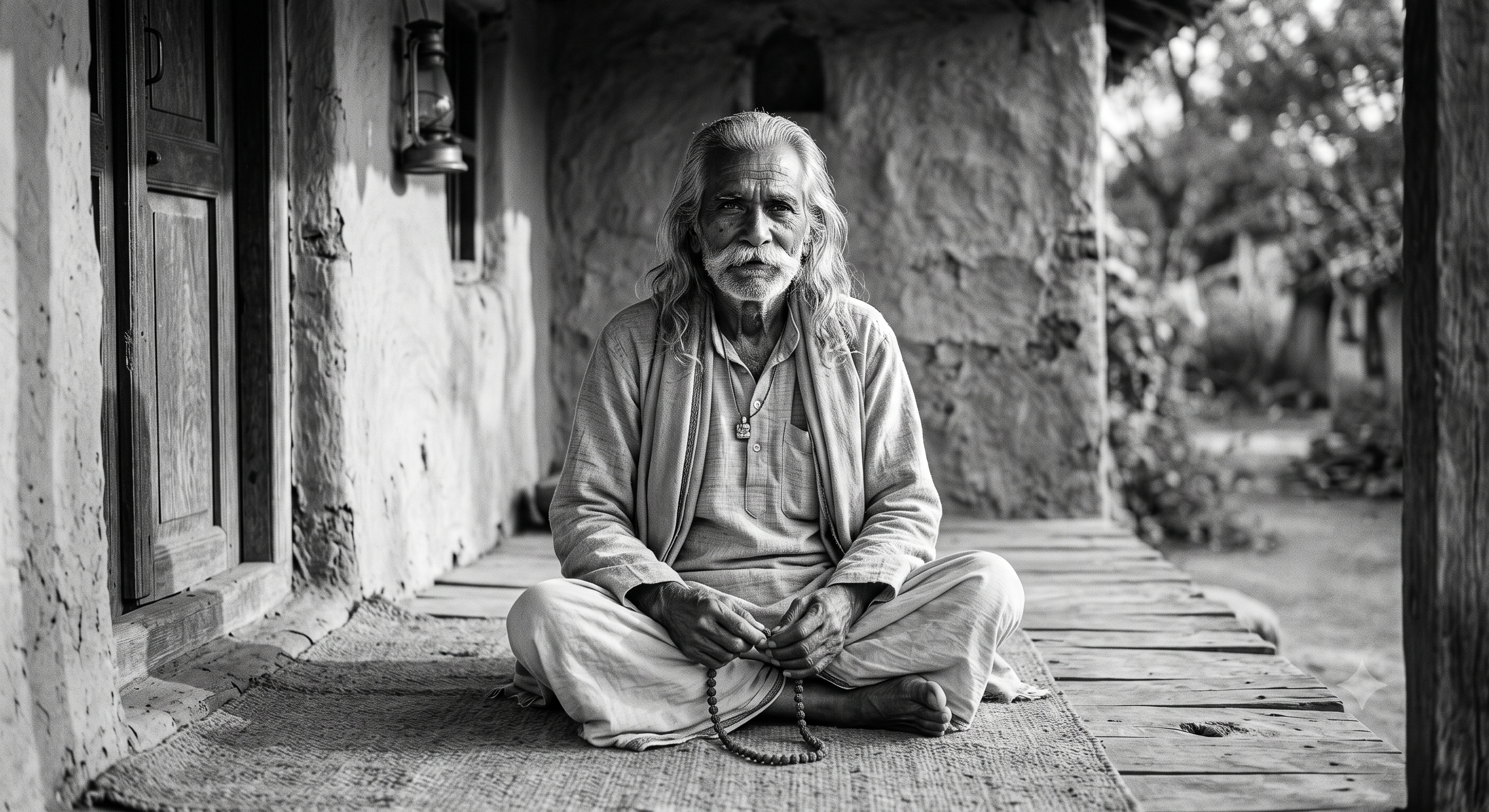
Meher Baba Profile
Meher Baba (born Merwan Sheriar Irani, 1894–1969) was an Indian spiritual master who maintained absolute silence for 44 years. Proclaiming himself the Avatar of the age, his teachings emphasized divine love, the eradication of the ego, and the underlying unity of all religious paths. This research note details his life, spiritual transformation, distinct phases of mystical work, and nondualistic metaphysics.
Early Life and Spiritual Awakening
Merwan Sheriar Irani was born on February 25, 1894, in Poona (now Pune), India, to Irani Zoroastrian parents [1]. His father, Sheriar Irani, was an ascetic seeker who had spent years wandering in search of spiritual truth before settling down [1:1]. Merwan grew up multi-lingual, was an accomplished poet and multi-instrumentalist, and possessed a deep love for literature [2].
His spiritual transformation began unexpectedly at the age of 19. In January 1914, while attending Deccan College, he encountered Hazrat Babajan, a centenarian Muslim woman and a recognized spiritual saint [1:2][3]. With a kiss on his forehead, Babajan unveiled Merwan's latent state of God-Realization [3:1]. Over the next seven years, Merwan integrated this boundless consciousness with ordinary human awareness under the guidance of four other "Perfect Masters" (Sadgurus): Upasni Maharaj, Sai Baba of Shirdi, Tajuddin Baba, and Narayan Maharaj [1:3][3:2]. By 1921, he began gathering his first close disciples (known as mandali), who bestowed upon him the name Meher Baba, meaning "Compassionate Father" [3:3][2:1].
The Period of Silence (1925–1969)
On July 10, 1925, Meher Baba began an absolute silence that would last for the remaining 44 years of his physical life [1:4]. He observed that words were inadequate for communicating ultimate reality, famously stating that he had come "not to teach but to awaken" [1:5].
To communicate with his disciples and the public, he adopted two primary methods over time:
-
The Alphabet Board (1925–1954): He initially spelled out sentences by pointing to letters on an English alphabet board. His monumental early dictations, including his Discourses, were transmitted this way [1:6][2:2].
-
Hand Gestures (1954–1969): On October 7, 1954, he discarded the alphabet board entirely, shifting exclusively to a unique and expressive system of dynamic hand gestures interpreted by his close disciples [2:3].
Meher Baba taught that the ultimate Truth cannot be captured in spoken words; real transformation is given and received in silence. He frequently asserted that his silence would eventually be broken by a single, universal "Word" that would shatter human illusions and ignite a global wave of divine love [1:7][3:4].
Major Phases of Spiritual Work
Meher Baba established his primary ashram community at Meherabad, near Ahmednagar, in the early 1920s [1:8]. Here, he initiated free schools, hospitals, and dispensaries that treated individuals regardless of caste, creed, or gender [3:5]. However, his inner spiritual work took distinct and radical forms throughout his life.
The Masts (Spiritual Intoxication)
Throughout the 1930s and 1940s, Meher Baba traveled tens of thousands of miles across the Indian subcontinent specifically to seek out individuals known as masts [2:4].
-
Masts are advanced spiritual pilgrims who have become overwhelmed or "spiritually intoxicated" by direct experiences of God, losing normal mental functioning and often appearing mad to society [2:5].
-
Meher Baba did not view them as mentally ill. Instead, he would personally wash their feet, bathe them, feed them, and sit with them in strict seclusion to help ground their consciousness or direct their spiritual energies for global benefit [3:6][2:6].
The New Life (1949–1952)
On October 16, 1949, Meher Baba initiated a highly demanding phase called the "New Life" [3:7].
-
He completely dissociated from all possessions, financial resources, ashrams, and his institutional role as a master [3:8].
-
Accompanied by a select group of disciples, he embarked on a nomadic journey of absolute self-reliance, begging for food and enduring intense physical hardship [3:9].
-
He described this phase as an effort to step down from the position of the Perfect Master to become a "Perfect Seeker" on behalf of humanity, experiencing absolute helplessness and hopelessness in total reliance on God [3:10]. This phase culminated in early 1952 with a process called Manonash (annihilation of the mind) [3:11].
Universal Suffering and Automobile Accidents
Meher Baba traveled extensively to the West (including the Americas, Europe, and Australia) during the 1930s through the 1950s [1:9][2:7]. During these travels, he survived two near-fatal automobile accidents: the first in Prague, Oklahoma, USA (1952), and the second in Satara, India (1956) [3:12].
-
These crashes caused severe, lifelong injuries and chronic physical pain.
-
Meher Baba explained that these physical traumas were an external manifestation of the "universal suffering" that he, as the Avatar, was required to take upon himself to spark human spiritual advancement [3:13].
Metaphysics and Key Teachings
God Speaks and Consciousness
His seminal metaphysical book, God Speaks: The Theme of Creation and Its Purposes (1955), provides a highly detailed description of the journey of the soul (atma) back to the Over-soul (Paramatma) [4]. The text maps a cosmic cycle of consciousness:
-
The Beyond-Beyond State: God exists in an unconscious, tranquil, and impressionless state of absolute potentiality [5][6].
-
The Whim: Driven by an inherent impulse to answer the cosmic question "Who Am I?", God projects the universe at the "Om Point" [5:1][6:1].
-
Evolution: The soul takes on physical forms—progressing through 50.4 million variations across gaseous, stone, metal, plant, insect, fish, bird, and animal kingdoms—to steadily expand its capacity for consciousness [5:2].
-
Reincarnation: Upon reaching human form, consciousness is fully developed but entangled by sanskaras (impressions/karmic residues) accumulated during evolution [5:3][6:2]. The soul undergoes roughly 8.4 million human lives, experiencing every polarity (gender, race, suffering, joy) to weaken these impressions [5:4].
-
Involution: The gradual inward turning of consciousness through seven distinct internal planes of energy, mind, and spirit, leading ultimately to God-Realization (the state of "I am God") [2:9][5:5].
The Discourses
While God Speaks serves as his structural cosmology, his multi-volume Discourses focus on practical spiritual living [1:11]. He emphasized:
-
The Elimination of the Ego: The false self must be systematically dissolved through love and selfless service.
-
Universal Love: Love is the driving force of creation. Loving God in all beings is the direct path to liberation.
-
Anti-Dogmatism: He explicitly warned against forming new sects, rites, or dogmas, instructing followers to find the core truth within their original religions [1:12].
Later Years and Legacy
In February 1954, Meher Baba publicly declared himself the Avatar of the age [1:13][3:14]. By the late 1950s, he retreated into strict, permanent seclusion at his residence, Meherazad, to focus on what he called his "Universal Work" on higher spiritual planes [3:15].
Meher Baba dropped his physical body (died) on January 31, 1969 [1:14][3:16]. He left strict instructions that his followers should not formalize a dogmatic religion or centralized sect around him [1:15]. Today, his Tomb-Shrine (Samadhi) in Meherabad, India, remains a major global pilgrimage site [3:17]. His birthday and his passing (commemorated annually as Amartithi) draw tens of thousands of visitors from around the world [3:18][2:10]. Culturally, his succinct aphorisms—most阻 famously "Don't worry, be happy"—subsequently gained wide pop-culture fame and deeply influenced 20th-century artists and musicians, including Pete Townshend of The Who [1:16][2:11].
References
Encyclopaedia Britannica: Meher Baba Biography ↩︎ ↩︎ ↩︎ ↩︎ ↩︎ ↩︎ ↩︎ ↩︎ ↩︎ ↩︎ ↩︎ ↩︎ ↩︎ ↩︎ ↩︎ ↩︎ ↩︎
Avatar Meher Baba Perpetual Public Charitable Trust: A Brief Biography ↩︎ ↩︎ ↩︎ ↩︎ ↩︎ ↩︎ ↩︎ ↩︎ ↩︎ ↩︎ ↩︎ ↩︎ ↩︎ ↩︎ ↩︎ ↩︎ ↩︎ ↩︎ ↩︎
Reunion Studios: Very Brief Primer on Meher Baba's Divine Theme ↩︎ ↩︎ ↩︎ ↩︎ ↩︎ ↩︎
World Happiness Foundation: Meher Baba's Ten States of God ↩︎ ↩︎ ↩︎