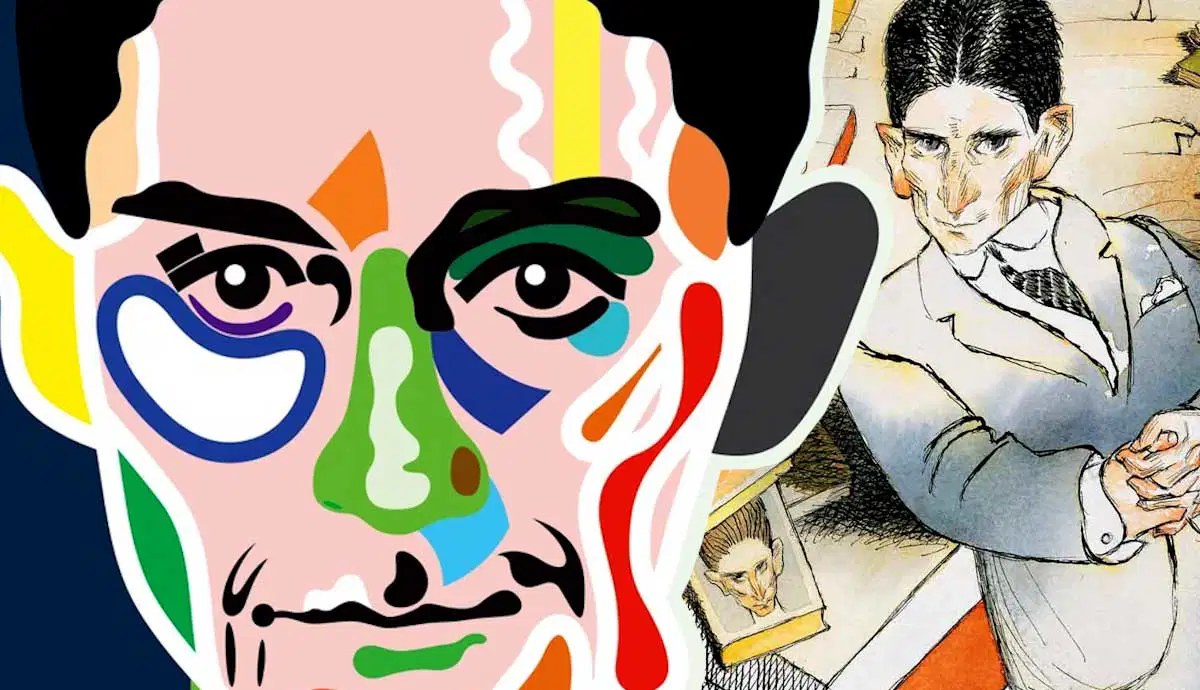
Franz Kafka
Franz Kafka’s work provides a haunting examination of modern human existence, depicting individuals trapped within opaque, irrational systems they can neither comprehend nor escape.[1] His core ideas center on systemic absurdity, existential alienation, omnipresent guilt without identifiable crime, and the perpetual search for unattainable authority and truth.[2]
Overview of Kafkaesque Philosophy
Franz Kafka (1883–1924) did not compose a formal philosophical treatise; instead, he embedded profound philosophical inquiries into surreal narrative fables.[1:1] His writings anticipate 20th-century Existentialism, Absurdism, and Critical Theory.
The term Kafkaesque has transcended literature to describe real-world conditions where complex, impersonal administrative forces strip individuals of agency, logic, and dignity.[3]
A situation is not merely "Kafkaesque" because it is oppressive or bizarre. It becomes Kafkaesque when an individual attempts to use reason and logic to navigate an irrational system, only for that logic to accelerate their own subjugation and confusion.
Core Themes and Ideas
1. The Absurdity of Modern Bureaucracy
Kafka was among the first writers to depict bureaucracy not merely as inefficient, but as a nightmarish, self-perpetuating apparatus.[3:1]
-
Impersonal Power: Authorities are faceless, represented by subordinate clerks, low-level officials, and impenetrable hierarchies.
-
Procedural Madness: Rules exist for their own sake, often contradictory or undisclosed to those subject to them.
-
The Illusion of Appeal: Protagonists waste immense energy seeking higher authorities that remain forever out of reach.[4]
2. Existential Alienation and Dehumanization
A central pillar of Kafka’s work is the profound isolation of the modern individual from family, society, and self.[2:1]
-
Capitalist Commodification: Human worth is tied entirely to economic productivity. When an individual ceases to be useful to the market or family unit, they are discarded.[2:2]
-
Bodily and Mental Estrangement: Characters experience profound disconnects from their own physical forms and social identities, as seen in The Metamorphosis.[2:3]
3. Unattainable Truth and Labyrinthine Authority
In Kafka’s universe, ultimate truth, legal justice, and spiritual redemption are perpetually deferred.[1:2]
-
Infinite Distance: The closer a character gets to the center of power (e.g., the Court in The Trial or the Castle in The Castle), the more obscured the power becomes.
-
The Parable of Before the Law: In The Trial, a man spends his entire life waiting outside a gate to the Law, guarded by a keeper. Upon his death, he learns the gate was made solely for him, yet he was never permitted to enter.
4. Omnipresent Guilt and Paternal Judgment
Kafka’s characters frequently suffer from an overwhelming sense of inherent guilt without knowing what crime they committed.[1:3]
-
Arbitrary Indictment: Guilt is not a consequence of an act; it is an existential state. To exist is to be accused.
-
Paternal Tyranny: Rooted in Kafka's tumultuous relationship with his authoritative father, Hermann Kafka, characters often face overwhelming, immovable paternal figures whose judgments are final and unappealable.[5]
5. Matter-of-Fact Surrealism (Nüchternheit)
Kafka introduces monstrous or impossible premises with dry, clinical, and objective prose.[1:4]
- By describing surreal nightmares in the tone of an official police report or legal brief, Kafka heightens the psychological realism and unsettling nature of the narrative.[2:4]
"We need the books that affect us like a disaster, that change our view of the world and question who we are." — Franz Kafka[5:1]
Major Works as Conceptual Case Studies
| Work | Core Philosophical Focus | Key Narrative Device |
|---|---|---|
| The Metamorphosis (1915) | Alienation under economic pressure; body dysmorphia; familial rejection.[2:5] | Gregor Samsa turns into a monstrous insect (ungeheures Ungeziefer). |
| The Trial (1925) | Legal absurdity; existential guilt; totalitarian bureaucracy.[1:5] | Josef K. is arrested without knowing his offense and tried by a shadowy tribunal. |
| The Castle (1926) | Unattainable spiritual or social validation; systemic opacity.[1:6] | K. the land surveyor arrives in a village but is endlessly blocked from entering the governing Castle. |
| In the Penal Colony (1919) | Authoritarian devotion to punishment; breakdown of moral justice. | An execution apparatus carves the condemned person's violated commandment into their skin. |
Philosophical Influence and Legacy
Kafka’s insights laid crucial groundwork for multiple 20th-century intellectual movements:
-
Existentialism & Absurdism: Directly influenced Jean-Paul Sartre, Albert Camus, and Maurice Merleau-Ponty in framing how humans seek meaning in an indifferent universe.[4:1]
-
Critical Theory: Intellectuals like Walter Benjamin and Theodor Adorno analyzed Kafka to critique the dehumanizing effects of modern industrial capitalism and totalitarian administration.
-
Political Foresight: Kafka’s depictions of arbitrary arrests, opaque tribunals, and administrative surveillance proved eerily prophetic of totalitarian regimes in the 20th century.[3:2]
Resonant Notes
🔗 Strong Resonance
-
Continental Philosophy — Kafka is a foundational literary precursor to the existentialist and absurdist movements within Continental philosophy. His depictions of opaque, irrational systems and the alienated individual directly anticipate the concerns of Sartre, Camus, and the Frankfurt School's critique of instrumental reason.
-
The Philosophical Worldview of Fyodor Dostoevsky — Dostoevsky and Kafka are twin pillars of existential literary philosophy. Both explore the psychology of the "underground" — individuals crushed by and rebelling against impersonal systems. The Underground Man's irrational revolt and Kafka's protagonists' futile rational navigation of irrational systems are mirror images of the same condition.
-
Søren Kierkegaard — Kierkegaard's analysis of anxiety (angst), the absurd, and the "leap of faith" provides the philosophical architecture for Kafka's fictional universe. Kafka's characters live out Kierkegaard's "sickness unto death" — a despair that cannot be resolved by reason alone.
-
Don DeLillo Major Themes Analysis — DeLillo explicitly inherits Kafka's mantle, diagnosing the colonization of consciousness by media, bureaucracy, and terrorism. DeLillo's characters, like Kafka's, are trapped in systems of meaning they cannot control, and his novelists are described as the heirs of Kafka's "raids on human consciousness."
-
The Matter With Things Analysis — McGilchrist's diagnosis of left-hemisphere dominance — the reduction of reality to abstract, decontextualized systems — is the neurological and philosophical framework for the Kafkaesque condition. The bureaucratic, procedural madness Kafka depicted is the cultural manifestation of a brain hemisphere run amok.
🏗️ Structural & Thematic Resonance
-
Theory of the Subject - Jacques Lacan — Lacan's Real — that which resists symbolization and erupts traumatically — maps directly onto Kafka's universe. Josef K.'s arrest and Gregor Samsa's transformation are eruptions of the Real that shatter the Symbolic order, leaving the subject trapped between meaninglessness and an impossible search for authority.
-
Durkheimian Sociology and Reified Gestalt — Kafka's bureaucracies are perfect case studies of reified gestalts — social facts that have taken on a life of their own, appearing as objective, coercive realities that individuals can neither escape nor fully comprehend. Anomie as gestalt collapse is the Kafkaesque condition.
-
Defining a Simulacrum — Kafka's Law, Castle, and Court are simulacra — systems of meaning that have become detached from any original referent, yet continue to exert total power over those subject to them. The Kafkaesque is the lived experience of living within a simulacrum that has forgotten its own constructed origins.
-
Aldous Huxley's Heaven and Hell (1956) — Huxley's mapping of the Infernal Antipodes — Piranesi's endless prisons, Bosch's torturous machinery, Goya's psychological dread — provides the visual and artistic vocabulary for the Kafkaesque nightmare. Kafka's fiction is the literary equivalent of these infernal landscapes.
-
John Updike — Updike's Rabbit Angstrom, like Kafka's protagonists, is a man trapped by his own consciousness, processing existential dread through compulsive behavior. Updike's antinomian Christianity — a faith that wrestles with suffering rather than offering easy consolation — echoes Kafka's search for an unattainable Law.
-
Jack Kerouac — Kerouac's "Dharma Vagabond" and Kafka's "K." are opposite responses to the same condition: the individual confronting an opaque, indifferent universe. Where Kafka's protagonists are paralyzed by the system, Kerouac's seek to transcend it through ecstatic movement and spiritual seeking.
-
Transdisciplinary Analysis of Epistemological Illusion, Cognitive Defense, and Neural Architecture — Terror Management Theory (TMT) provides a psychological framework for Kafka's universe: cultural worldviews as buffers against mortality salience. Kafka's characters experience the collapse of these buffers, confronting raw existential terror without the protective veil of meaning.
-
Henry James - Psychological Realism and the William James Dynamic — James's "central consciousness" technique and his exploration of narrative ambiguity (as in The Turn of the Screw) share Kafka's method of trapping the reader within a limited, unreliable perspective. Both writers force the reader to inhabit the protagonist's epistemological crisis.
Backlinks
-
Woody Allen — Kafka's labyrinthine authority, unattainable truth, and the parable of Before the Law resonate with Allen's cosmic injustice — the universe offers no gatekeeper, no justice, no redemption. Both depict a world where meaning is perpetually deferred and where individuals use reason to navigate irrational systems, only to accelerate their own confusion.
-
Jean-Paul Sartre — Kafka's literary universe directly anticipates Sartre's existentialist philosophy. The Kafkaesque condition — an individual trapped in an opaque, irrational system, using reason only to accelerate their own subjugation — is the fictional embodiment of Sartre's bad faith and the anguish of navigating a world without objective meaning. Sartre himself acknowledged Kafka as a crucial precursor to existentialist thought.
References
Encyclopaedia Britannica / Franz Kafka: Works / Britannica ↩︎ ↩︎ ↩︎ ↩︎ ↩︎ ↩︎ ↩︎
Abhishek James / Philosophy of Kafka's Metamorphosis / Medium ↩︎ ↩︎ ↩︎ ↩︎ ↩︎ ↩︎
The Baron / Understanding the Works of Kafka / The Baron ↩︎ ↩︎ ↩︎
Stanford Encyclopedia of Philosophy / Existentialist Aesthetics / SEP ↩︎ ↩︎
Literary Devices / Biography and Literary Works of Franz Kafka / Literary Devices ↩︎ ↩︎