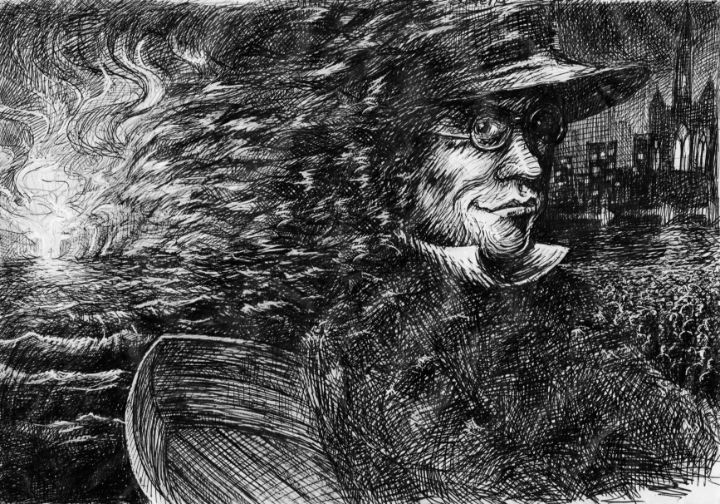
Søren Kierkegaard
Søren Kierkegaard (1813–1855) was a Danish philosopher, theologian, and cultural critic widely recognized as the father of Christian existentialism.[1] Writing during the Danish Golden Age, Kierkegaard rebelled against Hegelian systematic philosophy and institutionalized state religion. His work centers on individual existence, subjective truth, the psychological burden of freedom, and the radical nature of religious faith.[2]
1. Subjectivity as Truth ("Subjectivity is Truth")
Kierkegaard’s critique of 19th-century philosophy focused heavily on Georg Wilhelm Friedrich Hegel’s attempt to fit all of human history and reality into an all-encompassing, objective logical system.[2:1] For Kierkegaard, abstract, objective thinking misses the fundamental reality of concrete human existence.
-
Objective vs. Subjective Truth: Objective truth concerns what is believed—facts, scientific equations, and historical dates that exist independently of the observer.[2:2] Subjective truth, by contrast, concerns how an individual relates to a belief.[2:3]
-
Inwardness and Passion: In works like Concluding Unscientific Postscript (1846), Kierkegaard asserts that "Subjectivity is truth" because moral and spiritual meaning cannot be proven objectively; it must be lived with intense personal commitment and inward passion.[1:1]
"When subjectivity, inwardness, is the truth, the truth becomes objectively an uncertainty; but for that reason, the passion of inwardness is the truth."
— Søren Kierkegaard, Concluding Unscientific Postscript
2. The Single Individual (Den Enkelte)
Central to Kierkegaard's philosophy is the concept of Den Enkelte (the single individual). He argued that truth is not discovered by passive membership in a collective, but through individual choice and personal responsibility.[1:2]
-
Critique of "The Crowd": Kierkegaard viewed the public or "the crowd" as an abstraction that relieves individuals of moral accountability.[1:3] "The crowd is untruth," he famously claimed, because it encourages conformity and dilutes authentic existence.[3]
-
Anti-Systemic Thought: By refusing to build a universal philosophical system, Kierkegaard prioritized the particularity and contingency of concrete human life over abstract conceptual schemes.[4]
3. The Three Spheres of Existence
Kierkegaard posited that human life evolves across three distinct qualitative stages or "spheres" of existence.[2:4] An individual transitions between these stages not through gradual evolution, but through a decisive choice or leap.[4:1]
| Sphere | Primary Focus | Dominant Trait / Risk |
|---|---|---|
| Aesthetic | Immediate sensory pleasure, novelty, intellectual stimulation | Avoidance of commitment; leads to boredom and despair.[2:5] |
| Ethical | Moral duty, universal rules, civic obligation, self-choice | Conscious responsibility; can lead to guilt upon realizing one's limitations.[2:6] |
| Religious | Absolute relationship to the Divine; personal faith | Transcends ethical laws; embraces paradox and the absurd.[2:7] |
The Aesthetic Sphere
Explored extensively in Either/Or (1843), the aesthete lives in immediacy, seeking novelty, beauty, and emotional intensity while avoiding long-term commitments.[2:8] Because the aesthetic life relies on external circumstances, it ultimately culminates in boredom and deep existential despair (angst).
The Ethical Sphere
The individual moves to the ethical stage by consciously choosing themselves and accepting universal moral obligations.[4:2] Personified by "Judge Vilhelm" in Either/Or, the ethical person commits to duties like marriage, career, and civic engagement. However, ethics alone cannot resolve human sinfulness or finitude.
The Religious Sphere
The ultimate stage requires a transition into faith. In the religious sphere, the individual stands in a direct, unmediated relationship with God.[1:4] This stage is divided into:
-
Religiousness A: Natural religion or Socratic inwardness, where one attempts to relate to the divine within the limits of human reason.[1:5]
-
Religiousness B: Christian faith, which requires accepting the absolute paradox that God entered history as a mortal human being (Jesus Christ).[1:6]
4. Anxiety (Angst) and Freedom
In The Concept of Anxiety (1844), Kierkegaard provided an influential psychological analysis of human freedom and dread.[2:9]
-
The Dizziness of Freedom: Kierkegaard defined anxiety (angst) not as a fear of a specific object, but as the overwhelming awareness of one's own infinite possibilities and freedom.[1:7]
-
The Origin of Sin: Using the biblical allegory of Adam, Kierkegaard explained that before making a choice, humans experience a "dizziness" when staring into the abyss of potential outcomes. Freedom brings both the power to act and the terrifying responsibility for the consequences.[1:8]
Anxiety is not merely a negative emotion; it is the prerequisite for human self-awareness and spiritual development. Confronting anxiety forces the individual to make genuine choices.
5. Despair and the Structure of the Self
In The Sickness Unto Death (1849), written under the pseudonym Anti-Climacus, Kierkegaard analyzed despair as a spiritual disease of the self.[1:9]
Definition of the Self
Kierkegaard defined the self as a complex synthesis:
The self is not merely this synthesis, but "a relation that relates itself to itself." Despair occurs whenever this relation is out of balance.[1:10]
Forms of Despair
-
Unconscious Despair: Ignorance of having a spiritual self or being in despair.[1:11]
-
Weakness (Despair of Inauthenticity): Not wanting to be oneself; conforming to external expectations out of fear.[1:12]
-
Defiance (Promethean Despair): Desperately wanting to be oneself independent of God; asserting autonomy in defiance of the Creator.[1:13]
6. The Leap of Faith and The Absurd
Because God and the divine reality transcend human logic, Kierkegaard maintained that genuine faith cannot be arrived at through rational argument or historical proof.[1:14]
-
The Teleological Suspension of the Ethical: In Fear and Trembling (1843), under the pseudonym Johannes de silentio, Kierkegaard analyzed the biblical story of Abraham commanded to sacrifice his son Isaac.[1:15] From an ethical standpoint, Abraham's act is murder; from a religious standpoint, it is an act of absolute obedience to God. Abraham "suspends" the universal ethical rule for a higher teleological (ultimate) purpose.[1:16]
-
The Knight of Faith: Unlike the "tragic hero" who sacrifices himself for an understandable social good, the "Knight of Faith" acts solely on belief in the absurd—trusting that God can perform the humanly impossible.[1:17]
7. Indirect Communication and Pseudonyms
To prevent readers from blindly accepting his ideas as a new doctrine or objective system, Kierkegaard invented a complex network of pseudonymous authors.[1:18]
Key Pseudonyms:
-
Victor Eremita: Editor of Either/Or
-
Johannes de silentio: Author of Fear and Trembling
-
Johannes Climacus: Author of Philosophical Fragments and Concluding Unscientific Postscript
-
Anti-Climacus: Author of The Sickness Unto Death and Practice in Christianity
By assigning conflicting viewpoints to different fictitious personas, Kierkegaard forced readers to become active participants, evaluating the arguments inwardly rather than accepting them as objective truth.[1:19]
8. Critique of "Christendom"
Towards the end of his life, Kierkegaard engaged in a fierce public attack against the Church of Denmark.[3:1]
-
Christianity vs. Christendom: Kierkegaard drew a sharp line between authentic Christianity—which requires suffering, commitment, and personal risk—and "Christendom," the state-sanctioned, comfortable cultural habit of being born into a Christian society.[3:2]
-
The Scandal of Faith: He argued that official state religion had domesticated Christianity, making it easy and respectable, thereby stripping it of its radical, transformative power.[3:3]
Resonant Notes
🔗 Strong Resonance
-
The Philosophical Worldview of Fyodor Dostoevsky — Dostoevsky is Kierkegaard's closest literary-philosophical counterpart. Both are existential precursors who critique Western rationalism, explore the psychology of suffering and freedom, and wrestle with the problem of faith in a nihilistic age. The Underground Man's revolt against the "Crystal Palace" echoes Kierkegaard's critique of Hegelian system-building, while Ivan Karamazov's rebellion against God's harmony parallels Kierkegaard's analysis of the teleological suspension of the ethical.
-
Schopenhauerian Pessimism — Both Kierkegaard and Schopenhauer diagnose the human condition as fundamentally characterized by suffering and dissatisfaction. Where Schopenhauer prescribes ascetic denial of the Will, Kierkegaard prescribes the leap of faith. Their shared concern with boredom, despair, and the inadequacy of mere aesthetic pleasure creates a deep structural resonance.
-
Continental Philosophy — Kierkegaard is a foundational pillar of the existentialist tradition within Continental philosophy. His concepts of subjective truth, the single individual, and the leap of faith directly anticipate the existentialist themes developed by Sartre, Camus, and de Beauvoir.
-
Transdisciplinary Analysis of Epistemological Illusion, Cognitive Defense, and Neural Architecture — Terror Management Theory (TMT) provides a modern psychological framework that echoes Kierkegaard's analysis of anxiety (angst) as the fundamental human response to the awareness of mortality and freedom. Both frameworks see the construction of meaning systems as a buffer against existential terror.
-
John Updike — Updike's antinomian Christianity — a faith that wrestles with suffering rather than offering easy consolation — resonates deeply with Kierkegaard's critique of "Christendom" and his insistence on the radical, scandalous nature of authentic faith. Updike's protagonists embody Kierkegaard's "sickness unto death" in a secular age.
-
Perennial Philosophy — The perennialist distinction between exoteric (outer) and esoteric (inner) dimensions of religion parallels Kierkegaard's sharp division between "Christendom" (comfortable state religion) and authentic Christianity (personal, risky, paradoxical faith).
-
William James and the Landscape of Eastern Thought — James's distinction between "sciousness" (pure awareness) and "con-sciousness" (ego-driven awareness) resonates with Kierkegaard's emphasis on subjective truth and inwardness. Both thinkers champion the primacy of lived, personal experience over abstract, objective systems.
-
Iain McGilchrist — McGilchrist's critique of left-hemisphere dominance — the reduction of reality to abstract, decontextualized systems — echoes Kierkegaard's rebellion against Hegelian systematic philosophy. Both argue that the most important truths cannot be captured by analytical reason alone.
-
Jack Kerouac — Kerouac's "Dharma Vagabond" — the holy seeker who combines Buddhist meditation with Christian compassion while wandering through the wilderness — is a 20th-century incarnation of Kierkegaard's Knight of Faith. Both figures embody the solitary, risk-taking spiritual seeker who rejects comfortable conformity.
-
Dissolving vs. Evolving-The Self in Buddhism and Jung — Kierkegaard's analysis of the self as a dynamic synthesis (of the infinite/finite, temporal/eternal, freedom/necessity) resonates with both the Buddhist deconstruction of the self and the Jungian process of individuation. All three frameworks reject a static, reified notion of identity.
-
Theory of the Subject - Jacques Lacan — Lacan's concept of "traversing the fantasy" — giving up the illusion of finding ultimate completion in an external object — parallels Kierkegaard's leap of faith, which requires surrendering rational certainty for a paradoxical, subjective commitment. Both thinkers see authentic existence as requiring a radical break with conventional frameworks.
-
The Existential Paradox of Annie Hall's Opening Monologue — Alvy Singer's neurotic self-analysis and the Groucho Marx paradox ("I don't want to belong to any club that would have me as a member") embody Kierkegaardian themes of anxiety, self-loathing, and the difficulty of authentic belonging in a world of comfortable conventions.
Backlinks
- Jean-Paul Sartre — Sartre is Kierkegaard's direct philosophical heir in the existentialist tradition. Kierkegaard's concepts of anxiety (angst), subjective truth, and the leap of faith provide the foundational architecture for Sartre's existentialism. Where Kierkegaard ultimately grounds his leap in Christian faith, Sartre secularizes the same structure — radical freedom without a divine guarantor, anguish as the recognition of absolute responsibility.
Backlinks
- Woody Allen — Allen's aesthetic/neurotic persona — the intellectual who avoids commitment through irony, humor, and romantic distraction — maps directly onto Kierkegaard's Aesthetic Sphere, where the individual lives in immediacy and novelty-seeking, ultimately culminating in existential despair (angst). Alvy Singer's compulsive self-analysis and romantic self-sabotage are textbook Kierkegaardian aestheticism.
References
Soren Kierkegaard in 5 Minutes - The Father of Existentialism
This short video provides an accessible visual breakdown of Kierkegaard's life, his pseudonymous writing style, and his foundational concepts of existential anxiety and faith.
William McDonald / Søren Kierkegaard / Stanford Encyclopedia of Philosophy ↩︎ ↩︎ ↩︎ ↩︎ ↩︎ ↩︎ ↩︎ ↩︎ ↩︎ ↩︎ ↩︎ ↩︎ ↩︎ ↩︎ ↩︎ ↩︎ ↩︎ ↩︎ ↩︎ ↩︎
Wikipedia Editors / Philosophy of Søren Kierkegaard / Wikipedia ↩︎ ↩︎ ↩︎ ↩︎ ↩︎ ↩︎ ↩︎ ↩︎ ↩︎ ↩︎
World History Encyclopedia Editors / Søren Kierkegaard / World History Encyclopedia ↩︎ ↩︎ ↩︎ ↩︎
Encyclopedia.com Editors / Kierkegaard, Søren Aabye (1813–1855) / Encyclopedia.com ↩︎ ↩︎ ↩︎