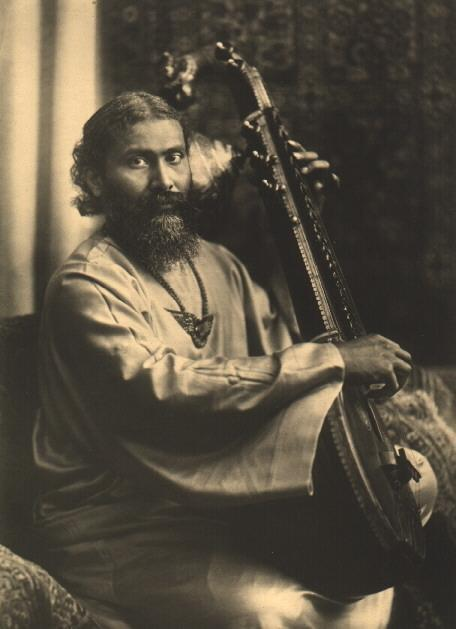
Hazrat Inayat Khan (1882–1927)
Hazrat Inayat Khan was a pioneering Indian mystic, classical musician, and philosopher who introduced Universal Sufism to the Western world in the early 20th century. Born into a celebrated lineage of Indian musicians, he traveled to the West in 1910, fusing classical music theory with Islamic mysticism to teach the fundamental unity of all major world religions.
Early Life and Musical Heritage
Noble Ancestry and the "Beethoven of India"
Hazrat Inayat Khan was born Inayat Khan Rehmat Khan on July 5, 1882, in Baroda, British India, to a noble Muslim family.[1]
-
Paternal Lineage: His father, Mashaikh Rahmat Khan, descended from an ancient family of Sufi saints, zamindars (feudal landowners), poets, and musicians from Punjab.[2]
-
Maternal Lineage: His mother, Khatija Bi, was the daughter of Sholay Khan Maulabakhsh, a celebrated classical Hindustani musician widely termed the "Beethoven of India".[2:1][1:1] In 1886, Maulabakhsh established the Gayanshala, the first formal academy of classical music in India, which later became the Baroda University Faculty of Music.[2:2][1:2]
-
Interreligious Household: Due to the prominent social standing of the Maulabakhsh family, Inayat Khan grew up in an interreligious environment.[3] His childhood was deeply influenced by regular contact with leading Brahmin and Parsi families, which fostered an early appreciation for comparative religion and universal spiritual values.[3:1]
Prodigious Musical Genius
Inayat Khan demonstrated supreme musical and intellectual capabilities from early childhood.[2:3]
-
Royal Performance: At just nine years old, he sang a famous Sanskrit hymn at a court ceremony, which earned him a reward and a scholarship from the Maharaja of Baroda.[2:4]
-
First Publication: By the age of fourteen, he published his first music theory textbook in Hindustani, titled Balasan Gitmala.[2:5] This text was specifically written to make music education accessible to children, especially female children in Muslim households.[4]
-
Professor of Musicology: Before he turned twenty, Inayat Khan was appointed a full professor of musicology at the Gayanshala academy.[2:6]
-
"Tansen of the Age": As a young virtuoso, he mastered the sarasvati veena, sitar, and classical vocal performance.[1:3] During a performance for the Nizam of Hyderabad, Mir Mahbub Ali Khan, his artistic prowess so moved the ruler that Inayat Khan was bestowed with the title Tansen az-Zaman ("Tansen of the Age") alongside an emerald ring.[1:4]
Spiritual Awakening and Sufi Training
The Inner Crisis
Despite achieving immense musical fame, Inayat Khan experienced a profound spiritual crisis in his early twenties.[3:2] He grew detached from worldly accolades and found himself questioning the empty mechanics of ritualized prayer.[3:3][4:1] He began visiting dervishes, sadhus, and various mystics in search of ultimate truth, eventually finding deep resonance at the shrines of Sufi saints such as Khwaja Moinuddin Chishti in Ajmer.[3:4]
Discipleship under Sayyid Abu Hashim Madani
In 1904, while in Hyderabad, Inayat Khan met the spiritual guide who would permanently alter his path: Sayyid Muhammad Abu Hashim Madani.[5] Recognizing Madani as the saint he had previously seen in a spiritual dream, Inayat Khan requested initiation.[3:5] Under Madani's close tutelage, Inayat Khan was trained and authorized in four major lineages of Sufism:[1:5]
-
The Chishti Order (Primary lineage, which traditionally integrated music as a vehicle for divine contemplation)[1:6][5:1]
-
The Suhrawardi Order[1:7]
-
The Qadiri Order[1:8]
-
The Naqshbandi Order[1:9]
The Divine Command
Following years of intensive mystical training, and shortly before his death in 1907, Sayyid Abu Hashim Madani gave Inayat Khan a monumental mission:[5:2]
"Go, my child, into the world, and harmonize the East and West with the music of thy soul."[3:6]
Journey and Teachings in the West (1910–1926)
Arrival and First Western Disciples
On September 13, 1910, Inayat Khan, accompanied by his brother Maheboob Khan and his cousin Mohammed Ali Khan, sailed from India to the United States.[5:3] Initially, they used Hindustani music recitals as a gateway to introduce Eastern mystical concepts to Western audiences.[5:4]
In 1911, while in San Francisco, Inayat Khan met Rabia Ada Martin, an American seeker who became his first major Western disciple.[5:5] He married Ora Ray Baker (later known as Pirani Ameena Begum) in 1912.[2:7][5:6] They had four children:[2:8][5:7]
-
Noor-un-Nisa (The heroic World War II Special Operations Executive wireless operator executed at Dachau)[4:2][5:8]
-
Vilayat (Who would later succeed his father as Pir of the Sufi Order)[5:9]
-
Hidayat (A prominent composer and later leader of the Sufi Movement)[5:10]
-
Khair-un-Nisa[5:11]
Institutional Evolution
| Period | Location / Landmark | Key Developments |
|---|---|---|
| 1914–1920 | London, England | At the outbreak of World War I, Inayat Khan established The Sufi Order to systematically train Western seekers.[6][5:12] |
| 1920 | Geneva, Switzerland | Believing that Switzerland's neutral status was ideal for a post-war, borderless peace message, he moved the international headquarters to Geneva.[2:9][5:13] |
| 1921 | Suresnes, France | Settled in a suburban villa near Paris, naming it Fazal Manzil. This site hosted his renowned annual Summer Schools.[2:10][3:7] |
| 1923 | Geneva, Switzerland | Formally registered The International Sufi Movement under Swiss law to legally solidify his trans-national mission.[5:14] |
The Philosophy of Universal Sufism
Hazrat Inayat Khan's "Universal Sufism" was not a conversion campaign to exoteric Islam, but a call to realize the absolute oneness of God (Tawhid) and the core truth hidden within all world religions.[3:8] He advocated for "spiritual liberty," freeing the human soul from sectarian dogma and rigid division.[3:9][1:10]
The Mysticism of Sound
Inayat Khan's philosophy of sound is arguably his most significant contribution to global metaphysics, compiled primarily in his seminal work, The Mysticism of Sound.[1:11]
-
Sound as Primary Creation: He argued that the entire universe is composed of active spiritual vibrations, with physical matter being simply the densest form of these vibrations.[1:12]
-
The Healing Power of Harmony: Music, being free from the limitations of form, words, and concepts, represents the most direct path to divine realization.[3:10] He taught that aligning the human mind and body to cosmic harmony could cure physical illness and elevate the soul to the plane of absolute consciousness.[3:11][1:13]
The Universal Worship Service
In May 1921, in London, Inayat Khan and his disciple Sophia Green created the Universal Worship Service.[7]
-
The Altar of Oneness: The service features an altar adorned with candles representing the world's great religions: Hinduism, Buddhism, Zoroastrianism, Judaism, Christianity, and Islam.[7:1] A final candle is lit to represent all those known or unknown truth-bearers who have guided humanity.[6:1]
-
The Scriptures: Portions of the sacred texts of each of these religions are read aloud to honor their unique expressions of the One Truth.[6:2]
-
The Cherags: The service is officiated by ordained ministers known as Cherags (Persian for "lamps" or "light-bearers").[7:2] Rather than acting as priests of a new creed, Cherags are tasked with fanning the spark of divine light in all situations, including none and excluding none.[7:3]
The Ten Sufi Thoughts
To present Sufi ideals in a clear, non-dogmatic format for Westerners, Inayat Khan articulated the Ten Sufi Thoughts:[1:14]
-
One God: The Only Being, from whom all proceeds and to whom all returns.[1:15]
-
One Master: The Guiding Spirit of all souls, who constantly leads humanity toward the light.
-
One Holy Book: The sacred manuscript of nature, the only scripture that can truly enlighten.
-
One Religion: The unswerving progress toward the spiritual ideal, which fulfills the soul's purpose.
-
One Law: The law of reciprocity, observed by a selfless conscience and an awakened sense of justice.
-
One Brotherhood and Sisterhood: Uniting all humanity under the Parenthood of God.
-
One Moral: The love that springs from self-denial and blooms in deeds of beneficence.
-
One Object of Praise: The divine beauty that uplifts the heart of its worshippers from the seen to the unseen.
-
One Truth: The true knowledge of our being, within and without, which is the essence of all wisdom.
-
One Path: The annihilation of the false ego in the real, raising the mortal to immortality.
Return to India, Death, and Legacy
Demise and Pilgrimage Site
In late 1926, physically exhausted by nearly two decades of constant transcontinental travel and lecturing, Inayat Khan returned to India.[1:16][5:15] He caught pneumonia during his travels and passed away in Delhi on February 5, 1927, at the age of 44.[1:17][5:16]
He was buried in the Nizamuddin West neighborhood of New Delhi.[1:18][6:3] His tomb (Dargah) is open to the public and remains a vibrant spiritual sanctuary, hosting weekly qawwali sessions and annual celebrations in his memory.
Lineage and Structural Splits
Following Inayat Khan's passing, his movement underwent several structural evolutions and transitions in leadership:
-
The Early Successors: His brother Maheboob Khan first assumed leadership of the International Sufi Movement, followed by their cousin Mohammed Ali Khan.[2:11]
-
The Inayatiyya (The Sufi Order): In 1956, Inayat Khan's eldest son, Pir Vilayat Inayat Khan, assumed the mantle.[5:17] He popularized Sufi retreats and inter-spiritual dialogue in the West.[6:4] Today, this lineage is headed by Pir Vilayat's son, Pir Zia Inayat Khan, and is known as the Inayatiyya.[1:19][7:4]
-
Sufi Ruhaniat International: In the United States, Inayat Khan's disciple Samuel Lewis (Sufi Ahmed Murad Chishti) blended his Sufi training with Zen Buddhism and dance, creating the "Dances of Universal Peace". This branch eventually formalized into the Sufi Ruhaniat International.
-
Sufism Reoriented: Rabia Martin, Inayat Khan's first US representative, later aligned herself with the Indian master Meher Baba. Her successor, Ivy Duce, founded Sufism Reoriented under Meher Baba's direction.
Backlinks
- Emanuel Swedenborg - The Polymath Who Mapped Science and Spirit — Inayat Khan's teaching that the universe is composed of spiritual vibrations, with physical matter as the densest form, parallels Swedenborg's Doctrine of Correspondences — both see material reality as the outer expression of an inner spiritual cause.
- Perennial Philosophy: Inayat Khan's Ten Sufi Thoughts (One God, One Religion, One Truth, One Path) and his Universal Worship Service — with candles for Hinduism, Buddhism, Zoroastrianism, Judaism, Christianity, and Islam — are perennialism enacted as ritual.
References
Grokipedia / Inayat Khan / grokipedia.com ↩︎ ↩︎ ↩︎ ↩︎ ↩︎ ↩︎ ↩︎ ↩︎ ↩︎ ↩︎ ↩︎ ↩︎ ↩︎ ↩︎ ↩︎ ↩︎ ↩︎ ↩︎ ↩︎ ↩︎
Inayatiyya / Hazrat Inayat Khan Biography / inayatiyya.org ↩︎ ↩︎ ↩︎ ↩︎ ↩︎ ↩︎ ↩︎ ↩︎ ↩︎ ↩︎ ↩︎ ↩︎
Sufi Ruhaniat International / Hazrat Inayat Khan Lineage / ruhaniat.org ↩︎ ↩︎ ↩︎ ↩︎ ↩︎ ↩︎ ↩︎ ↩︎ ↩︎ ↩︎ ↩︎ ↩︎
The Quint / Mystic Inayat Khan's Legacy: Music, Sufism And A Celebrated Spy Daughter / thequint.com ↩︎ ↩︎ ↩︎
Journal of Education and Social Science / Inayatian Mystical Movement as a Deviant Sect in Contemporary Muslim World / jesoc.com ↩︎ ↩︎ ↩︎ ↩︎ ↩︎ ↩︎ ↩︎ ↩︎ ↩︎ ↩︎ ↩︎ ↩︎ ↩︎ ↩︎ ↩︎ ↩︎ ↩︎ ↩︎
The Universal Worship / History of the Universal Worship / theuniversalworship.org ↩︎ ↩︎ ↩︎ ↩︎ ↩︎
Ihsan Center / Urs Murshida Sophia Saintsbury-Green 1939CE / ihsan.center ↩︎ ↩︎ ↩︎ ↩︎ ↩︎