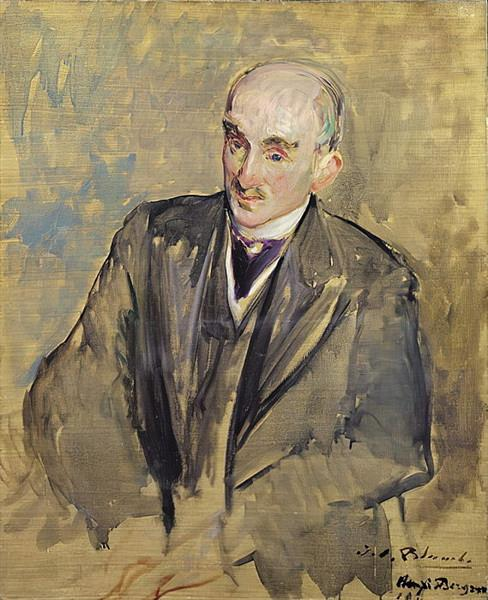
Henri Bergson (1859–1941)
Henri Bergson (1859–1941) was an exceptionally influential French philosopher and 1927 Nobel laureate in Literature. He is celebrated for his "process philosophy," which rejects static, mechanistic, and spatialized views of reality in favor of immediate experience, change, and continuous flow. His concepts of duration (la durée), the vital impetus (élan vital), and the brain as a utilitarian filter profoundly reshaped modern psychology, literature, theology, and philosophy.
Biographical Context & Intellectual Impact
Henri Bergson was born in Paris to a Polish-Jewish father and an English-Jewish mother. Appointed Chair of Modern Philosophy at the Collège de France in 1900, he quickly became a global intellectual sensation.
His public lectures were massive cultural events, drawing socialites, writers, and international academics alike—reportedly causing Paris's first automobile traffic jam due to the massive crowds eager to hear him speak. In 1927, Bergson was awarded the Nobel Prize in Literature "in recognition of his rich and vitalizing ideas and the brilliant skill with which they have been presented."
Core Philosophical Concepts
1. Duration (La Durée): True Time vs. Spatialized Time
-
The Error of Science: Bergson argues that natural science and mathematics treat time as if it were a dimension of space. Clocks divide time into discrete, static, and identical spatial units (seconds, ticks). This "spatialized time" is a conceptual construction built for utility and measurement.
-
The Continuous Flow: True time is duration (la durée)—the pure, undivided, qualitative flow of consciousness. Within la durée, the past continuously melts into the present to form an organic, evolving whole, where past and present are co-present without rigid boundaries.
-
Free Will: Free will is an intrinsic property of la durée. Because our conscious moments are a continuous, creative flow rather than a succession of discrete, deterministic states, human acts cannot be modeled mechanistically.
2. The Filter/Transmission Theory of Consciousness
-
Production vs. Transmission: Nineteenth-century materialism asserted that the brain "produces" consciousness (the production theory). In Matter and Memory (1896), Bergson opposed this reductionism, proposing that consciousness exists independently of the brain, and that the brain serves a transmissive or eliminative function.
-
The Brain as a Utilitarian Filter: The universe is a vast field of images and pure consciousness. To protect the biological organism from being overwhelmed by the infinite sensory and historical data of the cosmos, the brain acts as a filter. It restricts awareness down to a narrow stream of utilitarian, survival-oriented perceptions.
-
Memory and Matter: Bergson argues that "pure memory" is spiritual and immaterial; it is never actually lost. Brain lesions do not destroy memories; they merely damage the physical machinery (the "telephonic exchange") necessary to actualize those memories as motor actions in the physical present.
-
Huxley's Synthesis: This "reducing valve" model was directly adopted by Aldous Huxley in The Doors of Perception (1954) to explain how psychedelics (like mescaline) temporarily disable this neural filter, allowing a flood of raw reality ("Mind-at-Large").
3. Élan Vital: The Vital Impetus
-
Beyond Mechanism and Teleology: In Creative Evolution (1907), Bergson critiqued both mechanistic evolutionary models (which reduce evolution to passive material accidents) and teleological/finalist models (which view life as fulfilling a pre-determined divine blueprint).
-
The Creative Surge: He proposed the élan vital (vital impetus)—an original, creative force carrying life forward in an open-ended, unpredictable trajectory. Evolution is not a passive reaction to environments, but a creative, self-organizing struggle of consciousness to manifest itself in matter, constantly striving for greater freedom.
4. Intuition vs. Intellect
-
The Dual Modes of Mind: Bergson distinguishes between two radically different ways of knowing:
-
Intellect: Pragmatic, analytical, and spatial. It chops reality into static, isolated parts to manipulate them for everyday survival, engineering, and science.
-
Intuition: A form of "intellectual sympathy" that enters into the flow of the object. Rather than observing a thing from the outside, intuition grasps its inner, dynamic essence. Bergson argued that metaphysics must rely on intuition to touch absolute reality.
-
Major Works
-
Time and Free Will: An Essay on the Immediate Data of Consciousness (1889): Introduces la durée and critiques the spatialization of psychological experience.
-
Matter and Memory (1896): Explores the relationship between body, brain, and spirit through a dualistic, non-reductionist lens.
-
Laughter: An Essay on the Meaning of the Comic (1900): Explains comedy as "something mechanical encrusted on the living."
-
Creative Evolution (1907): Formulates élan vital and critiques both Darwinian mechanism and classic teleology.
-
The Two Sources of Morality and Religion (1932): Distinguishes between "closed" (dogmatic, social-survival-oriented) and "open" (mystical, universal love-oriented) moral systems.
The Historic Encounter: Bergson vs. Einstein (1922)
On April 6, 1922, the world-famous philosopher and the rising superstar of physics, Albert Einstein, met at the Société française de philosophie in Paris to debate the nature of time.
┌───────────────────────────────────────────────┐
│              The 1922 Clash                   │
├───────────────────────┬───────────────────────┤
│        Bergson        │       Einstein        │
│    (Philosopher)      │      (Physicist)      │
├───────────────────────┼───────────────────────┤
│ Time is Durée (Flow)  │ Time is Clock-Time    │
│ Experience is Primary │ Coordinates in Space  │
│ Clocks measure Space  │ Clocks measure Time   │
└───────────────────────┴───────────────────────┘
-
Bergson's Argument: Bergson did not dispute Einstein's mathematical formulas. Rather, he argued that Einstein's Theory of Relativity spatializes time, reducing it strictly to clock-time. Bergson claimed that physical time is only one dimension of a far deeper reality: la durée, the lived, psychological experience of time.
-
Einstein's Response: Einstein rejected any philosophical category of time distinct from physical measurement. In a brief but devastating reply, Einstein famously remarked: "The time of the philosophers does not exist; there is only a physical time and a psychological time."
-
The Consequence: Historians point to this debate as a massive paradigm shift. It symbolized the moment science wrested authority over the definition of physical reality away from philosophy, deepening the divide between the sciences and the humanities.
Legacy and Contemporary Relevance
-
Literary Influence: His philosophy of time deeply influenced the modernist literary movement, particularly Marcel Proust's In Search of Lost Time (Proust was Bergson's cousin-in-law and attended his lectures), Virginia Woolf, and James Joyce.
-
Process Philosophy: Along with William James and Alfred North Whitehead, Bergson laid the groundwork for process theology and metaphysics.
-
Post-Structuralism: French philosopher Gilles Deleuze revived Bergsonism in the mid-20th century, using Bergson's concepts of "the virtual" and multiplicity to critique traditional Western metaphysics.
-
Contemporary Neuroscience: Current research into the Default Mode Network (DMN) has renewed scientific interest in the transmission/filter theory of consciousness. Modern neuroimaging reveals that classic psychedelics do not increase brain activity, but rather suppress key filtering networks—providing striking modern support for Bergson and Huxley's "reducing valve" hypothesis.
Backlinks
-
Analytic Philosophy — Bergson's distinction between intellect (analytical, spatial, pragmatic) and intuition provides a philosophical framework that directly parallels — and critiques — the analytic tradition's method. His work represents an alternative approach to the same questions about time, consciousness, and knowledge that analytic philosophers address through formal logic and linguistic analysis.
-
Continental Philosophy — Bergson is a pivotal figure in the Continental tradition, bridging 19th-century spiritualism and 20th-century phenomenology. His concepts of la durée, intuition vs. intellect, and the brain as a utilitarian filter directly embody Continental philosophy's rejection of scientism and its emphasis on lived experience.
See Also
- Aldous Huxley's The Doors of Perception (1954) — Huxley directly adopted Bergson's "reducing valve" model to explain how psychedelics temporarily disable the neural filter, allowing raw "Mind-at-Large" to flood in.