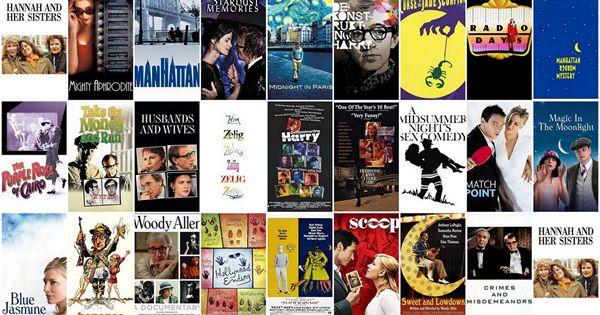
Woody Allen
Woody Allen’s body of work—spanning over five decades and more than 50 feature films—is defined by a synthesis of existential philosophy, tragicomic humor, and urban neurosis. His main ideas revolve around the inherent absurdity of existence, the silence of God, moral relativity, and the constant tension between romantic fantasy and harsh reality.[1] Methodologically, Allen operates on an unpretentious, disciplined model characterized by rapid scriptwriting, long visual takes, minimal actor direction, and heavy reliance on classic jazz and European art-house aesthetics.[2]
Core Philosophical Themes & Ideas
1. Existential Dread and the Indifferent Universe
At the heart of Allen's worldview is a deeply pessimistic, existential anxiety heavily influenced by European intellectuals such as Jean-Paul Sartre, Friedrich Nietzsche, and Søren Kierkegaard.[1:1] In Allen’s cinematic universe, reality is indifferent, unguided by divine providence, and fundamentally meaningless.[2:1] To cope with the terror of mortality and non-existence, human beings erect psychological distractions—such as romantic entanglements, artistic creation, or intellectual arrogance—which ultimately prove fragile.[1:2]
2. Morality, Guilt, and Cosmic Injustice
Drawing heavily from Fyodor Dostoevsky’s Crime and Punishment, Allen frequently explores whether morality is an absolute law or an artificial human construct.[1:3]
-
Absence of Divine Retribution: In films like Crimes and Misdemeanors (1989) and Match Point (2005), characters commit murder to preserve their comfortable lives, only to discover that the universe imposes no cosmic justice or karma.[1:4]
-
Internal Conscience: Punishment in Allen’s world is rarely external or judicial; rather, it manifests as internal psychological guilt—or, even more cynically, is easily rationalized away by human self-interest.[1:5]
3. Illusion, Escapism, and Nostalgia
Allen repeatedly contrasts the drab, painful nature of real life with the transcendent comfort of art and fantasy.[1:6]
-
Cinematic Refuge: In The Purple Rose of Cairo (1985), a movie character steps off the screen into the real world, illustrating cinema's intoxicating power to temporarily shield people from depression and poverty.[1:7]
-
The Nostalgia Trap: In Midnight in Paris (2011), Allen critiques romanticizing the past, demonstrating that every generation views a previous era as a "golden age" to avoid facing contemporary existential dissatisfaction.[1:8]
"Life is divided into the horrible and the miserable... So when you go through life, you should be thankful that you're miserable, because that's very lucky to be miserable."
— Woody Allen (Annie Hall, 1977)[2:2]
4. Neurosis, Modern Identity, and Romantic Anxiety
Allen’s signature on-screen persona—the erudite, hyper-analytical, self-deprecating, and phobia-ridden intellectual—functions as a primary lens to dissect modern intimacy.[2:3] His films frame romantic love as both essential for human connection and inherently chaotic, self-sabotaging, and ephemeral.[1:9]
Creative Methodology & Technical Approach
1. High Output and Prolific Work Ethic
Unlike many auteur directors who spend years developing a single project, Allen maintained an industrial schedule of writing and directing roughly one film per year for over four decades.[2:4] He treats filmmaking as a craft rather than a sacred art, often describing his process as a pragmatic routine designed to keep him productive and distracted from existential angst.[3]
2. Visual Style: The Master Shot and Long Takes
Visually, Allen relies on efficiency, spatial continuity, and naturalistic movement, frequently collaborating with renowned cinematographers such as Gordon Willis, Carlo Di Palma, and Vittorio Storaro.[1:10]
-
Minimal Coverage: Rather than cutting rapidly between close-ups and coverage angles, Allen favors long-take master shots (sequence shots) where actors move freely within the frame.[3:1]
-
Pacing and Budgeting: This method allows scenes to unfold with theatrical continuity, minimizes post-production editing, and keeps productions under budget.[3:2]
3. Minimalist Actor Direction and Improvisation
Allen’s directorial style on set is famously hands-off.[3:3]
-
Casting as Direction: He casts actors based on their established capabilities, then gives them considerable freedom.[3:4]
-
Dialogue Cadence: He frequently encourages actors to rephrase scripted lines into their own natural speech rhythms, fostering conversational authenticity.[3:5]
Allen's approach to working with actors prioritizes economy and trust: he hires actors who fit the roles naturally and avoids micromanaging their performances on set.[3:6]
4. Music as Narrative Architecture
Music in Allen’s films serves as a core narrative anchor rather than simple background scoring.[1:11] He predominantly scores his work with jazz, ragtime, and American Songbook standards from the 1920s to 1940s (featuring artists like George Gershwin, Louis Armstrong, and Duke Ellington), using nostalgic soundscapes to counterpoint the modern anxieties of his characters.[2:5]
Evolution of Style Across Eras
| Era | Key Characteristics | Exemplary Films |
|---|---|---|
| Early Comedy (1969–1975) | Slapstick, absurdity, parody, stand-up joke structures, visual gags.[2:6] | Take the Money and Run, Sleeper, Love and Death |
| Philosophical Realism (1977–1989) | Narrative innovation (breaking the 4th wall, non-linear structures), deep character studies, explicit existential themes.[1:12] | Annie Hall, Manhattan, Crimes and Misdemeanors |
| European / Global Era (2005–Present) | Setting stories across European capitals, exploring fate and chance, moral thrillers.[1:13] | Match Point, Vicky Cristina Barcelona, Midnight in Paris |
Resonant Notes
🔗 Strong Resonance
-
The Existential Paradox of Annie Hall's Opening Monologue — A dedicated vault note analyzing the very monologue that defines Allen's existential-comic voice. Explores Alvy Singer's Groucho Marx paradox, his fear of mortality, and the Schopenhauerian pessimism that underpins Allen's worldview. The note's backlinks already connect to Schopenhauerian Pessimism, Dostoevsky, Norman Mailer, John Updike, and Continental Philosophy — all of which resonate with Allen's work.
-
Jean-Paul Sartre — Allen's existential dread and the "indifferent universe" are directly indebted to Sartre's concepts of radical freedom, anguish (l'angoisse), and the absence of external moral guarantees. Sartre's notion that we are "condemned to be free" is the philosophical engine behind Allen's neurotic protagonists.
-
Søren Kierkegaard — Allen's aesthetic/neurotic persona — the intellectual who avoids commitment through irony, humor, and romantic distraction — maps directly onto Kierkegaard's Aesthetic Sphere, where the individual lives in immediacy and novelty-seeking, ultimately culminating in existential despair (angst).
-
Schopenhauerian Pessimism — The direct metaphysical framework behind Allen's Catskills joke ("life is full of misery and it's all over much too quickly"). Schopenhauer's blind, insatiable Will and the pendulum between pain and boredom is the philosophical substrate of Allen's entire comedic worldview.
-
Fyodor Dostoevsky (1821 - 1881) — Allen's exploration of morality without divine retribution (Crimes and Misdemeanors, Match Point) is a direct cinematic adaptation of Dostoevsky's question: if God is silent, is everything permitted? The Underground Man's irrational self-sabotage is Alvy Singer's spiritual condition.
🟡 Structural & Thematic Resonance
-
Norman Mailer — Both Mailer and Allen diagnose the existential crisis of the modern intellectual: the "Square" who submits to convention to avoid confronting the abyss. Mailer's Hipster authenticity vs. Square security is the same tension Allen's protagonists live — trapped between the desire for meaning and the terror of freedom.
-
John Updike — Updike's Rabbit Angstrom and Allen's Alvy Singer are spiritual twins: men trapped by their own consciousness, unable to accept love or happiness, processing existential dread through compulsive behavior. The Groucho Marx paradox is Rabbit's condition as much as Alvy's.
-
Don DeLillo Major Themes Analysis — DeLillo's White Noise diagnoses the same condition Allen articulates: the fear of death masked by consumerism, media saturation, and intellectual distraction. Jack Gladney's shopping sprees for "existential credit" are the late-capitalist version of Alvy's compulsive joke-telling.
-
Franz Kafka — Kafka's labyrinthine authority, unattainable truth, and the parable of Before the Law resonate with Allen's cosmic injustice — the universe offers no gatekeeper, no justice, no redemption. Both depict a world where meaning is perpetually deferred.
-
Viktor Frankl — Frankl's Tragic Triad (pain, guilt, death) and his concept of Tragic Optimism provide the counterpoint to Allen's pessimism. Where Allen's characters rationalize guilt and despair, Frankl insists on turning suffering into meaning — the road not taken by Allen's protagonists.
🟢 Peripheral & Thematic Resonance
-
Transdisciplinary Analysis of Epistemological Illusion, Cognitive Defense, and Neural Architecture — Terror Management Theory (TMT) provides the psychological mechanism behind Allen's existential dread: humans construct cultural worldviews to buffer against mortality salience. Allen's films are a cinematic exploration of these defense mechanisms failing.
-
Beyond the Macabre - Edgar Allan Poe's Rationalist Gothic — Poe's "Unity of Effect" — every word serving a single premeditated emotional goal — parallels Allen's disciplined, efficient filmmaking methodology. Both are meticulous craftsmen who treat art as a calculated, rather than inspired, process.
-
Continental Philosophy — Allen's entire intellectual framework — existentialism, the critique of the autonomous self, the irrational foundations of behavior — is a vernacular, cinematic adaptation of the Continental tradition (Sartre, Kierkegaard, Nietzsche, Freud as a "master of suspicion").
References
Atlantis Press / The Philosophy of "Crime and Punishment" and "Existentialism" in Woody Allen's Film / Atlantis Press ↩︎ ↩︎ ↩︎ ↩︎ ↩︎ ↩︎ ↩︎ ↩︎ ↩︎ ↩︎ ↩︎ ↩︎ ↩︎ ↩︎
Encyclopædia Britannica / Woody Allen: Biography, Movies, & Facts / Britannica ↩︎ ↩︎ ↩︎ ↩︎ ↩︎ ↩︎ ↩︎
Eric Lax / Conversations with Woody Allen: His Films, the Movies, and Moviemaking / Google Books ↩︎ ↩︎ ↩︎ ↩︎ ↩︎ ↩︎ ↩︎