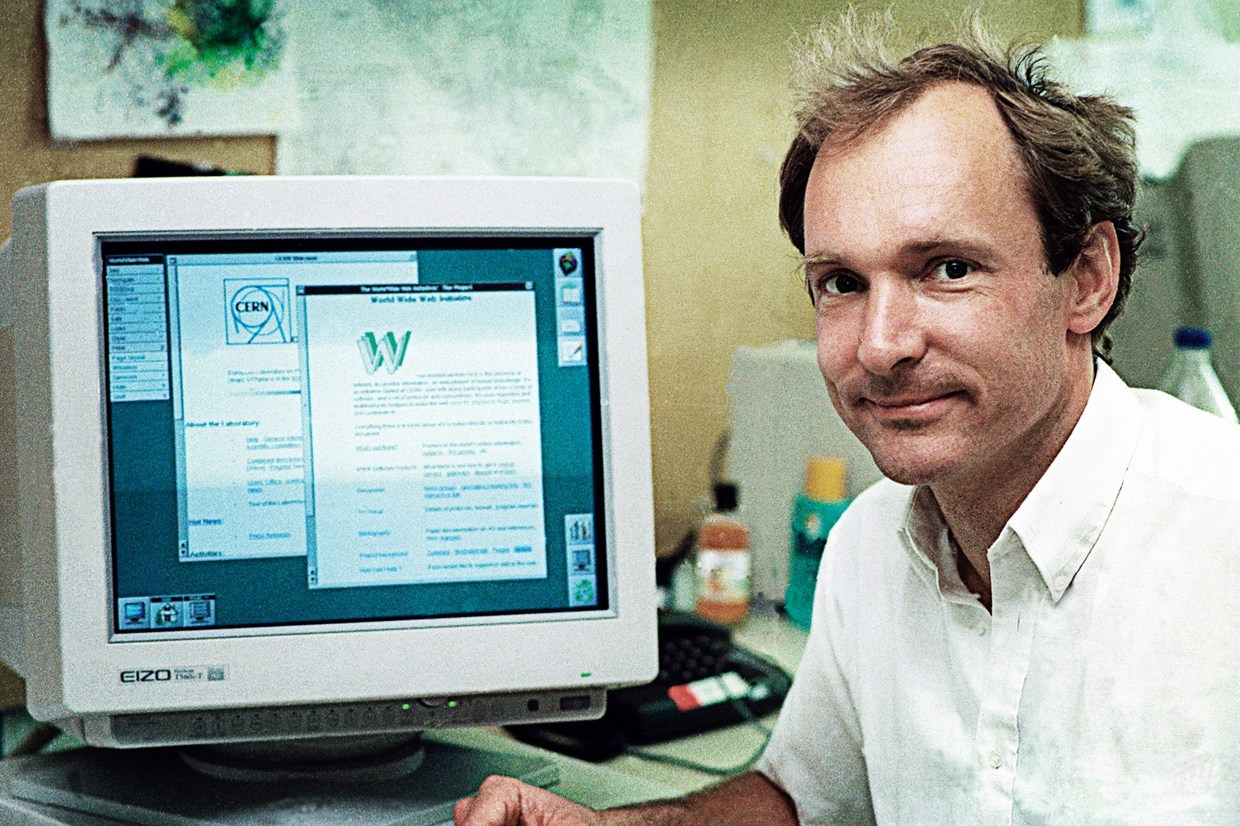
Timothy John Berners-Lee
Sir Tim Berners-Lee is a British computer scientist best known as the inventor of the World Wide Web, HTML, HTTP, and URLs.[1] His pioneering proposal at CERN in 1989 transformed global communication, digital commerce, and information sharing, laying the technical foundation for the modern digital age.[2]
Early Life and Academic Background
Sir Timothy John Berners-Lee was born on June 8, 1955, in London, England.[1:1] He was raised by parents who were both mathematicians and early computer scientists working on the Ferranti Mark 1, one of the earliest commercially built computers.[1:2]
He attended Emanuel School in London before earning a first-class degree in physics from The Queen's College, University of Oxford, in 1976.[1:3] While studying at Oxford, he demonstrated an early knack for hardware engineering by constructing his own computer using an old television set and spare parts.[1:4]
Invention of the World Wide Web
In 1980, while working as an independent contractor at CERN (the European Organization for Nuclear Research) in Geneva, Berners-Lee built a prototype system named ENQUIRE, which used hypertext concepts to share and update information among researchers.[1:5]
After returning to CERN as a fellow, he submitted a groundbreaking proposal in March 1989 titled "Information Management: A Proposal".[2:1] This document outlined a system to merge hypertext with the global Internet, enabling researchers across different network nodes to share data seamlessly.[2:2]
To bring this vision to life, Berners-Lee created three core technical specifications that remain fundamental to web architecture today:[2:3]
-
URL (Uniform Resource Locator): A global addressing system used to identify individual web pages and resources.[3]
-
HTTP (Hypertext Transfer Protocol): A protocol defining how messages and data are formatted and transmitted across the web.[3:1]
-
HTML (Hypertext Markup Language): The standard formatting language used to structure web content.[3:2]
By late 1990, Berners-Lee had written the first web browser (named WorldWideWeb), configured the first web server (httpd), and published the world's first website.[1:6]
In an influential decision on April 30, 1993, CERN placed the World Wide Web software into the public domain royalty-free, ensuring its rapid adoption and universal growth.[2:4]
Web Stewardship and Recent Initiatives
Recognizing the need for open standards to prevent web fragmentation, Berners-Lee founded the World Wide Web Consortium (W3C) at MIT in 1994.[2:5] He served as its director for decades, guiding the development of interoperable tools and guidelines.[2:6]
In his ongoing career, Berners-Lee has focused on web advocacy and decentralization:
-
World Wide Web Foundation: Co-founded in 2009 to champion the open web as a public good and basic human right.[2:7]
-
Open Data Institute (ODI): Co-founded in 2012 to promote open data sharing by governments and organizations.[1:7]
-
The Solid Project & Inrupt: Co-founded the commercial entity Inrupt to deploy the open-source Solid (Social Linked Data) protocol, aiming to decentralize the web and give users agency over their personal data.[2:8]
Major Awards and Recognition
Berners-Lee's contributions to humanity have earned him numerous international honors:[2:9]
-
Knighthood (2004): Appointed Knight Commander of the Order of the British Empire (KBE) by Queen Elizabeth II.[1:8]
-
Order of Merit (2007): Appointed to the exclusive Order of Merit by Queen Elizabeth II.[2:10]
-
ACM A.M. Turing Award (2016): Received the "Nobel Prize of Computing" for inventing the World Wide Web and fundamental protocols.[2:11]
-
Time 100: Named among Time magazine's "100 Most Important People of the 20th Century".[3:3]
Resonant Notes
Strong Resonance (Web Architecture & Information Infrastructure)
-
Net Neutrality — Berners-Lee's vision of an open, decentralized web is the philosophical foundation of net neutrality. His decision to release the web royalty-free and his ongoing advocacy through the Solid project for user agency over data directly align with the principle that ISPs should be neutral transport pipes, not gatekeepers controlling access to content.
-
How the Internet Works — The technical infrastructure (TCP/IP, packet switching, DNS) that the World Wide Web was built upon; Berners-Lee's HTTP/HTML layer sits atop this foundational network stack.
-
The Internet of Things (IoT) — The evolution of web-connected devices beyond the browser, extending Berners-Lee's vision of universal connectivity to physical objects and sensors.
-
Information Networks and the Architecture of Social Order — Information networks as the foundation of social order, directly building on the web architecture Berners-Lee pioneered.
-
Analytical Review - Nexus and the Evolution of Information Networks — Harari's analysis of how information networks shape civilization, with the web representing the most transformative information network since the printing press.
-
Signal vs Static - Breaking Down Communication Noise — Communication theory underpinning digital transmission, relevant to understanding how HTTP/HTML encode and transmit meaning across the web.
Medium Resonance (Media Theory & Digital Impact)
- McLuhan's The Medium is the Message — The web as the ultimate medium reshaping human perception and social organization; Berners-Lee's creation exemplifies McLuhan's thesis that the medium itself is more consequential than its content.
- Innis (1950) - Empire and Communications — Media bias theory applied to the web's space-biased nature; the web is the most extreme space-biased medium ever created, enabling instantaneous global communication.
- Innis (1951) - The Bias of Communication — Further media ecology analysis of how communication technologies shape civilizations, with the web as the defining medium of the information age.
- Media Theory Concept Research — McLuhan's framework for understanding the web's impact on human consciousness and social structures.
- Digital Infrastructure of Delusion — The unintended consequences of the web's attention economy, exploring how Berners-Lee's open web gave rise to surveillance capitalism and algorithmic manipulation.
- Yuval Noah Harari — Information networks, shared fictions, and the web's role in shaping the tension between truth and social order in the digital age.
- The Simulation Theory Framework — Wheeler's "It from Bit" and the information-theoretic view of reality, resonating with the web's fundamental nature as an information layer over physical reality.
Applied Resonance (Web-Enabled Systems & Impact)
- Every Business Is a Software Business - Core Frameworks and Enterprise Transformation — The web as the foundation of digital business transformation and the software-driven economy.
- Why Canada Will Never Have a WeChat — Web architecture, regulatory frameworks, and the tension between open standards and platform monopolies.
- Cryptocurrency for Idiots — Decentralization and the web's evolution toward distributed systems (blockchain, Web3), building on Berners-Lee's original vision of a decentralized information space.
- Circular Economy — Digital Product Passports as a web-enabled innovation for sustainability and supply chain transparency.
- The Digital Utility - Evaluating Technology's Impact on Work, Education, and Civic Life in Toronto — The web's impact on education, civic engagement, and urban life in the digital age.
- The Great Classroom Screen Debate - Device Bans vs. Digital Integration in Higher Education — Digital tools in education, enabled by the web, and the ongoing debate about their appropriate use.
- Neuroproductivity — Cognitive sovereignty in the web-mediated attention economy, addressing the challenges Berners-Lee's creation has introduced for human focus and agency.