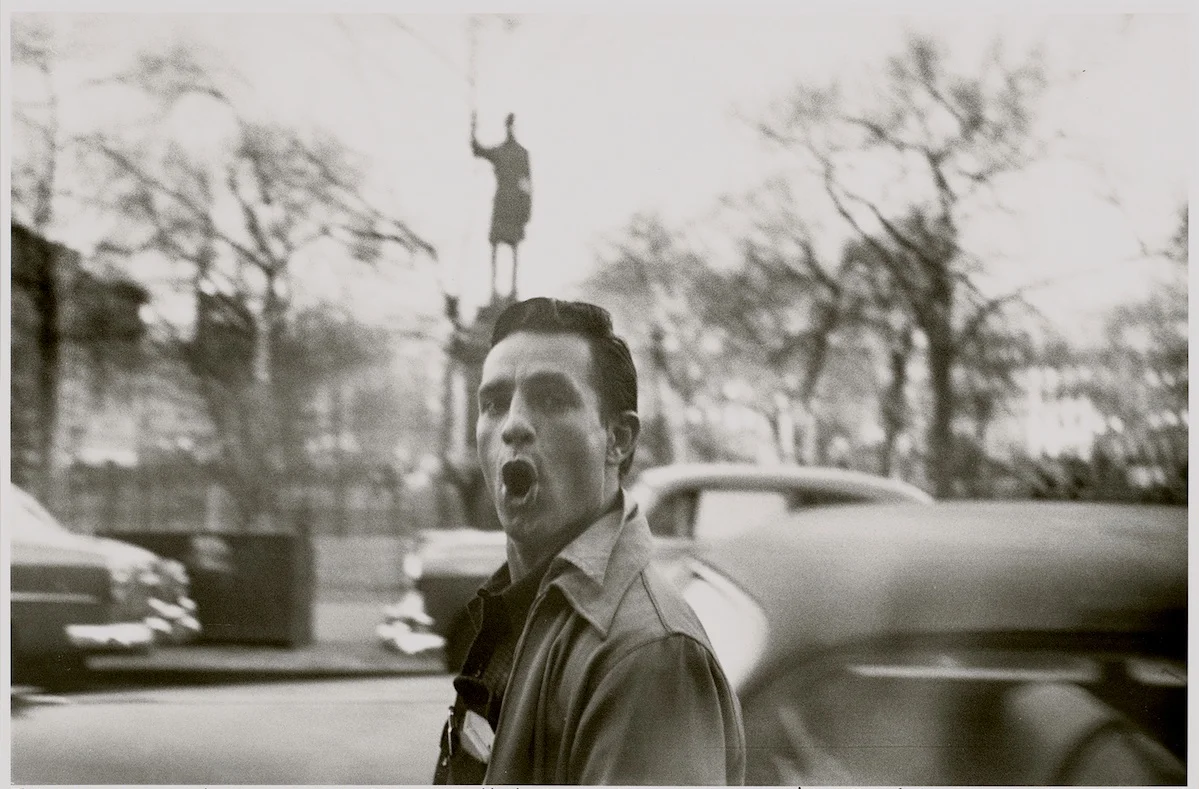
Jack Kerouac
Jack Kerouac’s intellectual and literary framework centers on the transformation of post-WWII American literature through Spontaneous Prose, the synthesis of Catholicism and Zen Buddhism, the sacralization of the open road, and the concept of the "Beatific" outcast. Rather than simple rebellion, Kerouac sought an ecstatic, transcendent experience through memory, brotherhood, jazz prosody, and nomadic movement.
1. The Dual Ethos of "Beat": Weariness and Beatitude
Jack Kerouac’s concept of the "Beat Generation" is frequently misunderstood as mere youthful rebellion or bohemian nihilism. In reality, Kerouac defined "Beat" through a precise dual etiology:
-
Physical and Social Exhaustion ("Beaten Down"): Derived from street slang popularized by Herbert Huncke, the term initially described being down-and-out, impoverished, and discarded by post-war industrial society.[1] Kerouac saw this state of exhaustion as a necessary shedding of societal illusions.
-
Spiritual Illumination ("Beatific"): Kerouac reinterpreted the term to mean beatitude—a state of holy grace, divinity, and spiritual radiance.[2]
By rejecting the rigid materialism, suburban conformity, and careerism of 1950s Cold War America, Kerouac elevated marginalized figures—hobos, jazz musicians, addicts, and wanderers—into "dumbsaints."[3] In his view, those at the bottom of society possessed a raw existential authenticity that revealed divine truth.[1:1]
2. Spontaneous Prose and Bop Prosody
Kerouac viewed traditional literary craft, editing, and formal grammar as artificial barriers that stifled the subconscious mind.[4] To bypass conscious censorship, he developed Spontaneous Prose (outlined in his essays Essentials of Spontaneous Prose and 30 Beliefs and Techniques for Modern Prose).[4:1][3:1]
"No periods separating sentence-structures already arbitrarily riddled by false colons and timid usually needless commas—but the vigorous space dash separating rhetorical breathing... Blow as deep as you want—write as deeply, fish as far down as you want, satisfy yourself first, then reader cannot fail to receive telepathic shock." [4:2]
Key Tenets of Kerouac's Technique:
-
Bop Prosody: Influenced by Bebop saxophonists like Lester Young and Charlie Parker, Kerouac structured his sentence rhythms on the exhalation of breath rather than conventional punctuation, substituting dashes (
--) for commas and periods.[4:3][5] -
"First Thought, Best Thought": Reversing the academic ethos of revision, Kerouac argued that editing corrupted the pure, immediate truth of memory and emotion.[4:4]
-
Sketching: The writer focuses intensely on a single "jewel center of interest" (a memory, a face, or a scene) and writes outward in an uninterrupted stream of consciousness until emotional exhaustion is reached.[4:5]
3. Spiritual Synthesis: Catholic Mysticism and Zen Buddhism
Kerouac’s worldview was deeply theological, forged through a synthesis of his Franco-American Roman Catholic upbringing and his mid-career immersion in Eastern philosophy.[1:2]
-
Roman Catholicism: Injected his work with themes of divine grace, original sin, redemption, suffering, and a profound reverence for the Sacred Heart of Jesus.[1:3]
-
Zen Buddhism: Introduced concepts of anicca (impermanence), śūnyatā (emptiness/void), and the liberation from ego-driven desire.[1:4][3:2]
In works like The Dharma Bums (1958), Kerouac articulated the archetype of the "Dharma Vagabond"—a holy seeker who combines Buddhist meditation and Christian compassion (agape) while wandering through the wilderness.[1:5] He viewed life on Earth as a transient, illusory dream (samsara) through which humanity must navigate with kindness and universal sympathy.[3:3]
4. The Open Road as Sacred Pilgrimage
For Kerouac, the American highway was not a geographical convenience, but a sacred arena for spiritual transformation.[6] In On the Road (1957), motion acts as a antidote to domestic stagnation and spiritual death.[6:1]
[Suburban Conformity & Security]  <--->  [The Open Road / Nomadic Movement]
          (Ego, Stasis, Fear)                    (Ecstasy, Truth, "IT")
The Search for "IT"
Throughout his travels across North America and Mexico, Kerouac sought moments of ultimate illumination, referred to simply as "IT." [6:2] "IT" represents a momentary state of cosmic ecstasy where time stops, the ego dissolves, and the seeker feels completely unified with the universe and God.[6:3] Figures like Dean Moriarty (modeled on Neal Cassady) functioned in Kerouac’s pantheon as manic secular guides propelling the narrator toward this transcendent boundary.[6:4]
5. The "Duluoz Legend": Memory, Impermanence, and Nostalgia
Kerouac conceived his major novels not as standalone fictions, but as interconnected chapters of a single massive autobiographical epic titled The Duluoz Legend.[1:6][3:4] Modeled explicitly on Marcel Proust’s In Search of Lost Time, Kerouac sought to chronicle his entire lifetime using uniform character archetypes across different books.[1:7]
-
Preservation Against Mortality: Traumatized by the early death of his older brother Gerard and the relentless passage of time, Kerouac wrote out of an urgent need to preserve fleeting human experiences before they dissolved into death.[1:8]
-
The Record of Human Suffering: Kerouac believed the fundamental obligation of the writer was to serve as a recording angel, capturing exact visual and emotional pictures of human life in all its "bleak inhuman loneliness." [4:6][3:5]
Summary of Core Concepts
| Concept | Primary Definition | Key Works |
|---|---|---|
| Beatitude | Finding the holy and divine within the marginalized and exhausted. | On the Road, Visions of Cody |
| Spontaneous Prose | Uncensored, breath-driven writing modeled on jazz improvisation. | The Subterraneans, Doctor Sax |
| Dharma Vagabondage | Blending Catholic devotion with Buddhist mindfulness on the road. | The Dharma Bums, Desolation Angels |
| The Duluoz Legend | A multi-volume Proustian autobiographical record of time and loss. | Vanity of Duluoz, Big Sur |
Resonant Notes
The following notes in the vault resonate with Kerouac's themes of spontaneous creativity, Buddhist-Catholic synthesis, the open road as pilgrimage, and the search for ecstatic transcendence:
Strong Resonance
-
American Transcendentalism — Kerouac's "Dharma Vagabond" is a direct descendant of Thoreau's saunterer and Emerson's "original relation to the universe." Both traditions sacralize nature, reject institutional conformity, and seek direct mystical experience — though Kerouac adds a distinctly urban, jazz-inflected, post-WWII restlessness to the Transcendentalist inheritance.
-
Aldous Huxley's The Doors of Perception (1954) — Huxley's exploration of mescaline-induced visionary experience as a gateway to "Mind at Large" parallels Kerouac's search for "IT" — both seek to dissolve the ego and access a transcendent reality beyond ordinary perception. Huxley's essay became a sacred text for the same counterculture Kerouac helped birth.
-
Aldous Huxley's Heaven and Hell (1956) — Huxley's mapping of visionary experience as "gratuitous grace" and his discussion of how artists use negative space to evoke the infinite resonates with Kerouac's Spontaneous Prose — both attempt to bypass the filtering, categorizing mind to access a more immediate, pre-conceptual reality.
-
Perennial Philosophy — Kerouac's synthesis of Catholic mysticism and Zen Buddhism embodies the Perennialist conviction that a universal metaphysical core underlies all religious traditions. His "Beatific" vision — finding the holy in the marginalized — is a lived, literary expression of the Perennialist "Highest Common Factor."
-
William James and the Landscape of Eastern Thought — James's "stream of consciousness" and his pluralistic openness to mystical experience (as documented in The Varieties of Religious Experience) provide the philosophical foundation for Kerouac's Spontaneous Prose. James's pragmatism — truth as what works in experience — mirrors Kerouac's "First Thought, Best Thought."
Medium Resonance
-
Beyond Representation- The Shared Epistemology of Thoreau and McGilchrist — Thoreau's concept of "Wildness" as epistemological openness — encountering the world without immediately categorizing or exploiting it — directly parallels Kerouac's Spontaneous Prose method. Both writers sought to bypass the analytical, categorizing mind to access a more immediate, embodied truth.
-
Tibetan Wheel of Life — Kerouac's Buddhist understanding of samsara (the illusory, suffering nature of conditioned existence) and his search for liberation through mindfulness and wandering resonates with the Wheel of Life's depiction of cyclic existence held by Yama (impermanence). The Buddha pointing outside the wheel mirrors Kerouac's "Dharma Vagabond" who steps out of societal conditioning.
-
Gestalt and Buddhism-Reality Construction — Kerouac's view of life as a "transient, illusory dream" aligns with the Buddhist concept of reality as constructed through perceptual and cognitive processes. His Spontaneous Prose — writing from the "jewel center of interest" without editing — can be read as a technique for accessing pre-conceptual, Gestalt-level experience before the mind reifies it.
-
Jung And Buddha Common Ground — Kerouac's archetypal figures (Dean Moriarty as manic guide, the "dumbsaint" as holy fool) resonate with Jungian archetypes. His search for "IT" — a state of cosmic ecstasy where the ego dissolves — parallels the Jungian process of individuation and the Buddhist concept of anattā (no-self).
-
Constructs of the Mind-Unmasking Consciousness in East and West — Kerouac's project of unmasking the constructed nature of conventional reality through spontaneous, uncensored writing aligns with this note's exploration of how Eastern and Western traditions deconstruct the illusion of a fixed self.
-
The Generative Eye (McGilchrist and Buddhism) — Kerouac's Spontaneous Prose — privileging the immediate, embodied, holistic apprehension of experience over analytical revision — can be understood through McGilchrist's framework of the right hemisphere's "Presencing" mode versus the left hemisphere's reductive, categorizing mode.
Comparative / Contextual Resonance
-
Beyond the Macabre - Edgar Allan Poe's Rationalist Gothic — Poe's "Unity of Effect" — every word serving a single premeditated design — offers a fascinating counterpoint to Kerouac's Spontaneous Prose. Where Poe meticulously calculated every effect, Kerouac trusted the uncensored flow. Both, however, sought to bypass conventional literary form to achieve a direct psychological impact on the reader.
-
Don DeLillo Major Themes Analysis — DeLillo's exploration of death-anxiety, media saturation, and the commodification of existential dread in postmodern America provides a dark mirror to Kerouac's Beat optimism. Where Kerouac sought "IT" through ecstatic motion, DeLillo's characters seek distraction from mortality through consumerism and spectacle.
-
Henry James - Psychological Realism and the William James Dynamic — Henry James's "central consciousness" technique — filtering narrative through a single character's subjective perception — anticipates Kerouac's autobiographical "Duluoz Legend." Both writers, influenced by William James's psychology, treat consciousness as a dynamic, selective stream rather than a passive recorder.
Backlinks
- Norman Mailer — Mailer's Hipster and Kerouac's Beat share the same post-WWII DNA. Both valorize the marginalized outsider, reject suburban conformity, and seek authentic experience through risk and marginality. Mailer's "The White Negro" and Kerouac's On the Road are twin manifestos of American countercultural existentialism — though Mailer's vision is darker, more violent, and more explicitly political than Kerouac's ecstatic, beatific wandering.
References
Encyclopædia Britannica / Jack Kerouac: Biography, Books, & Facts / Britannica ↩︎ ↩︎ ↩︎ ↩︎ ↩︎ ↩︎ ↩︎ ↩︎ ↩︎
Encyclopædia Britannica / Beat Generation / Britannica Kids ↩︎
Michael Hayward / Unspeakable Visions: The Beat Generation and The Bohemian Dialectic / Simon Fraser University ↩︎ ↩︎ ↩︎ ↩︎ ↩︎ ↩︎
Jack Kerouac / Essentials of Spontaneous Prose / University of Pennsylvania ↩︎ ↩︎ ↩︎ ↩︎ ↩︎ ↩︎ ↩︎
Justin Thomas Trudeau / Jack Kerouac's Spontaneous Prose: A Performance Genealogy / LSU Scholarly Repository ↩︎
Encyclopædia Britannica / On the Road: Novel by Jack Kerouac / Britannica ↩︎ ↩︎ ↩︎ ↩︎ ↩︎