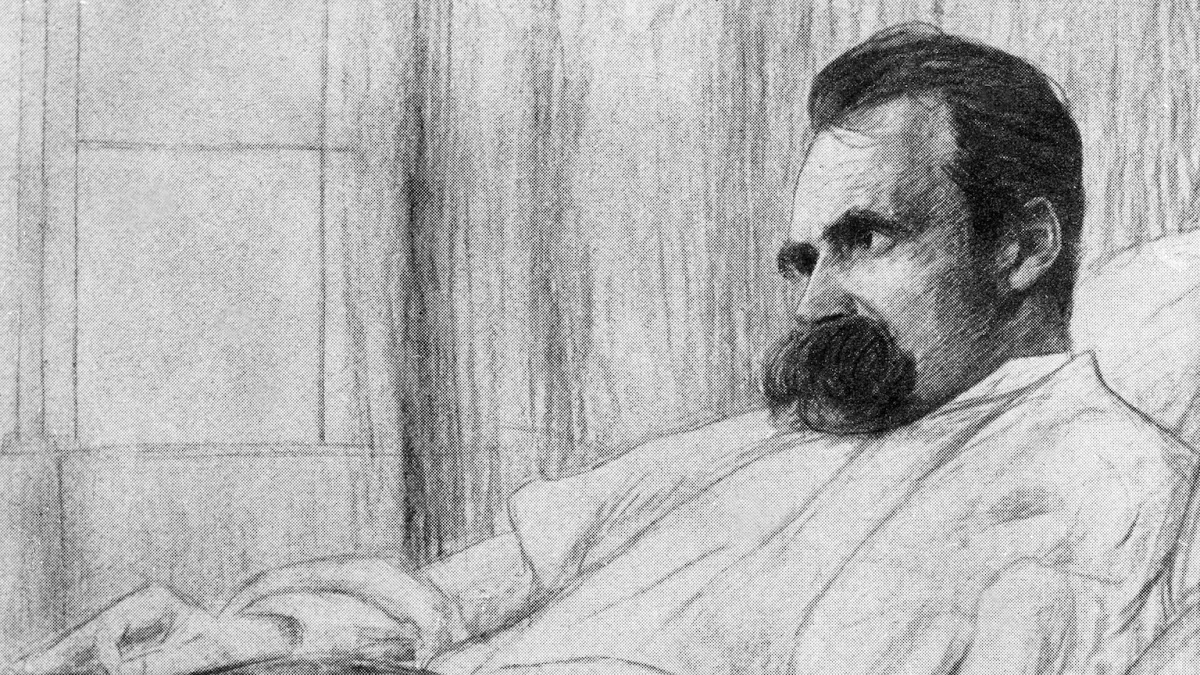
Friedrich Nietzsche (1844–1900)
Friedrich Nietzsche (1844–1900) was a German philosopher and philologist whose work radically challenged traditional Western metaphysics, religion, and morality. Centered on life-affirmation, his philosophy seeks to dismantle dogmatic value systems and address the existential vacuum created by the decline of religious belief.[1] Key themes include the "Death of God", Nihilism, the Will to Power, the Übermensch, Master-Slave Morality, Perspectivism, and Amor Fati.
1. The "Death of God" and the Threat of Nihilism
Nietzsche's famous pronouncement, "God is dead" (Gott ist tot), first introduced in The Gay Science (§125) and expanded in Thus Spoke Zarathustra, is a cultural diagnosis of Western civilization rather than a simple declaration of atheism.[1:1]
- Collapse of Transcendent Meaning: Nietzsche observed that secularization and scientific progress had eroded the foundation of Christian metaphysics. Without God as an objective grounding, the entirety of Western morality, truth, and purpose loses its ultimate justification.[1:2]
- The Crisis of Nihilism: The "Death of God" threatens humanity with nihilism—the belief that life lacks inherent meaning, purpose, or intrinsic value.[2]
- Passive vs. Active Nihilism:
- Passive Nihilism: A pessimistic resignation and retreat from life in response to the loss of universal values.[2:1]
- Active Nihilism: The destructive, necessary dismantling of old, false values to make way for new, life-affirming ones created by the individual.[2:2]
2. The Will to Power (Wille zur Macht)
Nietzsche proposed the Will to Power as the fundamental psychological drive governing human behavior, organic life, and the dynamics of existence.[3]
- Beyond Survival and Pleasure: Rejecting Arthur Schopenhauer's passive "will to live" and the Utilitarian pursuit of pleasure, Nietzsche argued that living entities fundamentally seek to expend energy, overcome obstacles, dominate challenges, and achieve self-mastery.[3:1]
- Psychological Sublimation: Drives such as artistic creation, intellectual inquiry, and self-discipline are viewed as sublimated expressions of the Will to Power.[3:2]
- Cosmological Interpretation: In his unpublished notes (Nachlass), Nietzsche tentatively framed the Will to Power as an overarching cosmological principle describing all force and change in nature.[1:3]
3. The Übermensch (The Overman) vs. The Last Man
To resolve the crisis of nihilism, Nietzsche introduced the visionary archetype of the Übermensch (often translated as the Overman or Superman) in Thus Spoke Zarathustra.[1:4]
- Self-Overcoming: The Übermensch is an individual who transcends inherited cultural and moral doctrines, exercises self-discipline, and invents their own autonomous values.[1:5]
- Earthly Affirmation: Unlike traditional religious ideals that focus on an afterlife, the Übermensch remains loyal to the earth and physical existence.[1:6]
- The "Last Man" (der letzte Mensch): The direct antithesis of the Übermensch. The Last Man represents the complacent, risk-averse individual of modern society who prioritizes safety, comfort, equality, and uncritical happiness over personal greatness and struggle.[1:7]
Although later distorted by 20th-century political movements (largely due to unauthorized edits by his sister, Elisabeth Förster-Nietzsche), Nietzsche conceived the Übermensch as a psychological, spiritual, and individual achievement of self-realization, not a political or biological hierarchy.[3:3]
4. Critique of Morality: Master vs. Slave Morality
In On the Genealogy of Morality and Beyond Good and Evil, Nietzsche undertook a historical and psychological critique of moral systems.[3:4][4]
-
Master Morality (Herrenmoral):
-
Developed by ancient ruling elites (e.g., classical Greece and Rome).[3:5]
-
Evaluates actions on a scale of Good vs. Bad.[4:1]
-
"Good" represents strength, beauty, nobility, pride, and self-assertion. "Bad" merely signifies weakness, cowardice, and insignificance.[3:6]
-
Slave Morality (Sklavenmoral):
-
Developed out of ressentiment (resentment) felt by the weak and subjugated against the powerful masters.[4:2]
-
Re-evaluates values on a scale of Good vs. Evil.[4:3]
-
Inverts master values: nobility and power are labeled "Evil," while humility, pity, selflessness, and meekness are praised as "Good".[3:7]
-
Revaluation of All Values (Umwertung aller Werte): Nietzsche called for a radical reassessment of Christian-Platonic moral frameworks, arguing that slave morality promotes psychological sickness by repressing vital human instincts.[3:8][4:4]
5. Epistemology: Perspectivism
Nietzsche rejected the Enlightenment notion of objective truth or a disinterested "view from nowhere".[1:8][3:9]
- Interpretative Knowledge: All perception and knowledge are conditioned by specific perspectives, biological drives, cultural contexts, and historical forces.[3:10]
- Rejection of Metaphysical Dogma: There are no unmediated facts, only interpretations.[1:9]
- Plurality of Perspectives: Achieving greater understanding does not mean finding a single objective truth, but rather synthesizing multiple perspectives to gain a richer conceptual grasp of reality.[3:11]
6. Life-Affirmation: Eternal Recurrence & Amor Fati
Nietzsche sought a framework for total affirmation of life, including its inherent suffering and tragedy.[1:10][4:5]
Eternal Recurrence (Ewige Wiederkunft)
A psychological thought experiment introduced in The Gay Science: Imagine a demon telling you that you must live your life over and over again infinitely, down to every joy and every agony, in the exact same sequence.[1:11]
- The Ultimate Weight: Would this thought crush you, or would it lead you to rejoice?[1:12]
- The Imperative: Nietzsche used this to test whether one lives a life of genuine affirmation and authenticity.[4:6]
Amor Fati (Love of Fate)
- Embracing Reality: The willingness to accept every aspect of one's life—both triumph and tragedy—as necessary components of existence.[1:13]
- Active Love: Moving beyond mere tolerance of adversity to actively loving one's fate as the raw material for personal growth and artistic self-creation.[4:7]
7. Aesthetic Philosophy: Apollonian vs. Dionysian
In his early work The Birth of Tragedy (1872), Nietzsche analyzed Greek culture through two opposing aesthetic forces:[1:14][2:3]
| Force | Symbolism | Characteristics |
|---|---|---|
| Apollonian | Apollo (God of Light & Sun) | Order, logic, form, measure, clarity, individual identity |
| Dionysian | Dionysus (God of Wine & Ecstasy) | Chaos, passion, instinct, intoxication, dissolution of the self |
- Synthesis in Tragic Art: Nietzsche argued that Attic tragedy achieved cultural greatness by synthesizing the chaotic, instinctual energy of the Dionysian with the clarifying form of the Apollonian.[2:4]
Overview of Key Works
| Title | Year | Central Focus |
|---|---|---|
| The Birth of Tragedy | 1872 | Apollonian/Dionysian dualism, critique of Socratic rationality.[2:5] |
| The Gay Science | 1882 | Announcement of the "Death of God", Eternal Recurrence.[1:15] |
| Thus Spoke Zarathustra | 1883–1885 | The Übermensch, the Last Man, Will to Power, life-affirmation.[1:16] |
| Beyond Good and Evil | 1886 | Critique of past philosophers, Perspectivism, Master-Slave morality.[3:12] |
| On the Genealogy of Morality | 1887 | Historical/psychological origins of guilt, asceticism, and moral values.[4:8] |
Resonant Notes
Strong Resonance — Direct Nietzschean Themes
-
Schopenhauerian Pessimism — Nietzsche's philosophical foil. Where Schopenhauer posited a blind, aimless Will driving endless suffering, Nietzsche reimagined this as the Will to Power — an active, creative, life-affirming force. Nietzsche's entire project can be read as an attempt to overcome Schopenhauer's pessimism without retreating into religious or metaphysical consolation.
-
Jean-Paul Sartre — Sartre's existentialism inherits Nietzsche's "Death of God" and the radical freedom it entails. Sartre's claim that "existence precedes essence" echoes Nietzsche's rejection of fixed human nature, while his concept of radical responsibility parallels Nietzsche's imperative to create one's own values in the absence of transcendent meaning.
-
Søren Kierkegaard — Both Kierkegaard and Nietzsche were fierce critics of Hegelian systematic philosophy and the complacency of Christendom. Kierkegaard's "leap of faith" and Nietzsche's Übermensch both represent individual responses to the crisis of meaning — though they arrive at radically different conclusions (faith vs. self-overcoming).
-
Fyodor Dostoevsky (1821 - 1881) — Dostoevsky's novels dramatize the very nihilism Nietzsche diagnosed. Raskolnikov's attempt to become an "extraordinary man" beyond good and evil, and Ivan Karamazov's rebellion against God, are literary explorations of Nietzschean themes — though Dostoevsky ultimately recoils into Christian existentialism where Nietzsche pushes forward into life-affirmation.
-
Franz Kafka — Kafka's Kafkaesque condition — where rational attempts to navigate an irrational system accelerate one's own subjugation — resonates with Nietzsche's critique of modern bureaucratic society as producing the "Last Man." Both writers diagnose the soul-crushing effects of impersonal systems on individual agency.
-
Norman Mailer — Mailer's American existentialism and his division of society into Hipsters vs. Squares is a direct literary application of Nietzsche's master-slave morality. The Hipster, like the Übermensch, rejects conventional morality, embraces risk and primal energy, and creates his own values in a world stripped of transcendent meaning.
Structural & Thematic Resonance
-
Goethe's Faust — Goethe's concept of Streben (perpetual striving) as the mechanism of salvation directly anticipates Nietzsche's Will to Power. Faust's relentless drive to push beyond boundaries, experience everything, and create meaning through action is the literary prototype of the Nietzschean life-affirming individual.
-
Viktor Frankl — Frankl's Tragic Optimism — the capacity to find meaning despite pain, guilt, and death — offers a practical, therapeutic response to the nihilism Nietzsche diagnosed. Where Nietzsche prescribed Amor Fati (love of fate), Frankl developed logotherapy as a clinical method for achieving the same life-affirmation.
-
Sigmund Freud (1856–1939) — Freud's drive theory (Eros vs. Thanatos) parallels Nietzsche's Will to Power as a fundamental psychological force. Nietzsche's concept of sublimation — where artistic and intellectual drives are expressions of the Will to Power — directly anticipates Freudian sublimation. Nietzsche's critique of repression in slave morality also resonates with Freud's civilizational discontents.
-
John Updike — Updike's Protestant existentialism — where religion serves as a "defense against nothingness" — grapples with the same post-Nietzschean crisis of meaning. His protagonists inhabit a world where God is dead but the longing for transcendence persists, echoing Nietzsche's diagnosis of the modern condition.
-
Woody Allen — Allen's films repeatedly explore Nietzschean themes: the absence of cosmic justice (Crimes and Misdemeanors, Match Point), morality as a human construct, and the existential comedy of living in a godless universe. His characters embody the tension between the desire for meaning and the recognition of life's absurdity.
-
Continental Philosophy — Nietzsche is a foundational figure in the Continental tradition. His critiques of Enlightenment rationalism, systematic philosophy, and objective truth paved the way for hermeneutics, post-structuralism, and critical theory. This note contextualizes Nietzsche within the broader Continental lineage.
Broader Resonance
-
Theory of the Subject - Jacques Lacan — Lacan's Master's Discourse — where authority and command hide the division of the subject — resonates with Nietzsche's critique of how moral systems conceal the will to power behind claims of universality and truth.
-
Northrop Frye's Fearful Symmetry - A Study of William Blake — Blake's Ulro — a spiritual wasteland of pure materialism and cold abstraction — parallels Nietzsche's critique of Socratic rationalism and the life-denying effects of reducing existence to mere physical laws.
-
Transdisciplinary Analysis of Epistemological Illusion, Cognitive Defense, and Neural Architecture — Terror Management Theory's account of how humans construct cultural worldviews to buffer against mortality salience provides a psychological framework for understanding Nietzsche's diagnosis of how religious and metaphysical systems function as existential defenses.
-
William James and the Landscape of Eastern Thought — James's Radical Empiricism and concept of Pure Experience resonate with Nietzsche's Perspectivism — both reject the notion of a single objective reality and emphasize the primacy of lived, interpreted experience over abstract metaphysical claims.
-
Dethroning the Ego - Rael’s Journey Through the Subterranean Mythos of Genesis — The narrative arc of ego dissolution and heroic self-overcoming in Genesis's concept album mirrors Nietzsche's call to transcend the self and create new values through struggle and transformation.
References
Robert Wicks / Nietzsche's Life and Works / Stanford Encyclopedia of Philosophy ↩︎ ↩︎ ↩︎ ↩︎ ↩︎ ↩︎ ↩︎ ↩︎ ↩︎ ↩︎ ↩︎ ↩︎ ↩︎ ↩︎ ↩︎ ↩︎ ↩︎
Dale Wilkerson / Friedrich Nietzsche / Internet Encyclopedia of Philosophy ↩︎ ↩︎ ↩︎ ↩︎ ↩︎ ↩︎
Brian Leiter / Nietzsche's Moral and Political Philosophy / Stanford Encyclopedia of Philosophy ↩︎ ↩︎ ↩︎ ↩︎ ↩︎ ↩︎ ↩︎ ↩︎ ↩︎ ↩︎ ↩︎ ↩︎ ↩︎
Andrew Fiala / Nietzsche's Ethics / Internet Encyclopedia of Philosophy ↩︎ ↩︎ ↩︎ ↩︎ ↩︎ ↩︎ ↩︎ ↩︎ ↩︎