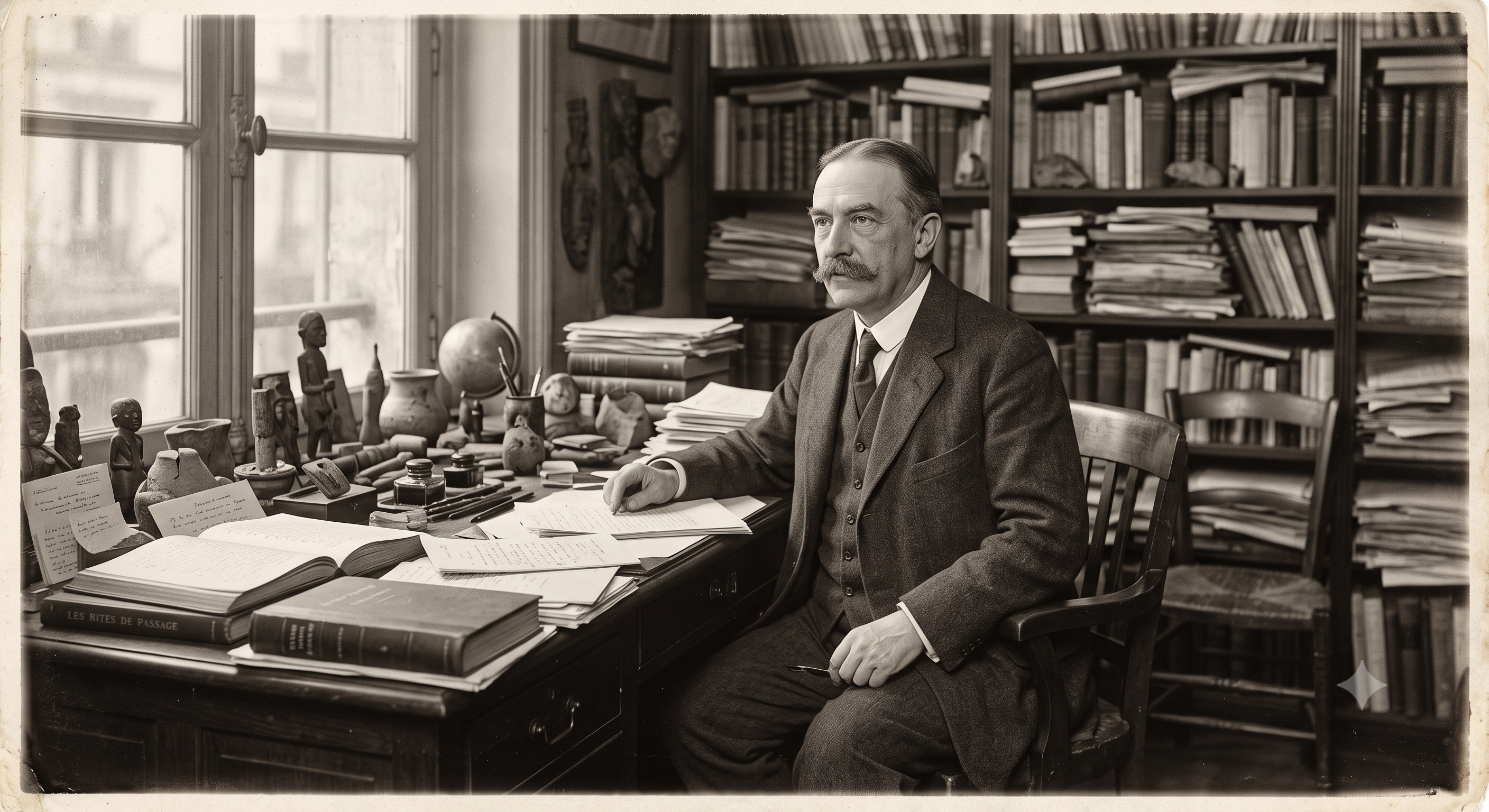
Arnold van Gennep (1873–1957)
Arnold van Gennep (1873–1957) was a pioneering French ethnographer and folklorist who introduced the foundational concept of the Rite of Passage (rite de passage). In his seminal 1909 work, Les Rites de Passage, he identified a universal tripartite structure—Separation, Transition (Liminality), and Incorporation—that governs human transitions across social, biological, and temporal boundaries. Historically marginalized by the dominant French sociological establishment of Émile Durkheim, Van Gennep's processual framework was later revived, profoundly shaping symbolic anthropology, psychology, and modern trauma theory.
Biographical Context and the "Maverick" Ethnographer
-
An International Pedigree: Charles-Arnold Kurr van Gennep was born in 1873 in Ludwigsburg, Germany, to a Dutch father and a French mother. This multicultural, transitional upbringing fostered a natural# linguistic genius; by his own account, he mastered eighteen languages and numerous dialects, enabling him to conduct incredibly broad comparative ethnographical analyses.
-
The Academic Outsider: Despite his immense erudition, Van Gennep spent most of his life outside the French university system. He held only one brief academic post as Chair of Ethnography at the University of Neuchâtel in Switzerland (1912–1915). Instead, he earned his living as a translator (including translating James George Frazer's works), a civil servant at the French Ministry of Agriculture, and a book reviewer.
-
Folklore as a Living Science: Unlike 19th-century European scholars who viewed folklore as dead "relics of the past," Van Gennep treated folklore as "living facts" within dynamic, evolving societies. He spent his later years exhaustively documenting rural French culture, establishing folklore as a rigorous, systematic science.
The Tripartite Structure of Rites of Passage
In his 1909 masterwork, Les Rites de Passage, Van Gennep argued that human life is a succession of transitions from one group, status, or age to another. To manage these transitions without causing social disruption or psychological trauma, all human societies utilize a specific ceremonial architecture comprising three distinct phases:
      [ Separation ]          [ Transition ]          [ Incorporation ]
      (Pre-Liminal)              (Liminal)              (Post-Liminal)
            │                        │                        │
            ▼                        ▼                        ▼
      Severing ties with ───► Crossing the ───► Re-entering society
       the old status           "threshold"             with a new identity
| Phase | Original French Term | Phase Type | Purpose and Symbolic Action |
|---|---|---|---|
| Separation | Rites de séparation | Pre-liminal | Detaches the individual from their former social status. Often involves symbolic death (e.g., physical isolation, shaving heads, discarding old clothes). |
| Transition | Rites de transition | Liminal | The "threshold" stage. The initiate is "betwixt and between" states—no longer what they were, but not yet what they will become. Subject to trial, instruction, and vulnerability. |
| Incorporation | Rites d'incorporation | Post-liminal | Re-integrates the individual back into the social group with their newly achieved status. Celebrated through community feasts, ritual gifts, and public recognition. |
Van Gennep rejected the absolute dichotomy between the "sacred" and the "profane" popularized by Émile Durkheim. He argued instead for the "pivoting of the sacred"—the idea that sacrality is mobile, relational, and temporary, activated specifically to guide individuals safely through the dangerous transitions between different social and cosmic spaces.
The Concept of Liminality & Spatial Metaphors
Van Gennep was highly attuned to how physical space represents social transitions. He coined the term liminality from the Latin word limen, meaning "threshold".
-
The Neutral Zone: Van Gennep observed that physical borders—such as those between countries, villages, or even the threshold of a house—act as neutral, dangerous zones. Passing over a physical threshold requires rites of passage (such as knocking, wiping feet, or exchanging gifts) to neutralize the spiritual danger of crossing a boundary.
-
The Living Clay: In the liminal phase, the initiate is symbolically stripped of rank, gender, or social attributes. They exist outside the social structure, acting as "soft clay" ready to be reshaped by the community's elders.
The Conflict with Durkheim and the French School
Van Gennep's intellectual isolation in France stemmed from a deep-seated theoretical and personal rivalry with Émile Durkheim and his chief lieutenant (and nephew) Marcel Mauss.
-
Structure vs. Process: Durkheim’s school focused on social stability and the static, absolute power of collective institutions over the individual. Van Gennep was intensely interested in social movement—the dynamic processes of change, regeneration, and personal transformation.
-
The Agency of the Individual: Durkheim posited that individuals are fundamentally subordinated to the collective conscience. Van Gennep argued that human society is composed of individual forces, and even in "primitive" societies, individuals possess the creative agency to reshape and modify the collective culture.
-
The Totemism Debate: Van Gennep publicly sparred with Mauss and Durkheim on the origins of religion, arguing that totemism was a pragmatic social tool for cohesion rather than a manifestation of a primordial religious intellect.
Consequently, the Année Sociologique (the powerful journal run by the Durkheim school) gave Les Rites de Passage highly critical reviews, blackballing Van Gennep from French academia.
Legacy and Modern Applications
Although ignored during his lifetime, Van Gennep's work underwent a massive renaissance in the 1960s after its English translation. Today, his framework extends far beyond classical anthropology:
-
Victor Turner and Symbolic Anthropology: Turner adopted Van Gennep’s liminal phase, expanding it into a sweeping theory of communitas (the unstructured community of equals in a liminal state) and the "liminoid" spaces of modern art, theater, and play.
-
The "Stuck Liminality" of Trauma: Modern clinical psychologists use Van Gennep's model to treat Post-Traumatic Stress Disorder (PTSD) and life-stage crises. Trauma is increasingly understood as an involuntary separation that hurls an individual into a state of chaos (liminality) without the stabilizing, community-guided third step of Incorporation. Without proper ritual containers, individuals remain "stuck" in a perpetual, high-arousal liminal state.
-
Narrative Theory: His tripartite structure directly informed Joseph Campbell's Hero's Journey (Departure, Initiation, Return), which is structurally identical to Separation, Transition, and Incorporation.
References
Would you like to explore how Victor Turner expanded Van Gennep's theory into his famous concept of communitas and "liminoid" spaces in modern society, or should we examine how modern therapists apply this tripartite structure to treat developmental trauma and PTSD?