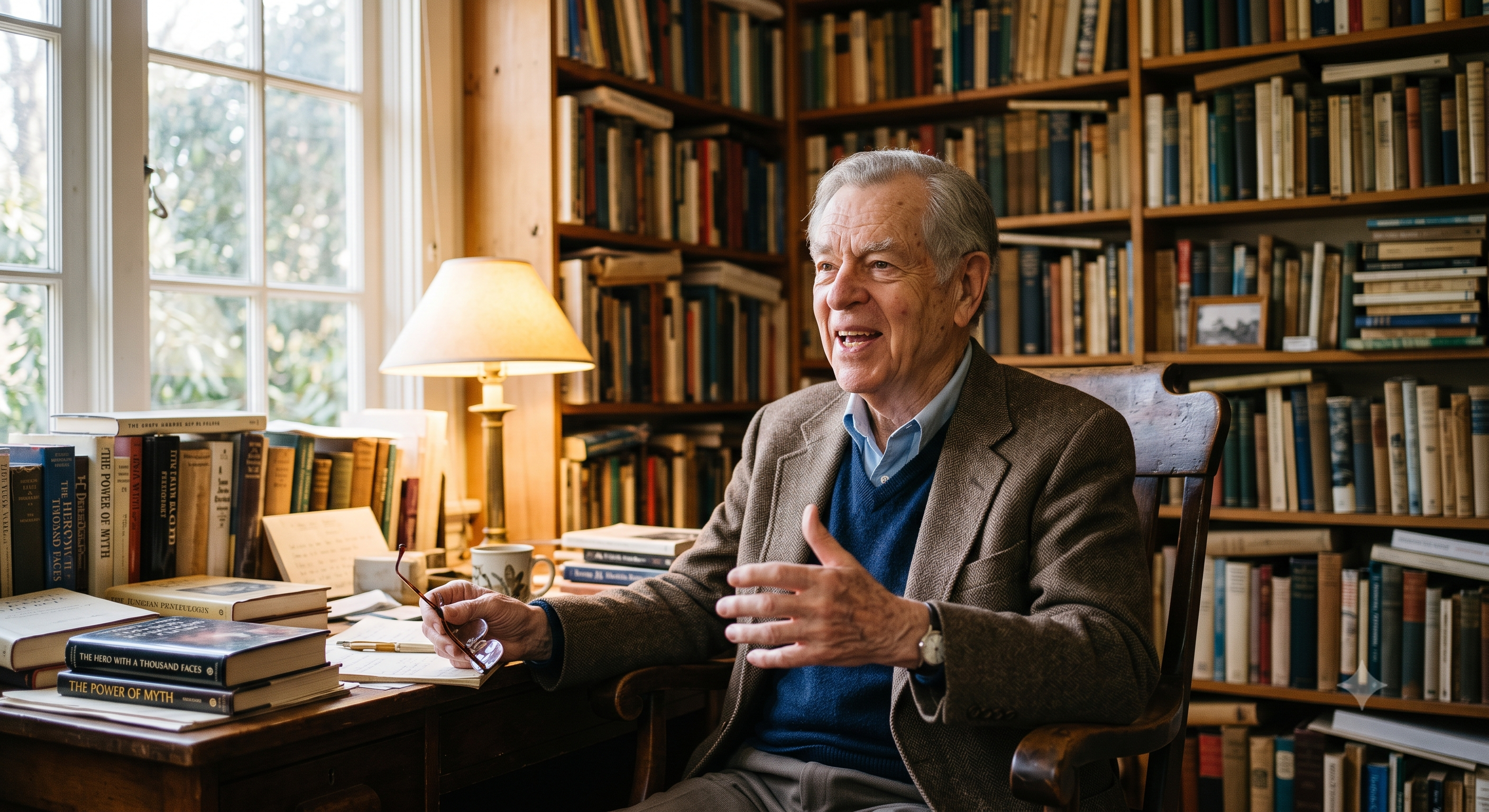
Joseph Campbell and the Hero's Journey
The Monomyth, or the Hero's Journey, is a universal narrative framework identified by comparative mythologist Joseph Campbell. First articulated in his 1949 text, The Hero with a Thousand Faces, the framework argues that all mythic narratives across cultures and eras share a fundamental psychological and structural template divided into three primary movements: Departure, Initiation, and Return.[1]
Origins and Psychological Foundation
Joseph Campbell was an American literature professor and mythologist whose work consolidated comparative religion and cross-cultural folklore into a unified structural model.[2] Published in 1949, The Hero with a Thousand Faces asserts that global myths are not merely disparate cultural artifacts but expressions of a shared human psyche.[1:1]
Campbell built his framework by synthesizing concepts from several prominent early-20th-century theorists:[1:2]
-
Carl Jung: Campbell relied heavily on Jung's theories of the collective unconscious and archetypes (such as the Shadow, the Mentor, and the Trickster), viewing the hero's external adventures as metaphors for internal psychological maturation.[1:3][2:1]
-
Arnold van Gennep: The broad three-act architecture of the Monomyth was adapted directly from Van Gennep’s anthropological study of traditional Rites of Passage, which transitions individuals through stages of Separation, Transition, and Incorporation.[1:4]
Campbell argued that the primary function of myth is pedagogical—to provide a symbolic roadmap that guides individuals through the inevitable, challenging transitions of human life.[3]
The Three Core Acts and the 17 Stages
Campbell's original formulation of the Monomyth breaks down into 17 detailed stages nested within three main acts.[4][2:2] While not every myth contains all 17 steps, the overarching macro-structure remains exceptionally consistent across global folklore.[3:1][2:3]
1. Act I: Departure (Separation)
In this act, the hero is dislodged from their familiar life and forced to step into the unknown.[4:1]
-
The Call to Adventure: An external event or messenger disrupts the hero's ordinary world, presenting a challenge or quest.[4:2][5]
-
Refusal of the Call: Driven by fear, obligation, or insecurity, the hero initially hesitates or resists the journey.[4:3]
-
Supernatural Aid: Once committed, a mentor or protective guide provides advice, wisdom, or a magical artifact to assist them.[4:4][5:1]
-
Crossing the First Threshold: The hero officially steps past the boundaries of their safe, known world into a realm governed by unfamiliar rules and dangers.[4:5][1:5]
-
The Belly of the Whale: The final separation from the old self and world.[4:6] The hero enters a state of symbolic metamorphosis, fully committing to the transformation ahead.[3:2][4:7]
2. Act II: Initiation
This phase takes place entirely within the supernatural or unfamiliar world, where the hero undergoes intense trials to achieve true enlightenment or power.[4:8][1:6]
-
The Road of Trials: A series of tests, obstacles, and combat encounters that challenge and refine the hero's capabilities.[4:9][1:7]
-
The Meeting with the Goddess: The hero encounters a powerful, unconditional love or experiences an encounter with an entity that offers boundless good.[4:10]
-
Woman as the Temptress: The hero faces material or spiritual temptations that threaten to lead them astray from their ultimate goal.[4:11]
-
Atonement with the Father: The emotional or spiritual core of the journey, where the hero must confront and reconcile with the ultimate authority figure (often a literal or symbolic parental power).[3:3][4:12]
-
Apotheosis: A moment of divine realization or ego death.[3:4][1:8] The hero achieves a transcendent state of understanding, shedding fear and gaining supreme insight.[4:13]
-
The Ultimate Boon: The achievement of the quest's objective—the retrieval of an elixir, holy object, or transformative wisdom that can save the hero's community.[4:14][5:2]
3. Act III: Return
The hero must bring the wisdom or treasure back to the ordinary world to integrate it for the benefit of humanity.[3:5][1:9]
-
Refusal of the Return: Having tasted the enlightenment of the supernatural realm, the hero may feel reluctant to return to the mundane world.[4:15]
-
The Magic Flight: If the ultimate boon was won through theft or trickery, the hero must flee a dangerous pursuit to make it home safely.[3:6][5:3]
-
Rescue from Without: Just as the hero needed guides to leave, they may require external assistance from the ordinary world to bring them back across the threshold.[4:16][5:4]
-
Crossing the Return Threshold: The hero journeys back across the boundary into everyday reality, facing the challenge of preserving their internal transformation while living in a mundane environment.[4:17][5:5]
-
Master of the Two Worlds: The hero successfully integrates their spiritual insights with their physical reality, moving seamlessly between the sacred and the ordinary.[4:18]
-
Freedom to Live: By conquering fear and reconciling the dualities of existence, the hero achieves a state of grace, allowing them to live fully in the present moment.[4:19]
Modern Variations and Screenwriting
While Campbell's text was strictly academic, it fundamentally transformed modern commercial storytelling in the late-20th and 21st centuries.[2:4]
In the 1980s, Hollywood screenwriter and development executive Christopher Vogler drafted an internal memo analyzing screenplays through Campbell's work.[2:5] This was later expanded into his book, The Writer's Journey: Mythic Structure for Writers.[2:6] Vogler streamlined Campbell's 17 stages into 12 practical steps, optimizing the narrative arc to fit seamlessly into the conventional three-act screenplay structure used across the film industry today.[2:7]
The most notable early adopter was George Lucas, who openly credited The Hero with a Thousand Faces as a primary framework for structuring the original Star Wars trilogy.[3:7][2:8] Luke Skywalker's journey from Tatooine farmer to Jedi Knight serves as the quintessential modern case study of Campbell's monomythic architecture.[3:8]
Critiques and Alternative Models
Despite its monumental influence, the Monomyth has faced significant scrutiny from contemporary literary scholars and psychologists:
-
Gender Exclusivity: Critics point out that Campbell's original model is heavily patriarchal, viewing the archetypal hero as inherently male, while female characters are frequently reduced to static archetypes like "The Goddess" or "The Temptress."[4:20]
-
The Heroine's Journey: To address this imbalance, psychotherapist Maureen Murdock published The Heroine's Journey in 1990. Murdock’s model focuses on healing the deep psychological rift between masculine and feminine energies, focusing on internal integration rather than external conquest.
-
Over-Standardization: Literary critics warn that an over-reliance on the Hero's Journey by Hollywood studios has resulted in formulaic, predictable narratives that suppress organic, diverse storytelling structures.[2:9]
References
Would you like me to break down Christopher Vogler's 12-stage Hollywood model step-by-step alongside Campbell's original 17 stages, or should we map out a specific narrative example like Star Wars or The Matrix using this structural framework?
Wikipedia / The Hero with a Thousand Faces / wikipedia.org ↩︎ ↩︎ ↩︎ ↩︎ ↩︎ ↩︎ ↩︎ ↩︎ ↩︎ ↩︎
Beemgee / Hero's Journey – Joseph Campbell's The Hero With A Thousand Faces / beemgee.com ↩︎ ↩︎ ↩︎ ↩︎ ↩︎ ↩︎ ↩︎ ↩︎ ↩︎ ↩︎
Joseph Campbell Foundation / Joseph Campbell and the Hero's Journey / jcf.org ↩︎ ↩︎ ↩︎ ↩︎ ↩︎ ↩︎ ↩︎ ↩︎ ↩︎
Heroine Journeys / Joseph Campbell's Hero's Journey Arc / heroinejourneys.com ↩︎ ↩︎ ↩︎ ↩︎ ↩︎ ↩︎ ↩︎ ↩︎ ↩︎ ↩︎ ↩︎ ↩︎ ↩︎ ↩︎ ↩︎ ↩︎ ↩︎ ↩︎ ↩︎ ↩︎ ↩︎
ORIAS - UC Berkeley / Monomyth: Hero's Journey Project / orias.berkeley.edu ↩︎ ↩︎ ↩︎ ↩︎ ↩︎ ↩︎