🌿Projects vs Operations in Project Management - Key Differences and Examples
🌿Project Management Lifecycles and Gate Deliverables
🌿Project Risk Management - A Comprehensive Guide to Identifying and Managing Project Threats
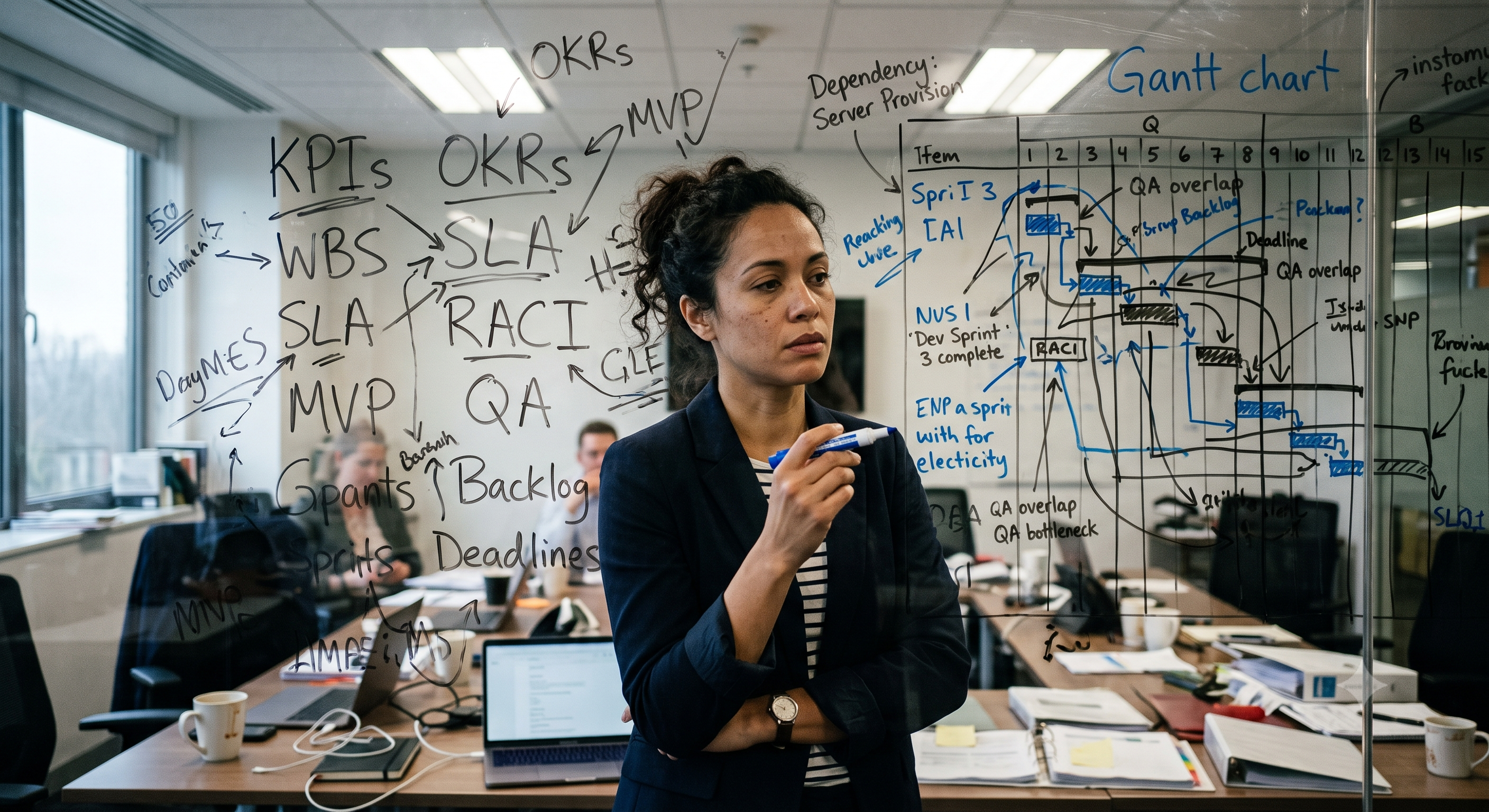
The Ultimate Project Management Jargon Lexicon
Project management is notorious for its dense acronyms, framework-specific terminology, and performance metrics. This reference guide compiles and clarifies the most vital project management jargon—ranging from classical Waterfall baselines to modern Agile concepts and quantitative Earned Value Management formulas—structured for rapid lookup and direct import into your Obsidian vault.
View Business English Lesson on StudyESL.ca
1. Core Frameworks & Methodologies
Project management is built upon distinct execution methodologies. Misaligning these terms often leads to strategic friction.
Agile
An iterative, incremental approach to project management that focuses on continuous feedback, flexibility, and the rapid delivery of functional value.[1] Rather than planning the entire project upfront, Agile projects adapt as new requirements and challenges emerge.
Waterfall
A linear, sequential project lifecycle where each phase (Initiation, Planning, Execution, Monitoring, Closing) must be completed before the next begins.[1:1] It prioritizes highly detailed, upfront documentation and rigid scope baselines.
Scrum
The most widely implemented Agile framework.[2] It relies on a highly structured cadence of short, fixed-duration execution cycles called sprints, managed by cross-functional, self-organizing teams.[2:1]
Kanban
A visual workflow management method designed to limit Work-in-Progress (WIP) and optimize the flow of tasks.[2:2] Tasks are represented as physical or digital cards moving across columns on a Kanban board (typically labeled To Do, In Progress, Testing, and Done).
2. Planning, Scope, & Execution Jargon
These foundational terms define how a project's boundaries are set, tracked, and protected.
Work Breakdown Structure (WBS)
A deliverable-oriented, hierarchical decomposition of the total scope of work to be executed by the project team.[1:2] The WBS breaks down the overall project into manageable, discrete chunks called work packages.[3]
Critical Path Method (CPM)
The sequence of dependent tasks that determines the absolute minimum duration of a project.[1:3] Any delay to a task on the critical path directly pushes out the project completion date.
Scope Creep
The uncontrolled expansion of project scope without corresponding adjustments to time, cost, or resources.[4] It is typically caused by poor initial requirement gathering, loose change-management procedures, or "gold plating" (adding unrequested features).
RACI Matrix
A responsibility assignment matrix used to clarify individual roles across project tasks.[1:4] RACI is an acronym for:
-
Responsible: The person who does the actual work to complete the task.
-
Accountable: The person with final decision-making authority and ownership of the outcome (only one person can be accountable per task).
-
Consulted: Subject matter experts who provide input before the task is finalized.
-
Informed: Stakeholders who must be kept up-to-date on progress or decisions.
Baseline
The approved, frozen reference version of the project's schedule, budget, or scope.[4:1] It is used as the yardstick to measure and compare actual performance over time.
3. Agile & Scrum-Specific Terminology
Agile and Scrum teams rely heavily on a distinct dialect of collaborative, fast-paced terms.
Sprint (or Iteration)
A fixed-duration period (usually 2 to 4 weeks) during which a dedicated team commits to completing a specific set of deliverables.[2:3]
User Story
A simplified, customer-centric description of a feature or requirement.[2:4] User stories are typically written from the perspective of the end-user:
"As a [user role], I want to [action], so that [benefit]."
Product Backlog vs. Sprint Backlog
-
Product Backlog: A prioritized, living list of all features, requirements, bugs, and enhancements required for the product.[2:5]
-
Sprint Backlog: A subset of items selected from the Product Backlog that the team commits to delivering during the current sprint.[2:6]
Velocity
An Agile metric measuring the amount of work (usually measured in story points) a development team successfully completes during a single sprint.[5] It helps predict future sprint capacity and timelines.
Daily Standup (or Daily Scrum)
A brief, daily synchronization meeting (typically limited to 15 minutes) where team members discuss progress, goals for the day, and immediate blockers.[2:7]
4. Performance, Metrics, & Financials (EVM)
In professional project management (specifically under the PMI/PMBOK standards), quantitative tracking relies on Earned Value Management (EVM).[6]
Core Inputs
-
Planned Value (PV): The authorized budget assigned to work scheduled to be completed by a specific date.[3:1]
-
Actual Cost (AC): The total realized cost incurred for the work performed during a specific period.[3:2]
-
Earned Value (EV): The measure of work actually completed, expressed in terms of the budget authorized for that work.[3:3]
EVM Formulas
To calculate performance variances and indexes, project managers utilize the following mathematical models:
-
Cost Variance (CV): Evaluates if a project is over or under budget.
InfoA positive
indicates the project is under budget, while a negative indicates it is over budget. -
Schedule Variance (SV): Evaluates if a project is ahead of or behind schedule.
InfoA positive
indicates the project is ahead of schedule, while a negative indicates it is behind schedule. -
Cost Performance Index (CPI): A measure of the financial efficiency of the project.
-
Schedule Performance Index (SPI): A measure of schedule efficiency.
Float (or Slack)
The total amount of time an individual activity can be delayed without delaying the overall project completion date (Total Float), or without delaying any subsequent successor activities (Free Float).[2:8]
5. Risk & Change Management
Managing unpredictability and steering mid-project changes requires strict governance protocols.
Change Control Board (CCB)
A formally chartered group of key stakeholders responsible for reviewing, evaluating, approving, delaying, or rejecting proposed modifications to the project's baseline.[3:4]
RAID Log
A critical management document used to identify, monitor, and mitigate execution hurdles.[4:2] RAID stands for:
-
Risks: Uncertain future events that could have a negative or positive impact.
-
Assumptions: Factors accepted as true or certain for planning purposes, without proof.
-
Issues: Current problems that are actively impacting the project.
-
Dependencies: Relationships or sequencing requirements between tasks.
Reserves: Contingency vs. Management
-
Contingency Reserve: Budget or time allocated for identified risks that have been formally logged ("known-unknowns").[4:3] This reserve is managed directly by the Project Manager.
-
Management Reserve: Budget or time set aside for completely unforeseen events ("unknown-unknowns").[4:4] Accessing this requires approval from senior leadership or a sponsor, as it is not part of the project's performance baseline.
6. Project Management Acronyms Cheat Sheet
| Acronym | Stands For | Core Purpose |
|---|---|---|
| PMBOK | Project Management Body of Knowledge | Global guide and standard terminology set by PMI.[1:5] |
| PMP | Project Management Professional | The gold-standard professional certification for project managers.[1:6] |
| SOW | Statement of Work | A legally binding document describing work deliverables, timelines, and requirements.[1:7] |
| KPI | Key Performance Indicator | A quantifiable metric used to measure success against project goals. |
| PERT | Program Evaluation Review Technique | A statistical tool used to analyze and represent the tasks involved in completing a project.[1:8] |
| WBS | Work Breakdown Structure | Hierarchical decomposition of project scope.[1:9] |
| WIP | Work in Progress | The number of active tasks currently being worked on simultaneously. |
References
Asana / Project Management Terms: 44 Key Definitions for Teams [2025] / Asana Resources ↩︎ ↩︎ ↩︎ ↩︎ ↩︎ ↩︎ ↩︎ ↩︎ ↩︎ ↩︎
Berkeley IT / PM Glossary / Berkeley IT Technical Project Office ↩︎ ↩︎ ↩︎ ↩︎ ↩︎ ↩︎ ↩︎ ↩︎ ↩︎
Project Management Institute / PMI Lexicon of Project Management Terms / PMI Lexicon ↩︎ ↩︎ ↩︎ ↩︎ ↩︎
PM4DEV / Project Management Glossary of Terms / PM4DEV Glossary ↩︎ ↩︎ ↩︎ ↩︎ ↩︎
Monday.com / Project management body of knowledge (PMBOK): guide for teams in 2026 / Monday Blog ↩︎
Project Insight / Top 100 Project Management Terms / Project Insight Blog ↩︎