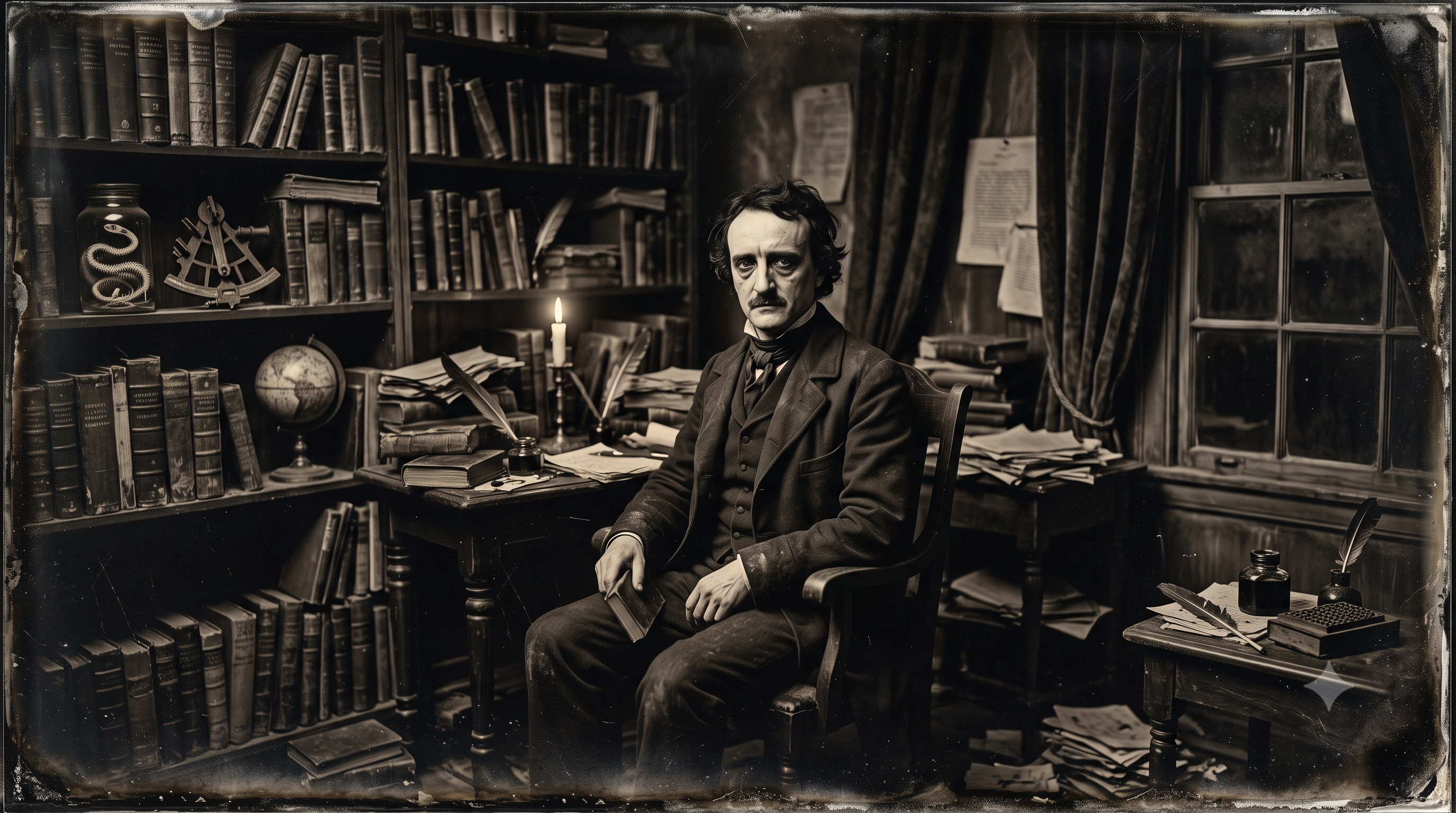
Beyond the Macabre: Edgar Allan Poe's Rationalist Gothic
Edgar Allan Poe (1809–1849) remains one of the most misunderstood figures in American literary history. Often caricatured as a morbid, drug-addled madman due to posthumous character assassination, Poe was in reality a meticulous literary craftsman, a pioneer of the science fiction and detective genres, and an intuitive cosmologist who predicted the mechanics of the Big Bang and solved a centuries-old astronomical paradox.
The Tragedy, the Triumph, and the Griswold Myth
Edgar Poe was born in Boston in 1809 to traveling actors, both of whom passed away or abandoned him before he was three years old.[1] Taken in by John Allan, a wealthy tobacco merchant from Richmond, Virginia, Poe grew up in relative comfort but faced a turbulent, eventually estranged relationship with his foster father.[1:1] After being expelled from West Point and permanently disowned by Allan, Poe turned fully to writing, enduring a lifetime of severe financial instability and personal tragedy, most notably the early death of his young wife and cousin, Virginia Clemm.[1:2]
Poe's tragic life ended under bizarre, unexplained circumstances when he was found delirious, wearing clothes that did not belong to him, in a Baltimore tavern on October 3, 1849. He died in the hospital four days later.[2]
Following Poe's death, his bitter literary rival, Reverend Rufus Wilmot Griswold, wrote a scathing, highly publicized obituary under the pseudonym "Ludwig".[3] Griswold became the literary executor of Poe's estate and published a highly distorted biography ("Memoir of the Author"). To paint Poe as a depraved, drunk, drug-addled lunatic, Griswold forged letters and fabricated stories.[4] Ironically, this lurid character assassination only heightened the public's fascination with Poe, cementing his legendary status as the tragic romantic outcast.
The Inventor of the Detective Genre: Ratiocination
While Poe is primarily remembered for horror, his most significant structural contribution to literature was the invention of detective fiction.[1:3] Before Poe, literature had mysteries, but it lacked the formal methodology of a detective dissecting clues.
With the publication of "The Murders in the Rue Morgue" in 1841, Poe introduced the world to C. Auguste Dupin.[1:4] Poe termed his intellectual process ratiocination—the application of rigorous analytical logic, psychological empathy, and mathematical deduction to solve crimes.
The Blueprints of Sherlock Holmes
Poe's Dupin stories set the foundational tropes of the entire mystery genre:
- The eccentric, hyper-observant amateur detective who outshines local police forces.
- The loyal, average-intelligence sidekick narrator who serves as the audience surrogate (the precursor to Dr. Watson).
- The "locked-room" puzzle where an impossible crime seems to have no physical solution.
- The psychological twist, where the solution relies on understanding the mental state of the perpetrator rather than physical evidence alone.
The Architecture of Gothic Horror: Unity of Effect
Poe rejected the rambling, disorganized Victorian novels of his contemporaries, arguing that every word in a piece of fiction must serve a single, premeditated emotional goal. He outlined this theory in his famous 1846 essay, "The Philosophy of Composition".[1:5]
"If his very initial sentence tend not to the outbringing of this effect, then he has failed in his first step. In the whole composition there should be no word written, of which the tendency, direct or indirect, is not to the one pre-established design."
The Psychology of Terror vs. Horror
Unlike standard gothic novels that relied on external monsters, haunted castles, and supernatural ghouls, Poe revolutionized horror by internalizing the monster. His stories explored the fragile limits of the human mind:
- The Tell-Tale Heart & The Black Cat: Psychological guilt manifesting as auditory hallucinations and self-sabotaging confessions.
- The Fall of the House of Usher: The physical dissolution of a family home reflecting the mental decay and hysteria of its inhabitants.
- The Premature Burial: Deep-seated phobias of the physical body's vulnerability, capitalizing on 19th-century anxieties of being buried alive.
The Cosmic Poet: Eureka and Scientific Intuition
In 1848, a year before his death, Poe delivered a public lecture that he expanded into his longest non-fiction work, Eureka: A Prose Poem.[5] Poe believed Eureka was his masterpiece, a grand unifying theory of the physical, metaphysical, and spiritual universe. Dedicating the work to naturalist Alexander von Humboldt, Poe explicitly stated that the work should be judged purely as a "Work of Art".[5:1]
Yet, without any scientific training or mathematical modeling, Poe’s creative intuition led him to outline concepts that modern physics would not validate for nearly a century:
1. The Big Bang and the Expanding Universe
Poe postulated that the universe originated from a single, hyper-dense "primordial particle" or singularity. He theorized that a "Divine Volition" caused this particle to shatter and expand outward, dispersing all matter and energy throughout space. He further hypothesized that gravity is the matter's innate desire to return to its original state of unified oneness, predicting an eventual "Big Crunch" where the universe collapses back on itself.[6]
2. Solving Olbers' Paradox
In the 1820s, German astronomer Heinrich Olbers noted a massive logical contradiction: if the universe is infinite and filled with an infinite number of stars, the night sky should be blindingly bright because there would be a star's light at every possible point of sight.
In Eureka, Poe became the first person to offer the correct, modern solution to Olbers' Paradox:[6:1]
"We could comprehend the voids which our telescopes find in countless directions, by supposing the distance of the invisible background so immense that no ray from it has yet been able to reach us at all."[5:2]
Poe realized that because light takes time to travel and the universe has a finite age, the light from the most distant stars simply has not had enough time to reach Earth yet.[6:2]
References
Encyclopedia Virginia / Edgar Allan Poe (1809–1849) / encyclopediavirginia.org ↩︎ ↩︎ ↩︎ ↩︎ ↩︎ ↩︎
Wikipedia / Death of Edgar Allan Poe / en.wikipedia.org ↩︎
Boston Public Library / The Long-simmering Feud Between Edgar Allan Poe and Rufus Griswold / bpl.org ↩︎
Killis Campbell / The Poe-Griswold Controversy / eapoe.org ↩︎
Wikipedia / Eureka: A Prose Poem / en.wikipedia.org ↩︎ ↩︎ ↩︎
Paul Halpern / Edgar Allan Poe's Eureka and the Big Bang / medium.com ↩︎ ↩︎ ↩︎