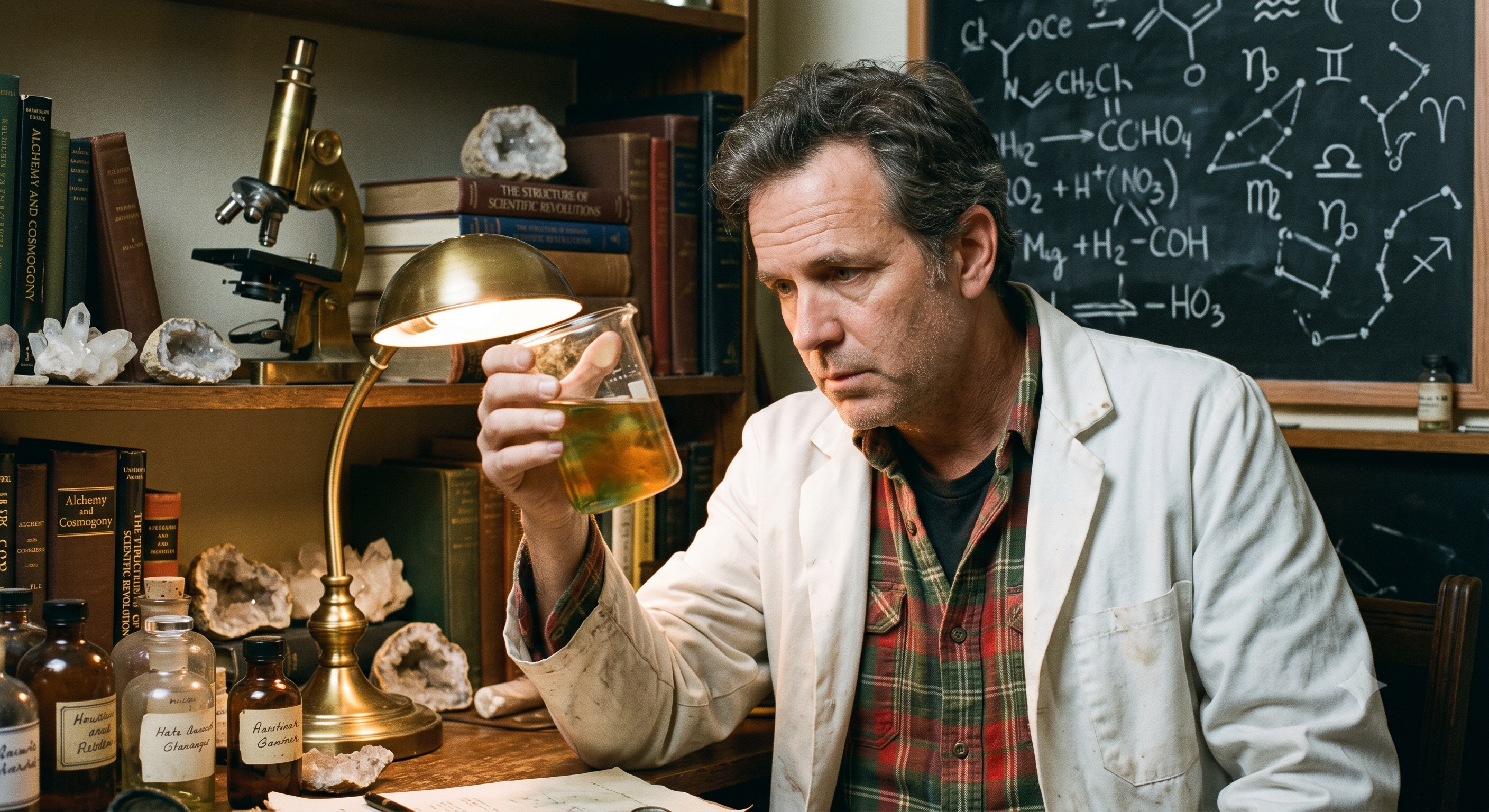
Pseudoscience presents ideas as scientific while completely bypassing the rigorous testing, peer review, and validation of the scientific method. This guide explores how to identify these "science-mimicking" theories, the historical and philosophical "demarcation problem" that defines their boundaries, their psychological appeal, and their real-world impact on public health and society.
Introduction: What is Pseudoscience?
The term pseudoscience—derived from the Greek prefix pseudo- (false) and the Latin scientia (knowledge)—refers to any body of beliefs, practices, or statements that claim to be scientific or factual, but are fundamentally incompatible with the scientific method.[1]
While the Latin word pseudoscientia was utilized as early as the 17th century in debates over religion and empirical research, the English term emerged in 1796 when historian James Pettit Andrews pejoratively described alchemy as a "fantastical pseudo-science."[1:1] Rather than acting as a benign alternative form of inquiry, pseudoscience actively mimics the structural appearance, vocabulary, and authority of genuine science without delivering any of its empirical integrity.[1:2]
While "bad science" consists of honest errors, poor study designs, or accidental miscalculations by legitimate researchers, pseudoscience is structurally distinct. It is organized to protect its core tenets from empirical scrutiny, remaining stagnant in the face of contradictory data.[1:3]
The Demarcation Problem: Drawing the Line
In the philosophy of science, the challenge of defining what is scientific and distinguishing it from non-science or pseudoscience is known as the demarcation problem.[2] Resolving this issue has profound consequences for education, law, and public policy.[1:4]
Karl Popper and Falsifiability
In the 20th century, philosopher Karl Popper proposed a landmark solution: falsifiability.[1:5] Popper argued that scientific theories make "risky predictions" that can, in principle, be proven wrong by empirical observation.[1:6]
For example, the statement "All swans are white" is scientific because it can be falsified by observing a single black swan. In contrast, Popper argued that fields like astrology or psychoanalysis are pseudoscientific because they are constructed so vaguely that any outcome can be explained away after the fact.[2:1]
[Scientific Theory]   ──> Makes Risky Predictions ──> Vulnerable to Falsification ──> Self-Correction
[Pseudoscience]      ──> Makes Vague Claims      ──> Protected by Ad Hoc Loops   ──> Permanent Dogma
The Limits of Pure Falsification
While elegant, strict falsificationism has notable limitations.[2:2] In practice, scientists do not immediately throw out an established theory the moment a single contradictory observation arises.[2:3]
Instead, they might propose temporary ad hoc hypotheses to explain the anomaly. A classic example occurred when irregularities in the orbit of Uranus did not disprove Newtonian physics; rather, they led astronomers to predict and discover the planet Neptune.[2:4]
The Contemporary Multi-Criteria Consensus
Because a single "silver bullet" criterion like falsifiability is sometimes too restrictive, modern philosophers of science, such as Larry Laudan, argue that no single, clean line of demarcation exists.[2:5] Instead, contemporary science relies on multi-criteria frameworks to evaluate whether a field of study is epistemically warranted.[1:7]
Core Characteristics of Pseudoscience
To distinguish pseudoscience from legitimate inquiry, critical thinkers look for specific "red flags." Pseudoscience typically exhibits several of the following hallmarks:
-
Oversimplification and Absolute Certainty: Genuine science is inherently comfortable with uncertainty, expressing findings through statistical probabilities and confidence levels.[3] Pseudoscientists, unburdened by scientific limits, often propose unnatural simplicity with unearned confidence, framing complex physiological systems as simple "tubes" that can be cleared by a universal panacea.[3:1]
-
Scienceploitation: Coined by health law professor Timothy Caulfield, scienceploitation is the practice of borrowing terminology from emerging, high-prestige areas of science (e.g., "quantum," "stem cell," "epigenetics," "microbiome") to market completely unproven treatments.[4] For example, companies market expensive "stem cell pills" for systemic rejuvenation, even though placing active human stem cells in oral capsule form is biologically implausible.[5]
-
Absence of Self-Correction: While genuine scientific consensus evolves as new evidence emerges (such as the historical transition to continental drift theory),[6] pseudoscientific theories remain rigid and immutable over decades or even centuries.[1:8]
-
Built-in Subterfuge & Ad Hoc Hypotheses: Pseudoscience relies heavily on "escape hatches" to dismiss negative results.[6:1] Sven Ove Hansson calls this "built-in subterfuge," where experiments are arranged so that they can only confirm, and never disconfirm, the underlying theory.[1:9]
-
Overreliance on Anecdotes: Legitimate science relies on double-blinded, randomized controlled trials with large sample sizes.[3:2] Pseudoscience relies on testimonials ("I tried it and it cured my chronic pain"), which fail to account for the placebo effect, natural regression to the mean, or selection bias.[6:2]
-
Obfuscating Jargon (Psychobabble): Using dense, highly technical language that sounds impressive but lacks any coherent physical or biological mechanism.[6:3]
Science vs. Pseudoscience: A Direct Comparison
The key operational differences between genuine science and pseudoscience can be organized across six critical axes:[1:10] [3:3] [6:4]
| Operational Axis | Genuine Science | Pseudoscience |
|---|---|---|
| Primary Objective | Explaining the natural world through systematic observation. | Constructing narratives to sell products, push agendas, or reduce anxiety. |
| Approach to Evidence | Actively searches for refutation; values negative results. | Collects handpicked confirming examples; ignores conflicting data. |
| Methodology | Standardized, transparent, and reproducible. | Anecdotal, opaque, and highly subjective. |
| Core Attitude | Skeptical, tentative, and self-correcting. | Dogmatic, immutable, and defensive under scrutiny. |
| Language & Scope | Precise, quantitative, with explicit boundaries. | Vague, hyperbolic, and full of sciency buzzwords. |
| Quality Control | Subject to peer review by independent experts. | Relies on "fake experts" or appeals to ancestral authority. |
The Psychology of Pseudoscience: Why We Believe
To understand how pseudoscience spreads, we must look at the cognitive and evolutionary psychology of the human mind.[7]
Confirmation Bias and Apophenia
Human evolution favored fast, heuristic-based thinking over slow, analytical logic. Our brains evolved to be hyper-active pattern detectors (apophenia), as assuming a rustle in the grass was a predator (a false positive) was far safer than assuming it was just the wind (a false negative). This hardwiring leaves us highly vulnerable to confirmation bias, leading us to remember the one time a psychic's prediction came true while forgetting the dozens of times they were wrong.[1:11]
Cultural Epidemiology & Emotional Anchoring
Pseudoscience also exploits emotional vulnerabilities.[7:1] Facing a severe health diagnosis, the death of a loved one, or societal instability creates deep existential anxiety.[7:2]
Pseudoscientific claims offer absolute certainty, simple explanations, and a feeling of personal agency.[3:4] Through the lens of "cultural epidemiology," ideas that are highly intuitive (or slightly counterintuitive but highly memorable, like astrology) spread easily through social networks, turning into shared cultural identities.[7:3]
Historical and Contemporary Case Studies
┌────────────────────────────────────────────────────────┐
│               EXAMPLES OF PSEUDOSCIENCE                │
├───────────────────┬───────────────────┬────────────────┤
│    Lysenkoism     │    Homeopathy     │ Wellness Pills │
│  (Ideological)    │  (Physical Laws)  │  (Modern Hype) │
└───────────────────┴───────────────────┴────────────────┘
1. Lysenkoism (Ideologically Driven)
Under Trofim Lysenko's direction in the mid-20th century, the Soviet Union rejected Mendelian genetics and Darwinian evolution as bourgeois pseudoscience, replacing them with Lamarckian inheritance theories.[8] This politically enforced scientific doctrine resulted in catastrophic agricultural failures, causing widespread crop loss and contributing directly to severe famines across the USSR.[8:1]
2. Homeopathy (Violation of Physical Laws)
Developed by Samuel Hahnemann in the late 18th century, homeopathy rests on the "law of similars" (like cures like) and the "law of infinitesimals" (diluting a substance increases its potency).[8:2] Many homeopathic solutions are diluted far past Avogadro's limit (
3. Unregulated Wellness Supplements (Modern Scienceploitation)
In the modern wellness economy, companies package basic vitamins or herbs under titles claiming they "activate cellular stem cells" or "rejuvenate mitochondrial pathways."[5:1] By taking advantage of legal loopholes that permit "structure-function" claims (e.g., using words like support or promote rather than cure), brands generate billions in revenue selling products that lack any human clinical trial data.[5:2]
The Real-World Impact
Pseudoscience is not a harmless intellectual eccentricity. It carries severe societal, financial, and physical costs:
-
Public Health Crises: Anti-vaccine activism and the promotion of homeopathic alternatives can cause individuals to delay or completely forgo life-saving medical treatments, leading to preventable outbreaks, severe illness, and death.[1:13]
-
Economic Exploitation: Consumers spend billions of dollars annually on unproven detoxes, weight-loss products, and healing crystals, diverting resources away from evidence-based medicine.[4:1]
-
The Knowledge Crisis: The proliferation of pseudo-experts degrades public trust in legitimate scientific institutions, making collective democratic decision-making on issues like pandemics and climate change exceedingly difficult.[4:2] [7:4]
A Skeptic's Evaluation Toolkit
Before accepting a claim, evaluate it using these four practical steps:
-
Test for Falsifiability: Is there any conceivable piece of empirical evidence that could convince the claimant they are wrong? If the answer is no, the claim is a matter of faith, not science.[1:14]
-
Trace the Buzzwords: Is the claims-maker using terms like "quantum alignment," "bio-energy," or "cellular detox"? Demand a precise, physical explanation of the biological mechanism.[4:3]
-
Audit the Evidence Hierarchy: Does the claim rely on peer-reviewed, randomized controlled human trials, or does it depend on animal studies, cell cultures in petri dishes, and personal testimonials?[3:5]
-
Verify the Expertise: Check if the person making the claim is an expert in the specific field being discussed, or if they are a "pseudo-expert" carrying a generic doctoral degree in an unrelated discipline.[7:5]
References
Which specific case study or hallmark of pseudoscience would you like to dive into next, or would you like to explore how modern regulatory bodies attempt to police "scienceploitation" in consumer advertising?
Sven Ove Hansson / Science and Pseudo-Science (Stanford Encyclopedia of Philosophy) / plato.stanford.edu ↩︎ ↩︎ ↩︎ ↩︎ ↩︎ ↩︎ ↩︎ ↩︎ ↩︎ ↩︎ ↩︎ ↩︎ ↩︎ ↩︎ ↩︎
James Fodor / The Demarcation Problem / jamesfodor.com ↩︎ ↩︎ ↩︎ ↩︎ ↩︎ ↩︎
McGill University Office for Science and Society / The Hallmarks of Pseudoscience / mcgill.ca ↩︎ ↩︎ ↩︎ ↩︎ ↩︎ ↩︎
Timothy Caulfield / What's "scienceploitation" and how can you stop it? / signalsblog.ca ↩︎ ↩︎ ↩︎ ↩︎
University of Alberta / Health law expert urges more regulation on stem cell supplement advertising / ualberta.ca ↩︎ ↩︎ ↩︎
Scott O. Lilienfeld / Tips for Spotting Psychological Pseudoscience / psichi.org ↩︎ ↩︎ ↩︎ ↩︎ ↩︎
PMC Editorial / The Psychology of Pseudoscience / ncbi.nlm.nih.gov ↩︎ ↩︎ ↩︎ ↩︎ ↩︎ ↩︎
Wikipedia / Pseudoscience / wikipedia.org ↩︎ ↩︎ ↩︎ ↩︎