View Business English Lesson on StudyESL.ca
Te Āpiti Wind Farm: A Case Study in Risk Management and Infrastructure Resilience
The Te Āpiti Wind Farm project in New Zealand stands as a premier benchmark for infrastructure resilience, agile project management, and geotechnical risk mitigation. Facing a catastrophic 100-year storm and flood event during construction, unstable soil matrices, and a rapidly evolving regulatory environment, the project team successfully delivered the 90.75 MW asset on time and within budget. This research explores the project's background, core geotechnical and environmental risks, adaptive mitigation strategies, and critical takeaways for modern civil engineering projects.
Project Background and Strategic Significance
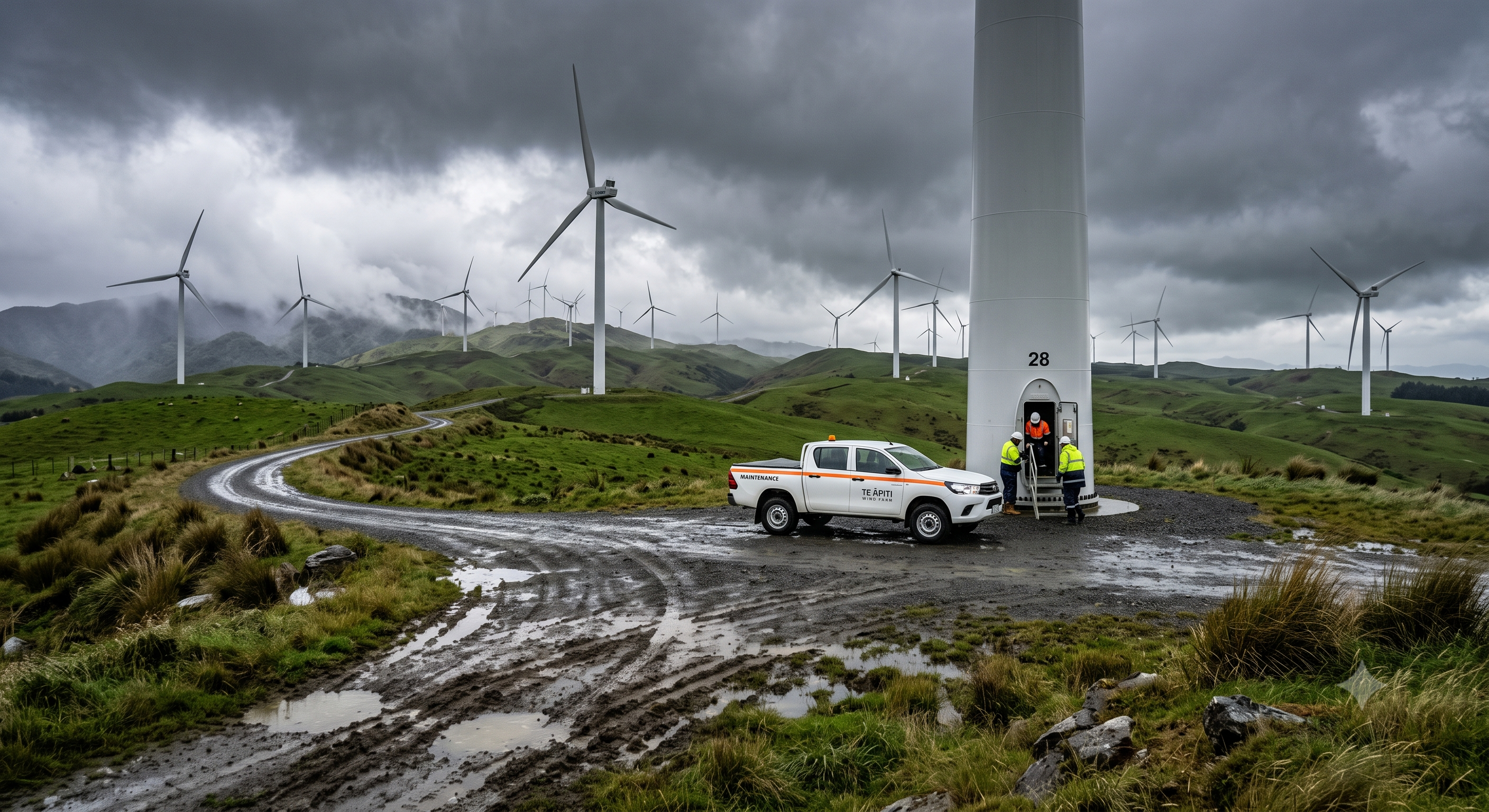
Commissioned by Meridian Energy Ltd., construction on the Te Āpiti Wind Farm began in November 2003 across 1,150 hectares of rugged farmland north of the Manawatu Gorge, approximately 15 kilometers from the city of Palmerston North.[1] The site was strategically chosen due to the exceptional "wind funnel" effect created by the geological gap between the Tararua and Ruahine Ranges, which forces strong, unimpeded winds from the Tasman Sea across the ridge lines.[1:1]
Te Āpiti holds a historic position in New Zealand's energy infrastructure by establishing several technical and operational precedents:
-
Direct Grid Integration: It was the first utility-scale wind farm in New Zealand to supply electricity directly into the Transpower national grid, establishing initial standardization for grid-interconnection.[1:2]
-
Turbine Capacity Scale: It was the first domestic project to transition to multi-megawatt class wind turbines, deploying 55 individual NEG Micon 1.65 MW turbines for a total capacity of 90.75 MW.[2]
-
Regulatory Compliance Proving Ground: It was one of the first major generation assets subject to the requirements of the newly established national Electricity Governance Rules, shifting how volatile renewable energy assets bid into the wholesale electricity market.[2:1]
Core Geotechnical and Environmental Risks
Developing large-scale utility infrastructure along an exposed ridge line introduced substantial compound hazards that required real-time engineering and managerial mitigation.
The 2004 Century Storm and Flooding Incident
In February 2004, just three months into the civil construction phase, the Manawatu region was struck by a historic 100-year storm and flood event.[3] The extreme, concentrated rainfall severely compromised the project by triggering widespread landsliding across the hillsides and completely wiping out the primary site access via Saddle Road.[3:1] This natural disaster brought heavy civil operations to a complete standstill and imposed an immediate six-week delay on the project timeline.[3:2]
Topographical and Civil Engineering Challenges
Beyond the acute flood incident, the physical characteristics of the Te Āpiti site presented ongoing engineering risks:
-
Unstable Soil Matrix: The site topography is defined by steep drop-offs, deep gullies, multiple streams, and highly variable soft silt soil profiles exhibiting undrained shear strengths ranging from 40 to 160 kPa.[4]
-
Heavy Equipment Transport Logistics: Erecting the 70-meter-tall turbine towers required a massive 400-tonne crawler crane.[3:3] To safely move this equipment across unstable slopes without triggering structural failure, contractors had to design and build 21 kilometers of specialized civil access roads widened to 10 meters.[5]
-
Foundation Load Eccentricity: Geotechnical designs had to account for unusual structural loading.[4:1] Unlike traditional building foundations, wind turbines possess a low gravity weight combined with extreme lateral wind forces.[4:2] Under high wind loads, this dynamic creates severe load eccentricity, generating intense stress concentrations along the outer edges of the concrete foundational pads.[4:3]
-
Thermal Constraints: Subsurface electrical cable networks required extensive thermal resistivity testing to mitigate the risk of underground cable degradation, necessitating specific cable ratings calibrated to a maximum of 1.2 m K/W.[6]
Strategic Risk Mitigation and Adaptive Engineering
The successful completion of Te Āpiti under disaster conditions is attributed to real-time risk assessment, robust technical flexibility, and agile project execution.
Real-Time Geotechnical Adaptation
To counter the threat of slope failure and structural shifting, project engineers implemented an exhaustive geotechnical investigation consisting of 59 exploratory boreholes, dynamic plate load testing, and triaxial testing to measure precise soil stiffness.[4:4]
Following the severe landsliding of February 2004, engineers immediately re-mapped the site to re-evaluate the safety of foundation platforms.[4:5] The investigation revealed that one turbine site had become critically unstable; rather than attempting an expensive or compromised engineering solution, the team proactively shifted and repositioned the turbine site entirely to eliminate long-term failure risk.[4:6]
Ultimately, the foundations were optimized using 21,000 cubic meters of concrete and extensive earthworks (exceeding 1,000,000 cubic meters of excavation) to satisfy rigid rotational and rocking stiffness standards.[5:1]
Collaborative Project Management and Rapid Incident Response
Absorbing a six-week disaster delay without breaching the tight 12-month delivery window required a departure from rigid, adversarial contracting frameworks.[3:4] The main contractor (McConnell Dowell) and the civil subcontractor (Goodman Contractors) instituted a highly integrated, collaborative team culture.[5:2]
Following the flood, the team deployed an agile, rapid incident response framework:
-
Bulk earthworks, site rehabilitation, and drainage designs were dynamically altered in the field to handle increased runoff.[5:3]
-
Project schedules were heavily compressed by overlapping civil foundation pouring and structural turbine assembly phases.[3:5]
-
Transparent, daily communication lines between Meridian Energy and contractors prevented bureaucratic blockages, transforming a potential multi-million dollar delay into an on-time delivery within budget.[3:6]
Environmental and Social Stakeholder Alignment
Managing the reputational and ecological risks of a landmark renewable project was integrated early into the planning pipeline.
To address community concerns regarding the visual impact on the scenic Ruahine foothills, the consenting team utilized advanced computer-generated visual simulations to align public expectations during consultations.[7]
Concurrently, ecological field assessments flagged a potential hazard: the turbine arrays could intercept wildlife migration corridors moving between the Manawatu Gorge and the Ruahine Forest Park.[7:1] To mitigate avian and wildlife mortality risks, Meridian Energy modified the physical layout of the wind farm, altering turbine spacing and omitting specific high-risk locations to avoid ecologically sensitive zones.[7:2] Additionally, the wide 10-meter construction tracks were systematically regrassed back to 5 meters upon completion to control long-term topsoil erosion and minimize the project's permanent environmental footprint.[5:4]
Key Takeaways for Future Infrastructure Projects
The Te Āpiti Wind Farm serves as an enduring case study in infrastructure resilience, validating several core tenets of risk management:
-
Dynamic Risk Re-Assessment is Mandatory: Static risk registers fail in volatile natural environments. The real-time re-mapping and relocation of assets post-disaster preserved the structural integrity of the wind farm.[4:7]
-
Access Infrastructure is the Primary Single Point of Failure: Wiping out Saddle Road halted the entire project supply chain.[3:7] Long-term infrastructure strategy must prioritize secondary access routing or rapid civil reinstatement capabilities.
-
Relational Contracting Outperforms Transactional Contracting: The compression of the schedule to overcome the six-week flood delay was driven entirely by shared risk ownership, open communication, and a unified project culture across the asset owner, main contractor, and subcontractors.[3:8]
References
Meridian Energy / Te Āpiti Wind Farm / meridianenergy.co.nz ↩︎ ↩︎ ↩︎
Scribd / New Zealand Wind Farm Project Case Study / scribd.com ↩︎ ↩︎
McConnell Dowell / Te Apiti Windfarm / mcconnelldowell.com ↩︎ ↩︎ ↩︎ ↩︎ ↩︎ ↩︎ ↩︎ ↩︎ ↩︎
A. Murashev / Te Apiti wind farm: megawatt - class machines aided by geotechnical expertise / academia.edu ↩︎ ↩︎ ↩︎ ↩︎ ↩︎ ↩︎ ↩︎ ↩︎
Goodman Energy / Te Apiti Wind Farm / goodmanenergy.nz ↩︎ ↩︎ ↩︎ ↩︎ ↩︎
Blackley Construction / Te Apiti / blackley.co.nz ↩︎
Boffa Miskell / Te Apiti Wind Farm / boffamiskell.co.nz ↩︎ ↩︎ ↩︎