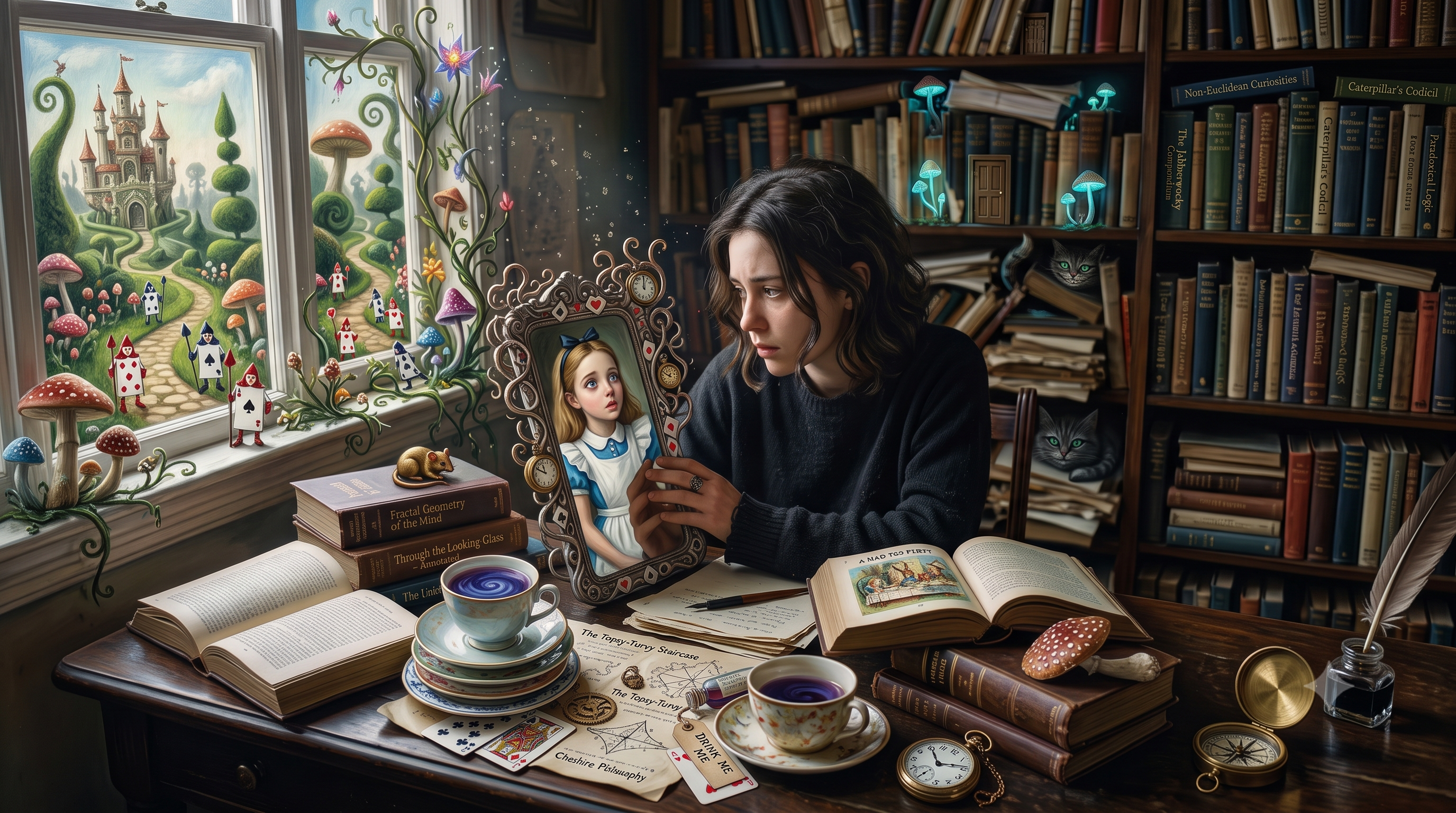
Decoding Alice in Wonderland
Alice's Adventures in Wonderland (1865) is far more than a whimsical children's fable; it is a complex tapestry of literary nonsense, sharp mathematical satire, and a pioneering psychological exploration of identity and perception. Written by Oxford mathematician Charles Lutwidge Dodgson under the famous pseudonym Lewis Carroll, the text systematically flips the rigid logic of the Victorian era on its head.
The Genesis: The Golden Afternoon
The narrative of Wonderland began on a "golden afternoon" on July 4, 1862, during a rowing trip along the River Thames (locally known as the Isis) in Oxford.[1] Charles Lutwidge Dodgson, an Oxford mathematical lecturer, alongside his friend Robinson Duckworth, took the three young daughters of Dean Henry Liddell—Lorina, Alice, and Edith—on a boat ride upstream.[2] To entertain the girls, particularly ten-year-old Alice Liddell, Dodgson spun a spontaneous tale about a bored girl falling down a rabbit hole.[3]
Enraptured by the story, Alice begged Dodgson to write it down for her. He complied, painstakingly compiling an illustrated manuscript titled Alice's Adventures Under Ground, which he gifted to her in 1864.[2:1] Upon the warm encouragement of literary peers, Dodgson expanded the text to twice its original size, integrated the legendary illustrations of cartoonist Sir John Tenniel, and officially published the book in 1865.[2:2]
Dodgson created "Lewis Carroll" by translating his real names, Charles Lutwidge, into their Latin counterparts (Carolus Ludovicus), reversing their order, and translating them back into English.[4]
The Mathematical Satire: Subverting Abstract Algebra
While generations of readers viewed the book as pure, unadulterated absurdity, modern literary and mathematical historians have uncovered a deeper layer of intellectual resistance. Dodgson was a deeply conservative mathematician who specialized in Euclidean geometry and traditional arithmetic.[5] The mid-19th century was a turbulent era for mathematics, witnessing the birth of "modern" abstract systems—such as symbolic algebra, projective geometry, and complex numbers—which Dodgson viewed as a chaotic departure from logical rigor.[6]
Through the chaotic laws of Wonderland, Dodgson used reductio ad absurdum to stretch these new mathematical premises to their most ridiculous, literal extremes.[6:1]
The Caterpillar and Symbolic Algebra
Alice's bizarre encounter with the hookah-smoking Caterpillar parodies the rise of symbolic algebra, a concept championed by contemporary mathematicians like Augustus De Morgan.[6:2] In traditional arithmetic, numbers represented physical, countable objects. In symbolic algebra, symbols could represent any abstract concept as long as they followed structural rules. The Caterpillar's shifting instructions and demand that Alice "Keep your temper" acts as a metaphor for the shifting proportions and abstract rules of an algebraic world that no longer maps neatly onto physical reality.[6:3]
The Cheshire Cat and Projective Geometry
The Cheshire Cat’s famous vanishing act satirizes the "principle of continuity" found in projective geometry.[6:4] This principle suggests that geometric shapes can bend, stretch, and deform continuously while retaining fundamental underlying traits (e.g., a circle warping into an ellipse). When the Cat disappears completely, leaving only its disembodied grin, Carroll mocks the abstract notion that a mathematical property can exist completely separated from its physical geometric structure.[6:5]
"I’ve often seen a cat without a grin, but a grin without a cat! It’s the most curious thing I ever saw in my life!"
The Mad Tea Party and Quaternions
One of the book’s most brilliant mathematical roasts occurs at the Mad Tea Party, which satirizes William Rowan Hamilton’s discovery of "quaternions."[6:6] Quaternions are a four-dimensional number system built on three spatial dimensions plus a fourth dimension of "pure time" (represented by the mathematical variable
In Hamilton's equations, if time (
The Mechanics of Literary Nonsense
Before Alice in Wonderland, Victorian children’s literature was dominated by heavy-handed didacticism and moralizing tales meant to teach religious, industrial, or social virtues.[7] Carroll radically altered the literary landscape by pioneering the genre of literary nonsense.[7:1]
Nonsense is not simply an absence of meaning; rather, it is a meticulous subversion of rules. It functions by creating an internal, airtight logic that mimics standard language but yields completely absurd results.
-
Parody of Didactic Poetry: Carroll explicitly mocks Victorian moral poems. For example, Isaac Watts' pious poem "Against Idleness and Mischief" (which praises the busy, industrious bee) is transformed into Carroll's absurd poem "How doth the little crocodile," which celebrates a deceptive predator smoothly luring fish into its jaws.[7:2]
-
Semantic and Syntactic Play: Wonderland runs on semantic slippage. Characters interpret idioms literally. When Alice states that she "must have lost her way," the characters treat "way" as a tangible, physical possession.
Psychological Interpretations & Neurological Reality
The Crisis of Adolescence
From a psychoanalytic perspective, Alice's constant changing of physical size mirrors the distressing, disorienting experience of puberty and bodily development.[8] Alice's existential lament to the Caterpillar—"I hardly know who I am, just at present—at least I know who I was when I got up this morning, but I think I must have been changed several times since then"—articulates the universal psychological fracture that occurs when transitioning from childhood to adulthood.[8:1]
Alice in Wonderland Syndrome (AIWS)
Beyond literature, the text made a permanent impact on the field of medicine and neurology. In 1955, British psychiatrist John Todd coined Alice in Wonderland Syndrome (AIWS) to describe a specific perceptual disorder.[9]
Individuals experiencing AIWS suffer from temporary distortions in visual perception and body image, known as:
Scholars note that Charles Dodgson suffered from severe, recurring migraine headaches throughout his life.[10:1] Because visual auras accompanying migraines can trigger micropsia and macropsia, medical historians strongly suspect that Dodgson's own neurological experiences directly inspired Alice's dramatic expansions and contractions in Wonderland.[10:2]
References
New York Public Library / First edition of Alice's Adventures in Wonderland / nypl.org ↩︎
The Morgan Library & Museum / Alice: 150 Years of Wonderland / themorgan.org ↩︎ ↩︎ ↩︎
Susannah Fullerton / 4 July 1862: Lewis Carroll tells the Alice story for the first time / susannahfullerton.com.au ↩︎
Canterbury Classics / Lewis's Adventures in Wonderland / canterburyclassicsbooks.com ↩︎
Jasna Novak Milic / Alice's Adventures in Scienceland / hrcak.srce.hr ↩︎
Melanie Bayley / The Mathematics of Alice in Wonderland / massline.org ↩︎ ↩︎ ↩︎ ↩︎ ↩︎ ↩︎ ↩︎ ↩︎
Encyclopedia Britannica / Alice's Adventures in Wonderland | Summary, Characters, & Facts / britannica.com ↩︎ ↩︎ ↩︎
Penguin Random House / Reading Guide from Alice's Adventures in Wonderland and Through the Looking-Glass / penguinrandomhouse.ca ↩︎ ↩︎
The MIT Press Reader / The Curious Case of Alice in Wonderland Syndrome / thereader.mitpress.mit.edu ↩︎ ↩︎
University of Nebraska Medical Center / The mystery of Alice in Wonderland syndrome / unmc.edu ↩︎ ↩︎ ↩︎