Project Risk Management - A Comprehensive Guide to Identifying and Managing Project Threats
Projects vs Operations in Project Management - Key Differences and Examples
Project Management Lifecycles and Gate Deliverables
The 4 Project Manager Archetypes - Aligning Leadership Styles to Project Success
The Ultimate Project Management Jargon Lexicon
View Business English Lesson on StudyESL.ca
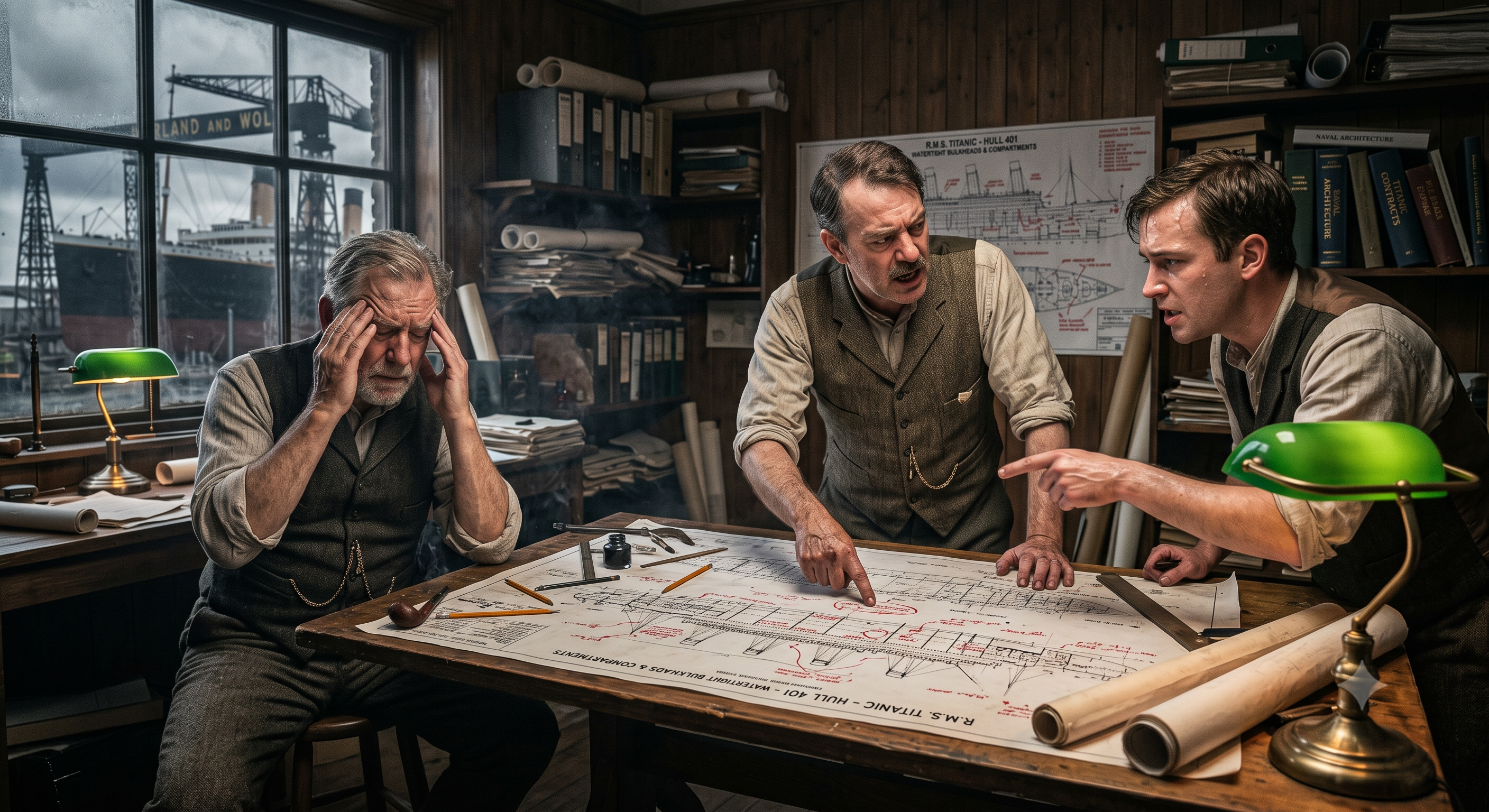
Unsinkable Assumptions: A Project Management Post-Mortem of the RMS Titanic
While the sinking of the RMS Titanic is historically cataloged as a tragic maritime accident, modern project managers analyze it as a classic case study in systemic project failure. Viewed through the lenses of Project Strategy & Scope Creep, Quality Assurance (QA), and Team Dynamics, the disaster reveals how commercial pressures, truncated testing, and fractured communication channels can compromise even the most technologically advanced endeavors.
1. Project Strategy & Scope Creep: Prioritizing Aesthetics Over Safety
In project management, "scope creep" and "gold plating" occur when additional features or aesthetic adjustments override the project’s core functional and safety requirements. The construction of the Titanic, overseen by the White Star Line to compete with the faster Cunard Line, suffered from a strategic shift: competing on unparalleled luxury and scale rather than speed.
-
The Design Compromise: The Titanic’s original design, drafted by Harland and Wolff's Alexander Carlisle, actually allowed for a highly advanced safety system utilizing Welin double-acting quadrant davits. These davits were engineered to hold up to 64 lifeboats, which would have easily accommodated all passengers and crew on board.[1]
-
Aesthetics Over Safety: During design finalization, the project's sponsors actively reduced the lifeboat count to just 20 (14 standard wooden lifeboats, 2 emergency cutters, and 4 Engelhardt collapsibles).[1:1] [2] This choice was made because a double row of lifeboats was believed to "clutter" the boat deck, compromising the spaciousness and visual appeal of the first-class promenade.[2:1]
-
Regulatory Exploitation: The decision-makers justified this reduction by pointing to the British Board of Trade regulations, which were severely outdated. The existing law, written in 1894, only required a minimum of 16 lifeboats for vessels over 10,000 tons—whereas the Titanic weighed over 46,000 tons.[1:2] [3] By prioritizing compliance over actual safety margins, the project’s strategy fundamentally failed to manage risk.
2. Quality Assurance: Truncated Sea Trials & Rushed Milestones
No critical project should go live without exhaustive stress testing and quality assurance (QA). The White Star Line, however, was bound to a rigid, highly publicized launch date milestone. Under intense pressure to begin her maiden voyage on April 10, 1912, the project's QA phase was severely rushed.
-
An 8-to-12 Hour Window: The Titanic's official sea trials were originally scheduled for April 1, 1912, but bad weather forced a postponement to April 2.[4] With her departure from Southampton just eight days away, the ship's sea trials were compressed into a single day, lasting approximately 12 hours.[4:1]
-
Insufficient Stress Testing: During this short window, the ship was driven at various speeds and completed basic turning maneuvers and a single "crash stop" in Belfast Lough.[4:2]
-
The Consequences of Truncated QA: These trials did not test the vessel under realistic high-speed Atlantic conditions, nor did they allow the crew to master the handling characteristics of a ship of that massive scale.[4:3] The pressure to hit the launch date milestone took precedence over robust, iterative QA—leaving the crew unprepared for how the vessel would behave when executing an emergency turn at high speed in the Atlantic.
3. Team Dynamics: A Failure in the "Forming" Stage
Under Tuckman’s Stages of Group Development, high-performing teams must progress through Forming, Storming, Norming, and Performing before they can handle crisis scenarios effectively. The Titanic's crew was thrust into a high-stakes operational environment while still stuck in a fractured "Forming" stage.
-
The Last-Minute Reshuffle: Just days before the Titanic sailed, Captain Edward Smith initiated a sudden change to the senior officer lineup. Henry Wilde was brought in from the sister ship Olympic to serve as Chief Officer, which bumped William Murdoch down to First Officer and Charles Lightoller to Second Officer.[5] This sudden reshuffle completely displaced the original Second Officer, David Blair, from the voyage.[5:1]
-
The Missing Binocular Key: In the haste of his unexpected reassignment, Blair accidentally left the ship with the key to the crow's nest binocular locker still in his pocket.[5:2] Because the team had not established clear inventory checklists or operational standards during their forming phase, the lookouts were forced to scan the dark horizon with the naked eye.[5:3]
-
Lack of Cohesion: The late structural changes meant the senior officers had virtually no time to work together, establish clear reporting lines, or run emergency drills as a unified team before the ship departed Southampton.
4. Fatal Communication Breakdown: High-Priority Risks vs. Low-Priority Data
In high-risk project environments, communication channels must be tightly managed so that critical threat alerts override routine operational data. On the Titanic, a toxic combination of commercial pressure and fragmented communications silenced vital safety warnings.
-
Misaligned Project Incentives: The wireless operators on board, Jack Phillips and Harold Bride, were not actually employees of the White Star Line. They were employed by the Marconi Company, and their primary commercial KPI was to transmit paid personal messages ("Marconigrams") for wealthy passengers.[6]
-
Risk Warnings Overridden by Commercial Scope: On the night of April 14, the wireless equipment broke down, leaving a massive backlog of passenger messages.[6:1] [7] Phillips was working frantically to clear this backlog through Cape Race.[6:2] [7:1]
-
The Ignored Ice Field Warning: At approximately 9:30 PM, the steamship Mesaba sent an urgent ice warning indicating a massive ice field directly in Titanic's path.[7:2] Because the message was not prefixed with the formal "MSG" (Master Service Gram) notation, and because Phillips was completely overwhelmed by commercial passenger traffic, he did not deliver the warning to the bridge.[7:3]
-
The Californian Incident: Shortly after, when the nearby SS Californian attempted to interrupt Phillips to warn him that they had been stopped by heavy ice, a highly stressed Phillips wired back: "Keep out! Shut up! I am working Cape Race."[6:3] [7:4] Ten minutes after the Californian's operator switched off his radio and went to bed, the Titanic struck the iceberg.[6:4]
5. Key Takeaways for Modern Project Leaders
-
Manage Scope & Gold Plating: Never allow aesthetic enhancements or market positioning to compromise essential safety frameworks and risk-mitigation infrastructure.
-
Protect the QA Phase: Rushing testing milestones to meet arbitrary launch deadlines almost always introduces hidden, catastrophic technical debt.
-
Build Cohesive Teams Early: Last-minute changes to key personnel require deliberate transition protocols to prevent critical knowledge and resources (like the binocular locker key) from being lost.
-
Prioritize Communication Protocols: Ensure that safety, risk, and escalation channels are structurally isolated and prioritized over day-to-day commercial activities.
References
Bartleby / The Changes In The Design Of Ships After The Titanic Disaster / Bartleby ↩︎ ↩︎
Library of Congress / Failure to Update the Law a Titanic Mistake / In Custodia Legis ↩︎
Titanic Wiki / Sea Trials / Titanic Fandom ↩︎ ↩︎ ↩︎ ↩︎
Mark Murphy & Leadership IQ / The Missing Locker Key That Sank the Titanic / YouTube ↩︎ ↩︎ ↩︎ ↩︎
Engineering Radio / Shut up! shut up! I am working Cape Race / Engineering Radio ↩︎ ↩︎ ↩︎ ↩︎ ↩︎
Wikipedia / Jack Phillips (wireless operator) / Wikipedia ↩︎ ↩︎ ↩︎ ↩︎ ↩︎