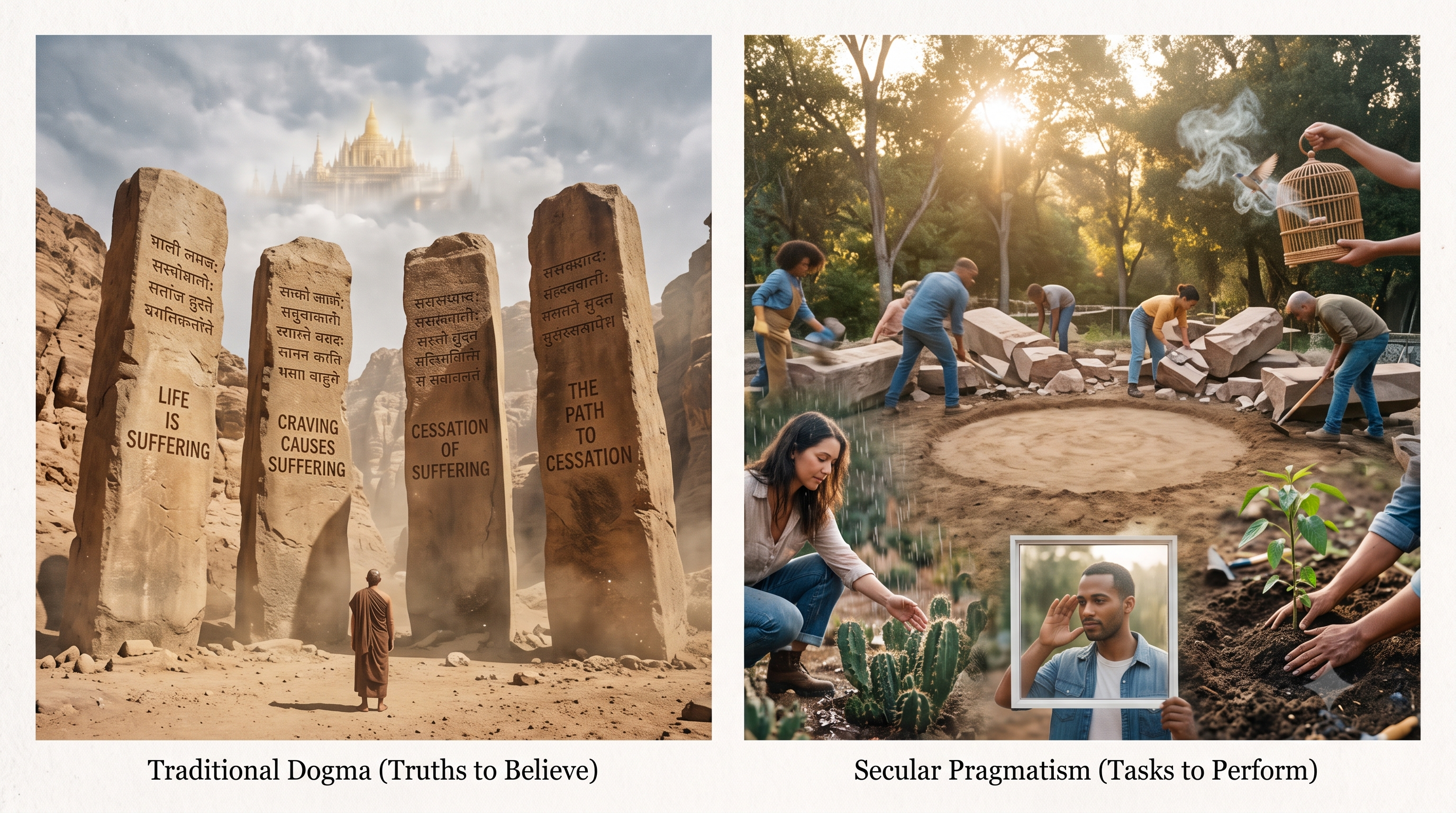
Stephen Batchelor reworks the traditional Four Noble Truths by shifting them from metaphysical dogmas to be believed into pragmatic, existential tasks to be performed.[1] Using his trademark ELSA acronym (Embrace, Let go, See, Act), Batchelor strips away the post-mortal, religious scaffolding of traditional Buddhism to offer a secular, therapeutic framework focused on immediate human flourishing rather than cosmic salvation.[2]
The Epistemological Pivot: From Truths to Tasks
Traditional orthodox Buddhism presents the Four Noble Truths as a series of propositional statements about the nature of reality: life is suffering, suffering is caused by craving, suffering ends with Nirvana, and the Eightfold Path is the way to achieve this.[2:1]
Batchelor argues that treating these four points as absolute "truths" transforms Buddhism into a dogmatic belief system.[1:1] Drawing from a philological analysis of early Pali texts—specifically the Dhammacakkappavattana Sutta (the Buddha's first sermon)—Batchelor points out that the Buddha originally framed these four elements not as metaphysical facts, but as kicca (urgent tasks or actions to be executed).[3]
The original Pali text utilizes gerundives (verbs indicating what ought to be done) rather than nominalized declarations:[3:1]
-
Pariññeyya: Dukkha is "to be fully understood/comprehended."
-
Pahātabba: Arising (craving) is "to be let go of."
-
Sacchikātabba: Cessation is "to be personally experienced/beheld."
-
Bhāvitabba: The path is "to be cultivated."
By shifting from an intellectual creed to an action-oriented framework, the question changes from "Do I believe this is true?" to "Have I done what needs to be done?"[4]
Additionally, Batchelor reframes the Sanskrit/Pali term taṇhā (typically translated as "craving") as habitual reactivity.[3:2] This shifts the diagnosis from a moral failing or cosmic sin to a natural, biological, evolutionary mechanism that humans are hardwired to execute, but which ultimately blocks existential freedom.[2:2]
The ELSA Framework
To make this operational for modern practitioners, Batchelor condensed these four tasks into the acronym ELSA:[2:3]
Embrace (Dukkha)
-
Traditional View: "Life is suffering" (a metaphysical description of existence).[1:2] [5]
-
Batchelor's Rework: Dukkha is not an abstract metaphysical claim, but the unavoidable reality of an impermanent, co-conditioned, and fragile life.[1:3] The task here is to fully embrace the existential reality of human limitation, change, old age, sickness, and death.[2:4] Instead of seeking to escape the world, one must lean into and accept what Zorba the Greek called "the full catastrophe" of life.[2:5]
Let Go / Let Be (Samudaya)
-
Traditional View: "Craving causes suffering" (a linear cause-and-effect doctrine).
-
Batchelor's Rework: The second task is to let reactivity be and let it go.[2:6] When habitual reactivity (such as anger, fear, pride, or grasping) arises in response to the challenges of life, the practitioner's task is not to violently suppress or destroy it, but to observe it clearly without identifying with it or being driven by it.[4:1] [6]
See / Behold (Nirodha)
-
Traditional View: "Cessation (Nirvana) is the absolute end of suffering."
-
Batchelor's Rework: In orthodox frameworks, Nirvana is often mythologized as a transcendent, post-mortal release from the cycle of rebirth.[2:7] Batchelor radically redefines Nirvana as any immediate, immanent moment where habitual reactivity stops.[2:8] The task is to consciously behold and witness these transient windows of non-reactive clarity, peace, and freedom within daily life.[4:2]
Act / Actualize (Magga)
-
Traditional View: "The Eightfold Path is the means to achieve Nirvana."
-
Batchelor's Rework: Instead of the path being a rigid, linear highway designed to escape the physical world, the path is an ongoing, creative, and ethical way of being.[2:9] Once reactivity stops, a spacious creative clearing opens up.[4:3] The task is to act out of that empty, non-reactive space—responding to the world with wisdom, mindful awareness, and compassionate action.[4:4]
Restructuring the Sequence of Practice
By transforming truths into tasks, Batchelor turns the traditional sequence of Buddhist practice upside down:
In orthodox Buddhism, the Path (4) is a means to achieve Nirvana (3). In Batchelor's model, Nirvana (3) is not the final destination; it is the generative source of the Path. Experiencing the momentary stopping of reactivity is what frees us to creatively act (4) and live an ethical life in the world.[2:10] [4:5]
This creates a dynamic feedback loop rather than a linear trajectory:[2:11]
Paradigm Comparison: Metaphysics vs. Pragmatics
| Dimension | Traditional Orthodoxy | Batchelor's Secular Reworking |
|---|---|---|
| Core Nature | Metaphysical Doctrines / Dogmatic Truths | Practical, Experiential Tasks [5:1] |
| The Problem | Ontological suffering caused by craving | Conditioned reactivity blocking creative potential [2:12] |
| Nirvana | Final, transcendent escape from rebirth | Momentary windows of non-reactive freedom [2:13] |
| Ultimate Goal | Transcendence of the human condition | Fully engaged ethical flourishing in the here and now [2:14] |
References
For an in-depth conversation featuring Stephen Batchelor explaining these four tasks in detail, you can watch The Four Great Life Tasks with Stephen Batchelor. This video features an interview with Stephen Batchelor directly discussing his framework and explaining how shifting from truths to life tasks fundamentally transforms modern practice.
Eightfold Path / Secular Buddhism - A discussion with Stephen Batchelor / eightfoldpath.com ↩︎ ↩︎ ↩︎ ↩︎
Winton Higgins / A core concept of secular Buddhism: the four tasks / secularbuddhistnetwork.org ↩︎ ↩︎ ↩︎ ↩︎ ↩︎ ↩︎ ↩︎ ↩︎ ↩︎ ↩︎ ↩︎ ↩︎ ↩︎ ↩︎ ↩︎
Dhivan Thomas Jones / 'Does It Float?': Stephen Batchelor's Secular Buddhism / dhivanthomasjones.wordpress.com ↩︎ ↩︎ ↩︎
Stephen Batchelor / Stephen Batchelor on the Four Noble Tasks / upaya.org ↩︎ ↩︎ ↩︎ ↩︎ ↩︎ ↩︎
Middle Way Society / The Four... Noble Truths, Tasks, Principles, or Curates? / middlewaysociety.org ↩︎ ↩︎
Stephen Batchelor / Stephen Batchelor on 'Buddhism in a nutshell' / secularbuddhistnetwork.org ↩︎