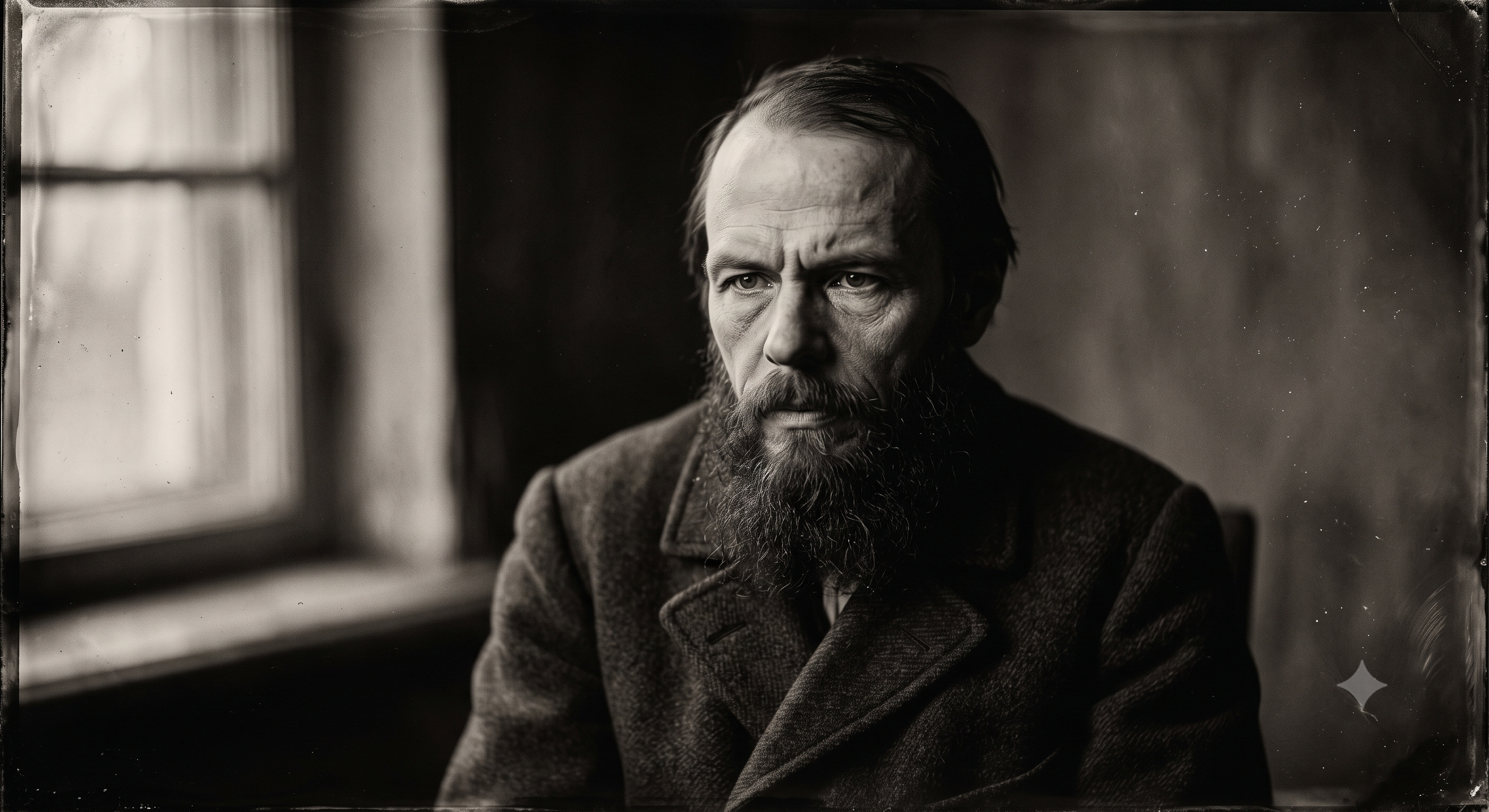
The Philosophical Worldview of Fyodor Dostoevsky
Fyodor Dostoevsky is widely regarded not only as a master of the novel but as one of the most profound existential philosophers and theologians of the modern era. His post-Siberian works formulate a devastating critique of Western rationalism, utilitarianism, and rising nihilism. In their place, Dostoevsky championed absolute spiritual freedom, explored the deep psychological pathology of ideological possession, and proposed a redemptive theology centered on suffering, active love, and the "living life."
1. The Siberian Crucible: Rebirth of an Artist
Before his arrest in 1849, Dostoevsky was a member of the Petrashevsky Circle, discussing French utopian socialism and circulating banned anti-tsarist literature. Following a mock execution that deeply traumatized him, he was exiled to a Siberian labor camp in Omsk for four years.
This brutal experience catalyzed a profound shift in his worldview. He emerged from Siberia having rejected political utopianism in favor of a deep exploration of the human soul, rooted in Russian Orthodox Christianity and an acute awareness of the limits of human reason. The New Testament was the only book he was permitted to read during his years of imprisonment, which permanently anchored his post-exile intellectual and spiritual developments[1].
2. Existential Autonomy and the Revolt Against the "Crystal Palace"
In Notes from Underground (1864), Dostoevsky delivers his most direct blow against the prevailing rational egoism of the 19th century, particularly targeting Nikolay Chernyshevsky’s socialist manifesto What Is to Be Done?
The Critique of the Crystal Palace
Chernyshevsky argued that human behavior could be perfectly mapped and optimized through science, reason, and self-interest, using the metaphor of the "Crystal Palace." Dostoevsky, through the voice of his nameless Underground Man, vehemently rejects this deterministic view.
-
The Irrationality of Will: The Underground Man argues that humans do not want to be "piano keys" played upon by the laws of nature. Even if human actions could be mathematically calculated, a person would deliberately act self-destructively or irrationally just to prove that they possess free will[2].
-
The "2 + 2 = 4" Formula:
"2 x 2 = 4 is no longer life, gentlemen, but the beginning of death."
For Dostoevsky, scientific and mathematical certainty strip humanity of its essence—choice.
The "Crystal Palace" represents a utopian vision where science and reason have resolved all human conflict, rendering life perfectly predictable. Dostoevsky warns that to achieve such a state, humanity must sacrifice its most defining attribute: the chaotic, sometimes self-destructive, capacity to choose.
3. The Pathology of Ideological Possession
Dostoevsky viewed the rising tide of Russian Nihilism and Western utilitarianism as intellectual diseases that threatened to unravel the social and moral fabric of humanity. He treated ideas as active, viral forces that could possess the human mind.
The Napoleonic Complex in Crime and Punishment
In Crime and Punishment (1866), Rodion Raskolnikov represents the tragic culmination of utilitarian and nihilistic thinking.
-
The Utilitarian Calculus: Raskolnikov rationalizes the murder of an unscrupulous, wealthy pawnbroker by arguing that her death will benefit society and fund his own noble pursuits.
-
The Extraordinary Man Theory: Raskolnikov divides humanity into "ordinary" and "extraordinary" people. He believes extraordinary figures (like Napoleon) have the right to overstep moral boundaries, including murder, to achieve great ends.
Dostoevsky uses Raskolnikov's subsequent mental collapse, fever, and acute psychological isolation to demonstrate that the human conscience cannot survive the utter eradication of objective moral truth[3].
The Prophetic Vision of Demons
In Demons (1872), Dostoevsky warns that the intellectual skepticism of the older generation inevitably morphs into the violent, destructive nihilism of the younger generation. He prophesied that when society replaces God with human-centric ideologies, it inevitably results in totalitarian control (what the character Shigalov calls "Shigalovism," where 90% of humanity is enslaved by the remaining 10%).
4. The Problem of Evil and the Rebellion of Reason
Nowhere is Dostoevsky’s philosophical genius more apparent than in The Brothers Karamazov (1880), where he pits rationalism against faith.
Ivan Karamazov's Rebellion
Ivan Karamazov, the hyper-rational intellectual, presents a formidable critique of Christian theology.
-
The Suffering of Children: Ivan does not deny God's existence; rather, he rejects the "harmony" God promises. He argues that no future eternal paradise can justify the horrific, uncompensated suffering of innocent children in the present.
-
"Returning the Ticket": Ivan famously states that if the entry fee to God’s eternal harmony requires the torture of even one innocent child, he respectfully declines the ticket. His focus on the uncompensated suffering of innocent children is the ultimate anti-theodicy[4].
The Grand Inquisitor
In Ivan's prose poem, The Grand Inquisitor, Christ returns to Earth during the Spanish Inquisition. The Inquisitor arrests Christ, arguing that Christ's gift of free will was a cruel burden that humanity could not bear.
The Inquisitor asserts that the Church has corrected Christ's work by stripping humanity of freedom and giving them security, bread, and mystery instead. The scene represents Dostoevsky's ultimate warning: the rationalist desire to eliminate suffering eventually demands the complete elimination of human freedom.
The Grand Inquisitor reveals the tragic human paradox: humans crave freedom, yet are constantly seeking to surrender it to anyone who can guarantee comfort, security, and relief from the agonizing choices of life.
5. The Form of Truth: Polyphony and Dialogism
Dostoevsky's philosophical method is inextricably linked to his unique literary style. Mikhail Bakhtin famously identified Dostoevsky as the creator of the polyphonic novel.
-
No Authorial Monopoly: Unlike traditional authors who use characters to parrot their own views, Dostoevsky creates a plurality of independent, unmerged voices.
-
Unfinalizability of the Hero: Characters like Ivan, Raskolnikov, and Dmitri are not static representations of ideas. They are "unfinalizable" consciousnesses constantly in dialogue with themselves and others.
-
Truth as Dialogue: This artistic innovation mirrors Dostoevsky’s philosophical stance: truth is not a static scientific formula or a set of logical propositions to be declared, but a living, relational process that can only be discovered through dialogic interaction[5].
6. The Soteriology of Active Love and Suffering
Dostoevsky does not answer Ivan Karamazov's rational rebellion with a counter-argument of logic. Instead, he presents an experiential and spiritual alternative through the characters of Alyosha Karamazov and Father Zosima.
Active Love vs. Abstract Humanitarianism
Father Zosima advocates for Active Love—a demanding, daily commitment to loving individual neighbors rather than the abstract "humanity" loved by intellectual socialists.
-
Abstract Love: Easy, emotional, self-serving, and focused on global utopias.
-
Active Love: "A harsh and dreadful thing compared to love in dreams." It requires humility, patience, and the willingness to face the messy realities of human brokenness[6].
Shared Guilt and Redemption Through Suffering
Zosima teaches that "each of us is guilty before all for all." Dostoevsky believed that humanity is profoundly interconnected; a sin committed by one person ripples through the entire community.
Therefore, redemption is only achieved when individuals voluntarily take on the suffering of others, as Sonya Marmeladova does for Raskolnikov in Crime and Punishment, and as Dmitry Karamazov does when he accepts a wrongful conviction for his father’s murder.
Key Philosophical Differences in Dostoevsky's Work
| Philosophical Dimension | Rationalist Egoism / Nihilism | Spiritual Freedom / Christian Existentialism |
|---|---|---|
| View of Human Nature | Deterministic, predictable, mathematically mapped (the "Crystal Palace"). | Radically free, irrational, capable of absolute good or absolute evil. |
| Moral Framework | Utilitarian calculation; "extraordinary men" can overstep boundaries (e.g., Raskolnikov). | Grounded in conscience, divine love, and personal responsibility. |
| Social Ideal | Collective security, state control, or ideological revolution (e.g., Shigalovism). | The Kingdom of God on Earth, built through personal spiritual transformation. |
| Handling of Suffering | To be eliminated through material progress, or used to justify rebellion (e.g., Ivan Karamazov). | Transformed into a means of purgation, redemption, and spiritual growth (e.g., Father Zosima). |
References
David J. Leigh / The Philosophy and Theology of Fyodor Dostoevsky / utppublishing.com ↩︎
Bilal Siddiqi / Existentialism, Epiphany, and Polyphony in Dostoevsky’s Post-Siberian Novels / mdpi.com ↩︎
Antonio Malo / Nihilism and freedom in the Legend of the Grand Inquisitor / tandfonline.com ↩︎
J. J. W. Yen / Dostoevsky within the problem of evil: influences and reception / ox.ac.uk ↩︎
V. Copello / Justice in Crime and Punishment: Aristotle, Bakhtin, and Dostoevsky in a Dialogic Penetration of the Ultimate Manifestation of Virtue / ucbcluj.wordpress.com ↩︎
Ioniţă Apostolache / “I Want to Live for Immortality”: Fyodor Mikhailovich Dostoevsky in Search of God / tnkul.pl ↩︎