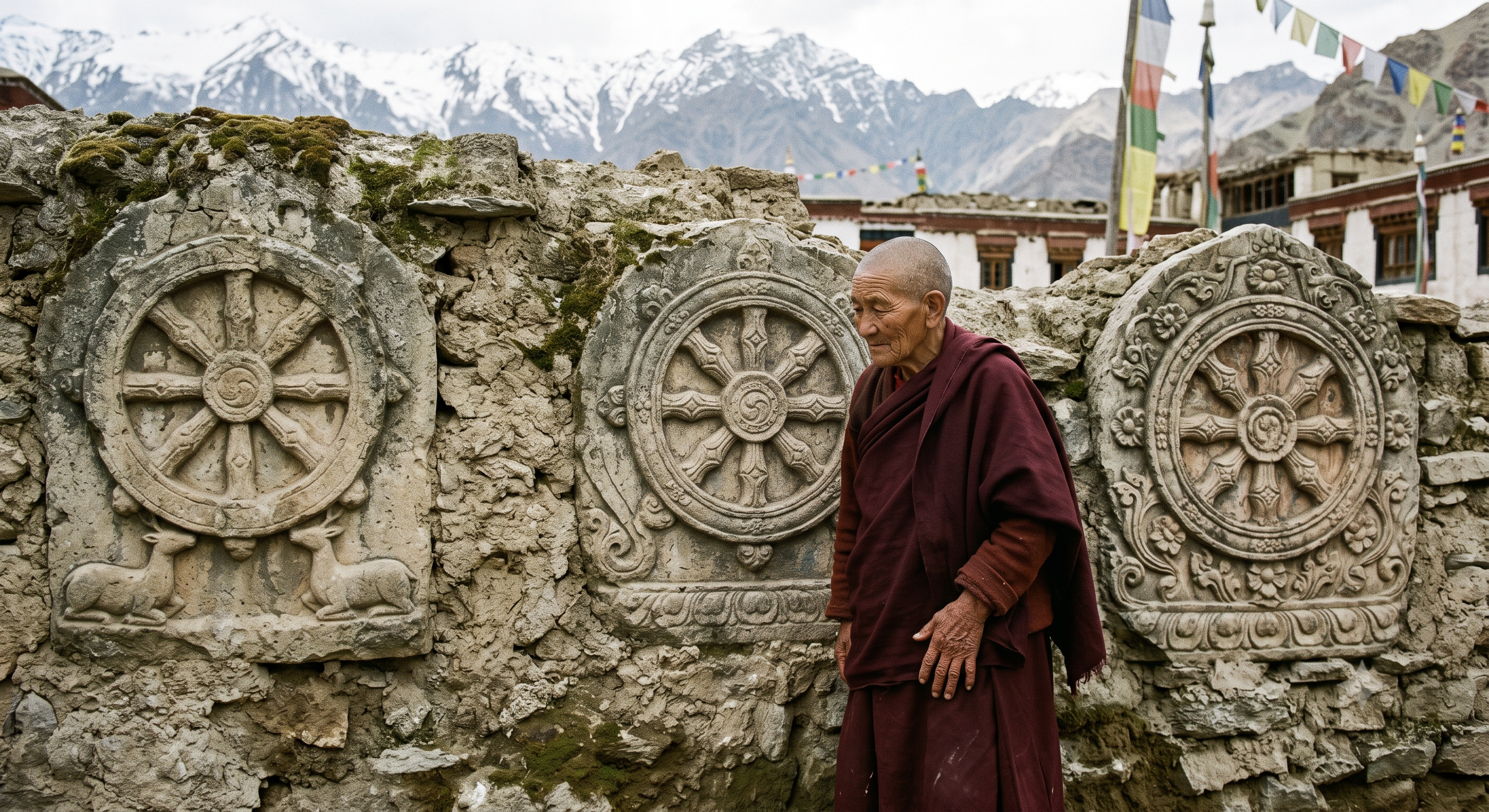
The Three Turnings of the Wheel: Hermeneutics of Mahāyāna Philosophy
Introduction to the Three Turnings of the Wheel
The "Three Turnings of the Wheel of Dharma" (dharmachakra-pravartana) is a foundational hermeneutical framework in Mahāyāna Buddhism. First systematically articulated in the Saṅdhinirmocana Sūtra (The Sūtra Unraveling the Intent), this schema classifies the Buddha's lifetime of teachings into three distinct historical and philosophical phases. This division serves as a pedagogical tool to reconcile seemingly contradictory doctrines—ranging from the substantial reality of personal suffering to the absolute emptiness of all phenomena, and finally to the luminous, non-dual nature of consciousness.
The concept of the "turnings" addresses a central historical and philosophical reality in Buddhism: the Buddha did not teach a single, static dogma. Instead, he utilized upāya (skillful means), tailoring his language and concepts to the specific psychological and spiritual capacities of his audience.[1] To organize this diverse body of teachings, subsequent Buddhist traditions grouped his discourses into three developmental stages.
The First Turning: The Wheel of the Four Noble Truths
Historical and Scriptural Context
The First Turning began in Sarnath at the Deer Park, where Shakyamuni Buddha delivered his very first sermon, the Dhammacakkappavattana Sutta, to his former companions in asceticism.[2] This turning represents the foundation of what is traditionally called the Sravakayana or early Nikaya schools (largely preserved in modern Theravāda Buddhism).
Core Doctrines
The teachings of the First Turning focus on pragmatic psychology, ethics, and liberation from the cycle of samsara:
-
The Four Noble Truths (Caturāryasatya): The diagnostics of suffering (duhkha), its cause in craving (samudaya), its cessation (nirodha), and the path (marga) to achieve liberation.[2:1]
-
The Three Marks of Existence: The reality of impermanence (anitya), suffering (duhkha), and the selflessness of the person (pudgala-nairātmya).
-
Dependent Origination (Pratītyasamutpāda): The twelve-linked chain of causation demonstrating how ignorance drives the continuous wheel of rebirth.[2:2]
Philosophical View: Analytical Realism
In this phase, the concept of "self" (atman) is systematically dismantled. The individual is analyzed as a fluid heap of five psychophysical aggregates (skandhas). However, while the person is recognized as empty of a permanent self, the fundamental constituents of reality—the dharmas (such as sensations, consciousness, and physical matter)—are treated as possessing their own intrinsic, substantial existence (svabhāva). The early Abhidharma schools categorized and studied these dharmas as building blocks of conventional reality.[2:3]
The Second Turning: The Wheel of No-Characteristics
Historical and Scriptural Context
The Second Turning is said to have occurred on Vulture Peak near Rajgir, delivered to an assembly of advanced disciples and bodhisattvas. This phase is characterized by the vast literature of the Prajñāpāramitā (Perfection of Wisdom) sutras, including the Heart Sūtra and the Diamond Sūtra.[3]
Core Doctrines
The primary focus of this turning is a radical expansion of the doctrine of selflessness:
-
Phenomenal Emptiness (Śūnyatā): Where the First Turning argued that the person is empty of self, the Second Turning asserts that all phenomena (dharmas) are also completely empty of inherent, independent existence (dharma-nairātmya). Nothing possesses "own-being" (svabhāva); everything exists only in relation to other factors.[3:1]
-
The Two Truths (Satyadvaya): A division between conventional truth (samvrti-satya), which is the pragmatic, language-based reality of everyday experience, and ultimate truth (paramartha-satya), which is the non-conceptual direct realization of emptiness.[3:2]
Philosophical View: Madhyamaka (The Middle Way)
This turning was systematically developed by the great master Nāgārjuna, who founded the Madhyamaka school. Nāgārjuna utilized rigorous deconstructive logic to demonstrate that any assertion of intrinsic existence leads to logical absurdity. For Madhyamaka, emptiness is not a void or a state of non-existence; rather, because things are empty of independent existence, they are able to dependently arise.[3:3]
In the Second Turning, even emptiness itself is declared "empty." This prevents practitioners from reifying emptiness into a metaphysical absolute or a prime creator.
The Third Turning: The Wheel of Thorough Distinction
Historical and Scriptural Context
The Third Turning arose to resolve a major psychological and practical challenge: many practitioners interpreted the radical emptiness of the Second Turning as a form of nihilism, leading to spiritual despair. Promulgated in texts such as the Saṅdhinirmocana Sūtra (The Sūtra Unraveling the Intent) and the Laṅkāvatāra Sūtra, the Third Turning provides a more constructive, affirmative framework.[4]
Core Doctrines
This phase introduced systematic models of the mind and innate spiritual potential:
-
The Three Natures (Trisvabhāva): A precise tripartite division of reality designed to clarify how emptiness operates without falling into nihilism:[5]
-
Parikalpita-svabhāva (The Imagined Nature): The dualistic projection of subject and object, which has no ultimate reality.
-
Paratantra-svabhāva (The Dependent Nature): The flow of causal, interconnected mental events that arise dependently.
-
Pariniṣpanna-svabhāva (The Consummated Nature): Ultimate reality—the dependent nature experienced completely free of dualistic projections.
-
-
Storehouse Consciousness (Ālaya-vijñāna): A foundational layer of consciousness that stores karmic seeds, explaining how karma and habit-patterns persist across lifetimes without an enduring soul.[4:1]
-
Buddha-Nature (Tathāgatagarbha): The teaching that all sentient beings possess the primordial, luminous potential for full awakening. Rather than a blank emptiness, the ultimate nature of mind is replete with positive, enlightened qualities.[4:2]
Philosophical View: Yogācāra (Mind-Only)
Formalized by the brothers Asaṅga and Vasubandhu, the Yogācāra school asserts that the external, physical world does not exist independently of our cognitive acts (vijñapti-mātra or "representation-only"). Emptiness in this context is the absence of a split between an external object and an internal subject.[5:1]
Hermeneutical Debates: Neyārtha vs. Nītārtha
The classification of these three turnings sparked a massive hermeneutical debate across India and Tibet regarding which teachings represent the absolute, definitive truth (nītārtha) and which are merely provisional, educational tools (neyārtha).
The Madhyamaka Perspective
The Madhyamaka school (historically championed in Tibet by the Ge-luk school of Tsongkhapa) asserts that the Second Turning is definitive (nītārtha).[1:1]
-
Emptiness (śūnyatā) as presented in the Prajñāpāramitā is the final, ultimate reality.
-
The Third Turning is considered provisional (neyārtha)—a pedagogical compromise for students who were terrified by the abyss of absolute emptiness.[1:2] The positive language of "Buddha-nature" is seen as a skillful metaphor rather than an ontologically real entity.
The Yogācāra and Shentong Perspective
The Yogācāra and Shentong (other-emptiness) schools (historically preserved in Tibet by the Jonang and Kagyü lineages) argue that the Third Turning is the definitive, crowning achievement of the Buddha's path.[5:2]
-
They claim the Second Turning is provisional because its focus on "lack of characteristics" is merely a negative deconstruction.
-
The Third Turning is definitive because it provides a positive, experiential description of the ultimate: a luminous, non-dual gnosis (ye-she) that is empty of temporary defilements (shentong) but inherently rich with Buddha-qualities.[5:3]
Many non-sectarian (Rimé) masters of Tibet seek to harmonize the turnings, arguing that the Second Turning describes the ultimate from the perspective of objective reality (the object), while the Third Turning describes it from the perspective of subjective, pristine awareness (the mind realizing that object).
References
Garfield, J. L. / The Three Turnings of the Wheel of Dharma: Why They Are Each Essential to All of Us / info-buddhism.com ↩︎ ↩︎ ↩︎
Gethin, R. / The Foundations of Buddhism / buddhism.lib.ntu.edu.tw ↩︎ ↩︎ ↩︎ ↩︎
Garfield, J. L. / The Fundamental Wisdom of the Middle Way: Nāgārjuna's Mūlamadhyamakakārikā / Oxford University Press ↩︎ ↩︎ ↩︎ ↩︎
Powers, J. / Wisdom of Buddha: The Saṅdhinirmocana Sūtra / tsemrinpoche.com ↩︎ ↩︎ ↩︎
Hopkins, J. / Reflections on Reality: The Three Natures and Non-Natures in the Mind-Only School / University of California Press ↩︎ ↩︎ ↩︎ ↩︎