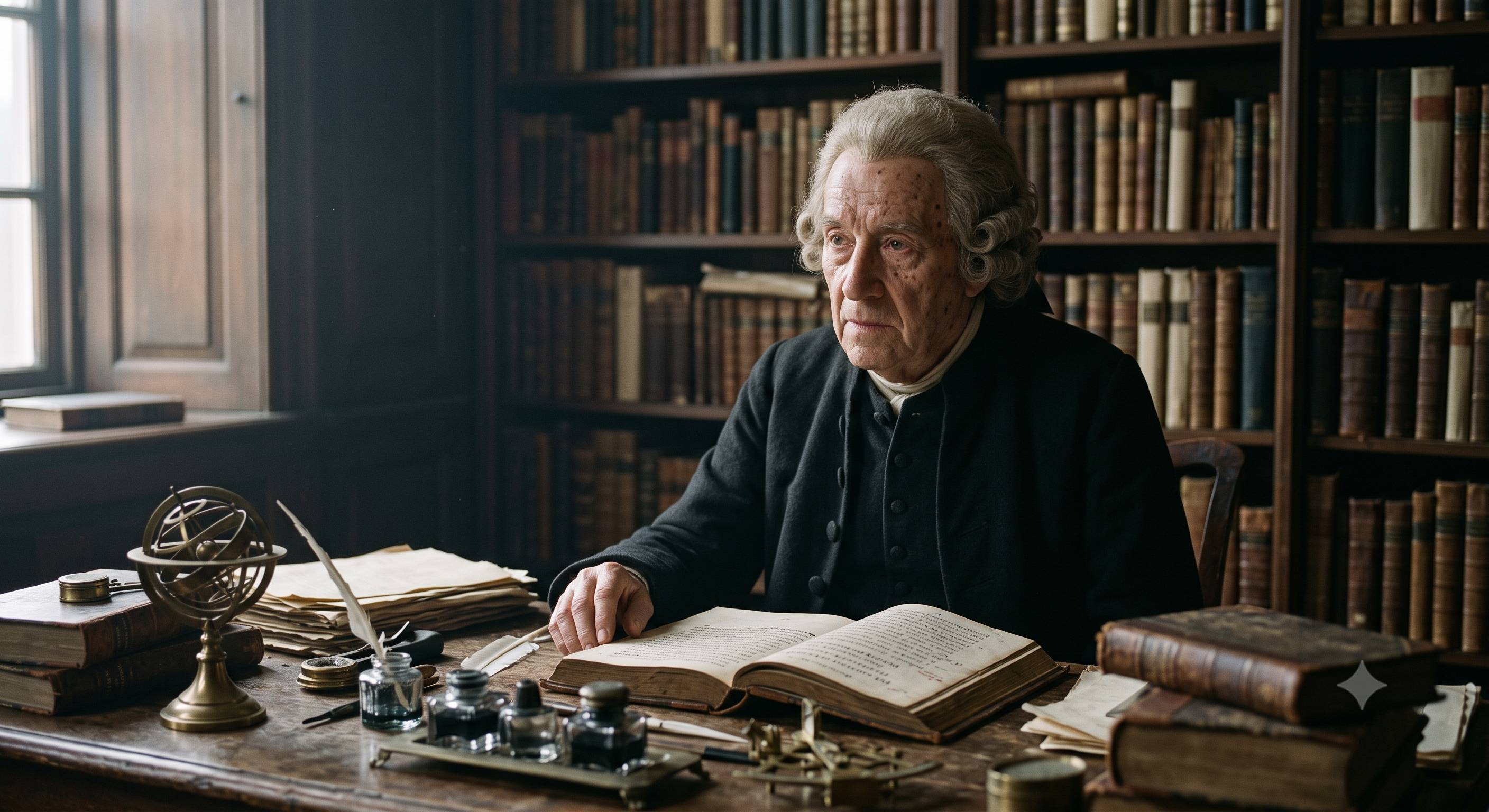
Emanuel Swedenborg: The Polymath Who Mapped Science and Spirit
Emanuel Swedenborg (1688–1772) was a premier Swedish polymath, scientist, and engineer who underwent a dramatic mid-life spiritual transition to become an influential Christian theologian and mystic. His extensive intellectual journey uniquely bridges Enlightenment rationalism and visionary esotericism, introducing a groundbreaking "Doctrine of Correspondences" that deeply impacted Western literature, psychology, and religious philosophy.
Early Life and Education
Born Emanuel Swedberg in Stockholm, he was the son of Jesper Swedberg, a prominent court chaplain who would later serve as a Lutheran bishop.[1] Raised in an environment heavily saturated with religious discourse, Emanuel pursued his formal education at the University of Uppsala, graduating in 1709.[2]
Following his graduation, he embarked on an extensive multi-year tour of Europe, lodging with scientists, mathematicians, and craftsmen to avidly absorb the mechanics of the early Enlightenment.[1:1] In 1719, his family was ennobled by the Swedish crown, changing their surname to Swedenborg.[1:2]
The Scientific and Polymathic Career
Long before his theological transformation, Swedenborg established a stellar European reputation as a practical scientist, mechanical inventor, and natural philosopher. He spent decades serving as the Assessor for the Swedish Board of Mines, optimizing mining technology and metallurgy.[3]
Metallurgy, Engineering, and Cosmology
In 1716, Swedenborg founded and edited Daedalus Hyperboreus, Sweden's very first scientific journal, which detailed various mechanical inventions—including early blueprints for a submarine and a glider aircraft.[4]
His mature natural philosophy culminated in the three-volume Opera Philosophica et Mineralia published in 1734.[3:1] Within its first volume, Principia Rerum Naturalium, he posited a nebular hypothesis for the origin of the solar system and argued that matter is composed of particles locked in constant vortical motion, anticipating discoveries in modern physics.[2:1]
Prescient Breakthroughs in Neuroanatomy
Driven by an insatiable quest to locate the physical "seat of the soul," Swedenborg spent the late 1730s and early 1740s conducting intense investigations into human anatomy and physiology.[4:1] He published The Economy of the Animal Kingdom (1740–1741) and The Animal Kingdom (1744–1745).[4:2] Though largely unnoticed by his contemporaries, modern scholars have discovered that Swedenborg anticipated several major neurological concepts a century or more before mainstream science, including:
-
The Cerebral Cortex: He identified the cortex as the locus of higher psychical and mental functions.[3:2]
-
The Neuron Concept: He conceptualized the basic framework of the nerve cell and localized mental processes.[2:2]
-
Glandular and Fluid Dynamics: He correctly deduced the functions of the cerebrospinal fluid and the vital significance of the pituitary gland.[4:3]
The Spiritual Crisis and Visionary Transition (1743–1745)
By 1743, Swedenborg began experiencing a profound internal crisis characterized by vivid, turbulent dreams, which he meticulously documented in his private Journal of Dreams.[3:3] This psychological and spiritual unpacking culminated in a series of intense visions of Jesus Christ between 1744 and 1745.[5]
Swedenborg claimed that during these encounters, his spiritual senses were fully opened, allowing him to consciously travel to heaven and hell and converse with angels, spirits, and demons.[2:3] He stated that he was divinely commissioned to abandon worldly learning and dedicate his remaining years to unveiling the true, spiritual architecture of the universe.[3:4]
Theological System and the Doctrine of Correspondences
Swedenborg spent the final 28 years of his life writing nearly 30 volumes of theology, composed entirely in Latin and primarily published anonymously at his own expense.[1:3]
Swedenborgian theology centers on three main pillars: God is singular in essence and person with three distinct aspects; salvation requires a living synthesis of faith and active charity toward one's neighbor; and the spiritual world is a real, structured blueprint that dynamically sustains the physical world.[4:4]
The Science of Correspondences
The absolute cornerstone of Swedenborg's theological architecture is the Doctrine of Correspondences.[4:5] He asserted that reality unfolds across distinct levels of being, where everything existing in the physical world is an effect generated by a spiritual cause.[3:5]
-
The Sun: The natural sun reflects the spiritual sun. Natural solar heat corresponds to Divine Love, while natural solar light corresponds to Divine Wisdom.[2:4]
-
Psyche and Expression: Human emotions and thoughts are non-physical realities that express themselves dynamically through corresponding physical gestures and spoken words.[2:5]
Exegesis and the Inner Senses of Scripture
Applying this doctrine to biblical texts, Swedenborg argued that Scripture possesses a continuous, hidden spiritual meaning beneath its literal historical prose.[3:6] In his monumental eight-volume work Arcana Cœlestia (Heavenly Arcana, 1749–1756), he provided a verse-by-verse exposition of Genesis and Exodus, asserting that the creation narrative is not literal history but an allegorical map of the human soul's spiritual regeneration.[1:4]
His most widely read work, De Coelo et ejus Mirabilibus et de Inferno (Heaven and Hell, 1758), mapped out a concrete, highly populated afterlife where individuals freely gravitate to realms that perfectly match their internal spiritual condition.[4:6]
Later Life, Legacy, and Impact
Swedenborg never attempted to organize a separate religious sect or denomination during his lifetime, contenting himself with mailing his texts to prominent academic libraries and clergymen.[1:5] He published his comprehensive theological summary, Vera Christiana Religio (True Christian Religion), in 1771 at the age of 83.[3:7] He passed away in London on March 29, 1772, reportedly having foretold the exact date of his death to his acquaintances.[6]
Following his death, dedicated readers founded Swedenborgian societies, which eventually evolved into "The New Church".[5:1] His unique harmonization of empirical observation and visionary esotericism exerted a massive, enduring influence on Western thought, deeply inspiring Romanticism, Symbolism, and early psychology—most notably shaping the work of William Blake, Ralph Waldo Emerson, Honoré de Balzac, Charles Baudelaire, Carl Jung, and William Butler Yeats.[6:1]
References
Wikipedia / Emanuel Swedenborg / en.wikipedia.org ↩︎ ↩︎ ↩︎ ↩︎ ↩︎ ↩︎
Britannica / Emanuel Swedenborg: Biography, Philosophy & Theology / britannica.com ↩︎ ↩︎ ↩︎ ↩︎ ↩︎ ↩︎ ↩︎ ↩︎
Swedenborg Society / Emanuel Swedenborg (1688-1772) / swedenborgsociety.wordpress.com ↩︎ ↩︎ ↩︎ ↩︎ ↩︎ ↩︎ ↩︎
Swedenborg Foundation / Correspondences / swedenborg.com ↩︎ ↩︎
Gary Lachman / Swedenborg's Correspondences and Disenchantment / youtube.com ↩︎ ↩︎