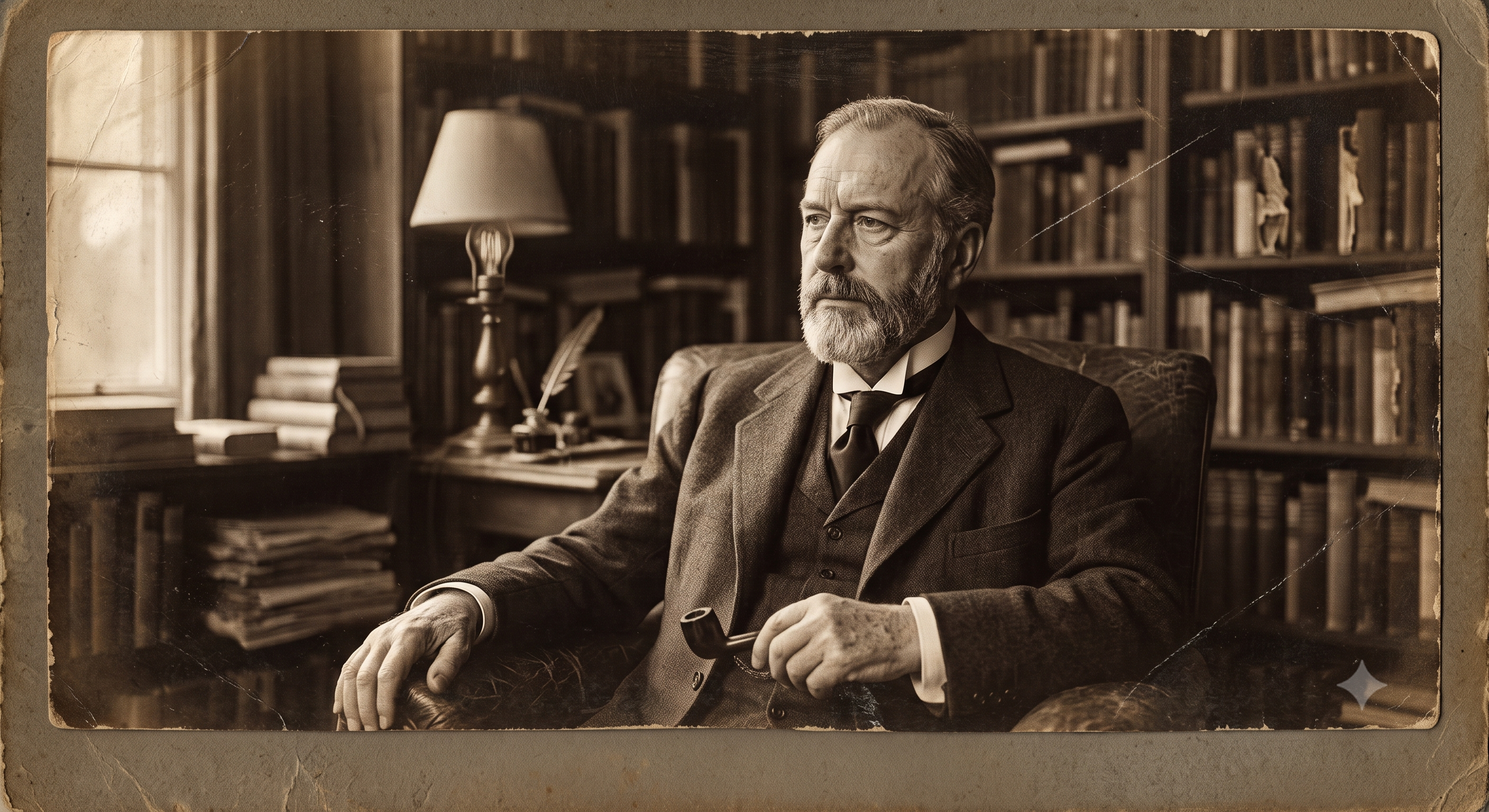
Henry James: Psychological Realism and the William James Dynamic
Henry James (1843–1916) stands as one of the most vital transitional figures between 19th-century literary realism and 20th-century modernism.[1][2] While his older brother, William James, mapped the human mind through the foundational scaffolding of modern psychology and pragmatist philosophy, Henry achieved an identical feat through narrative fiction.[3][4] Frequently described by contemporaries as a writer who "wrote novels like a psychologist," Henry pioneered psychological realism, permanently shifting the focal point of the English novel from external social plotting to the labyrinthine, subjective interiority of human consciousness.[1:1][3:1]
1. Biographical Foundation & The Transatlantic Identity
Born on April 15, 1843, in New York City, Henry James was immersed from infancy in an extraordinary crucible of intellectual privilege.[1:2][4:1] His father, Henry James Sr., was a deeply eccentric Swedenborgian theologian who inherited a massive family fortune, freeing his children from ever having to pursue traditional commercial careers.[3:2] Alongside his older brother William and his brilliant, diarist sister Alice, Henry was subjected to a "haphazard and promiscuous" continental education designed by their father to expose them to fluid, cosmopolitan influences.[2:1]
This peripatetic childhood birthed Henry's lifelong obsession with the Transatlantic identity.[4:2] Finding post-Civil War America culturally thin and barren for artistic rendering, James permanently relocated to Europe in his thirties, eventually settling in England.[2:2] His life became a literal embodiment of his primary literary motif: the clash between the naïve, moral exuberance of the New World and the corrupt, deeply layered wisdom of the Old World.[4:3] In a final act of devotion to his adopted home—and in protest of American neutrality during World War I—he renounced his U.S. citizenship to become a British subject in 1915, just a year before his death.[4:4]
2. The Sibling Dynamic: Henry vs. William James
The relationship between Henry and William James represents one of the most fascinating intellectual dialogues in American history. As children, William was the hyper-active, dominant, and wiry older brother, while Henry cast himself as the quiet, passive "devourer of libraries" and observer.[2:3][4:5] This childhood dynamic crystallized into a profound, lifelong sibling rivalry played out across thousands of pages of personal correspondence.[3:3][5]
Despite their divergent disciplines, their intellectual projects were fundamentally unified:
-
The Shared Subject: Both brothers were obsessed with the mechanics of human consciousness and how an individual processes external stimuli.[3:4][5:1]
-
The Textual Inversion: As literary lore famously states, William wrote psychology textbooks like novels, while Henry wrote novels like psychology texts.[3:5]
-
Stream of Consciousness vs. Central Consciousness: While William was busy coining and formalizing the psychological concept of the "stream of consciousness,"[4:6][5:2] Henry was actively inventing a narrative equivalent. Rather than utilizing an omniscient, god-like narrator, Henry filtered his stories through a "central consciousness"—a specific character's highly limited, biased, and deeply subjective point of view.[6]
For both brothers, the self is not a static soul, but a dynamic construct formed by attention. In William's psychological texts and Henry's fiction, the word "interest" appears constantly. They both argued that it is through the act of noticing and caring that a disjointed series of neurological events coalesces into a coherent human identity.[5:3]
3. Literary Methodology: Psychological Realism
Henry James fundamentally revolutionized the trajectory of the English novel by pioneering psychological realism.[1:3] He rejected the notion that fiction existed merely for escapism, entertainment, or rigid moral lecturing; instead, he demanded that fiction be treated as a fine art that faithfully "represents life."[6:1]
The Interiorization of Action
In traditional realism (pioneered by contemporaries like William Dean Howells), truth was found in meticulous external descriptions—class status, clothing, and drawing-room manners.[6:2] James recognized that in a rapidly shifting modern world, external markers could no longer guarantee internal truth.[5:4] Therefore, he shifted the "action" of the novel inside. For James, a character experiencing a subtle shift in perspective, parsing a moral dilemma, or misinterpreting a glance was far more dramatic than a sudden murder or a bankrupt estate.[5:5][6:3]
The "House of Fiction" and Perspective
In his monumental essay The Art of Fiction (1884) and his later prefaces, James laid down the theoretical foundations of modern narrative.[6:4] He famously conceptualized the novel as a "House of Fiction" featuring millions of windows:[5:6]
"The house of fiction has in short not one window, but a million... They are but windows at the best, mere holes in a dead wall, disconnected, perched aloft... They are not hinged doors opening straight upon life."[5:7]
This structural metaphor emphasizes that there is no single, objective "reality" in a novel; there are only individual, highly circumscribed perspectives.[5:8] This directly paved the way for the unreliable narrators and fragmented perspectives of 20th-century Modernism.[2:4][6:5]
4. Canonical Masterworks & Themes
James's incredibly prolific career—spanning 20 novels, 112 tales, and multiple volumes of criticism—is generally divided into three major phases, moving from accessible social realism to dense, highly abstract psychological probing.[1:4][4:7]
The International Theme: The Portrait of a Lady (1881)
Representing the peak of his middle period, this novel follows Isabel Archer, a fiercely independent, idealistic young American woman who travels to Europe, inherits a fortune, and is systematically ensnared by a pair of sophisticated, deeply cynical expatriates.[1:5][4:8] The novel is a masterclass in psychological realism: the climax is famously not a physical confrontation, but a chapter where Isabel sits alone by a dying fire, silently realizing the terrifying truth of her marriage through a sequence of internal epiphanies.
Narrative Ambiguity: The Turn of the Screw (1898)
James's legendary gothic novella showcases his mastery of the limited perspective.[1:6] Told through the diary of an unnamed governess hired to care for two children at a remote English estate, the story presents ghosts that may or may not be real.[1:7] Because the narrative is entirely trapped within her central consciousness, James forces the reader to decide: is this a genuine supernatural haunting, or a chilling case study of a woman suffering a severe psychological breakdown?[1:8]
The Major Phase: The Ambassadors (1903)
Part of his later, dense style, this novel tracks Lambert Strether, an aging American sent to Paris to retrieve his wealthy fiancée's son.[4:9] Instead of rescuing the young man, Strether succumbs to the rich, aesthetic complexity of Parisian life. The plot is entirely secondary to Strether's internal evolution, capturing the precise, microscopic movements of an aging mind realizing it has missed out on life's sensory richness.[4:10]
References
De Vere Society / Henry James Portfolio / deveresociety.co.uk ↩︎ ↩︎ ↩︎ ↩︎ ↩︎ ↩︎ ↩︎ ↩︎ ↩︎
Wikipedia Contributors / Henry James / Wikipedia ↩︎ ↩︎ ↩︎ ↩︎ ↩︎
Psychology Today / Oh Those Fabulous James Boys! / Psychology Today ↩︎ ↩︎ ↩︎ ↩︎ ↩︎ ↩︎
Encyclopaedia Britannica / Henry James | Novelist, Short Story Writer, Critic / Britannica ↩︎ ↩︎ ↩︎ ↩︎ ↩︎ ↩︎ ↩︎ ↩︎ ↩︎ ↩︎ ↩︎
Modern American Fiction / From Social Realism to Psychological Realism / Pressbooks ↩︎ ↩︎ ↩︎ ↩︎ ↩︎ ↩︎ ↩︎ ↩︎ ↩︎
Scribd Document / Henry James and Psychological Realism / [Scribd](https://www.scribd.com/document/431666145/Psyc-Realis ↩︎ ↩︎ ↩︎ ↩︎ ↩︎ ↩︎