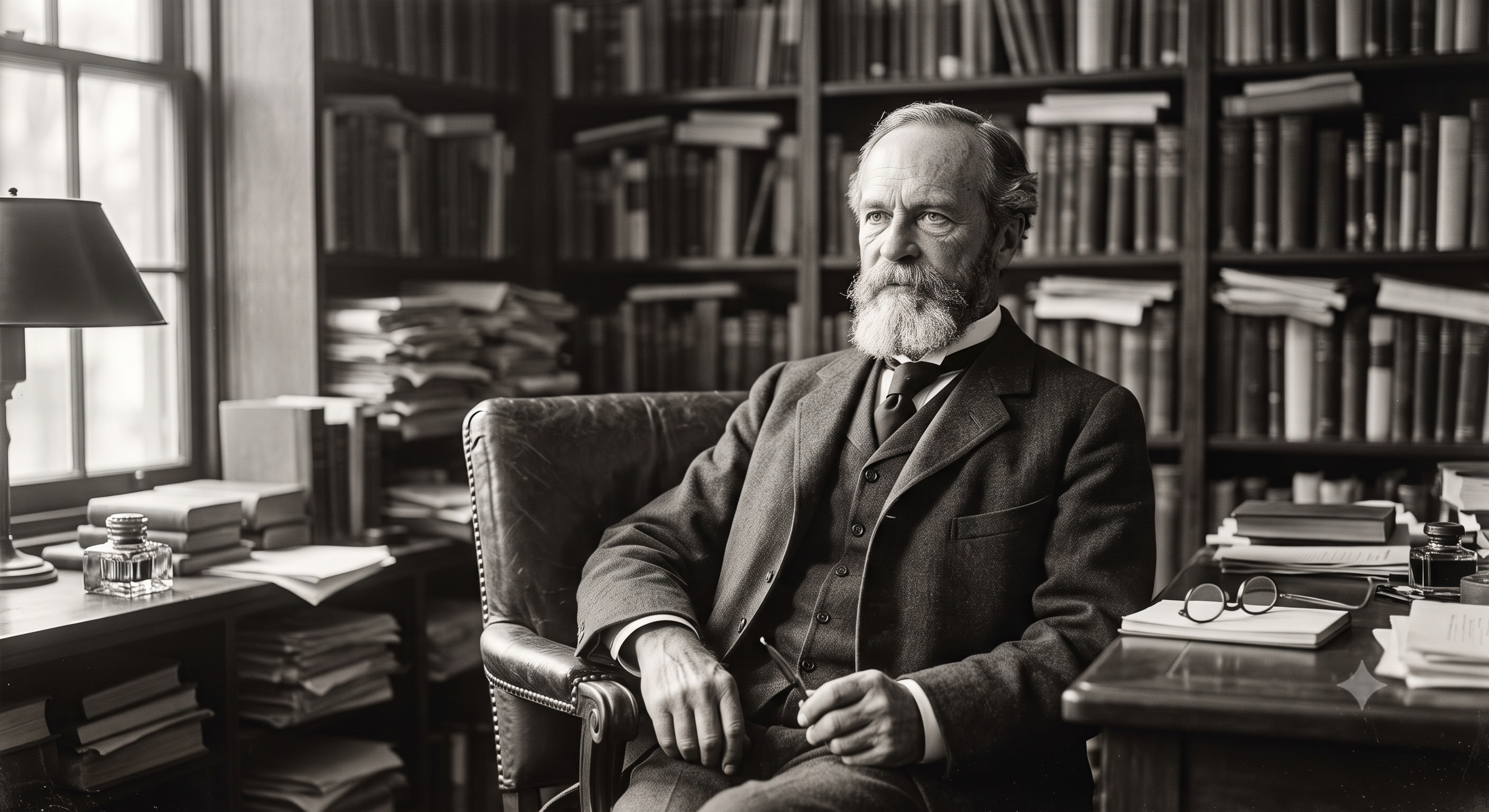
The Pluralistic Mystic: William James and the Landscape of Eastern Thought
William James—the father of American psychology and a cornerstone of Pragmatism—operated at the frontier of Western philosophy. While rooted in empirical observation, his philosophy fundamentally dissolved the rigid dichotomies of Western materialism. This deep dive explores the core tenets of James's thought and highlights his remarkable, often prophetic convergences with Eastern philosophical traditions—specifically Advaita Vedanta, Samkhya-Yoga, and Buddhism.
The Radical Horizon of William James
To understand William James is to understand a mind in open revolt against the "block universe"—the deterministic, sterile, and hyper-rationalist view of reality that dominated the late 19th century. James constructed a philosophical triad designed to preserve human agency, vitality, and mystery:
-
Pragmatism: The truth of an idea is determined by its "cash-value" in experiential terms. If a belief works practically and bears positive fruits for human life, it possesses genuine truth-value.
-
Pluralism: Reality is not an absolute, static Monolith (or "One"), but an open-ended, shifting, and interconnected web of relations. It is a universe of "ever-not-quite."
-
Radical Empiricism: Traditional empiricism only counted isolated sense data. James argued that a truly radical empiricism must account for the entire spectrum of human experience—including the transitions, feelings, relations, and mystical states that tie our moments together.
It was precisely this openness to the full continuum of human consciousness that naturally drew James toward the complex landscapes of Eastern thought.
The Meeting of Minds: James and Vivekananda
In the late 19th century, Asian spiritual traditions began filtering deeply into the American intellectual mainstream. A pivotal moment occurred in October 1894, when James met Swami Vivekananda, the charismatic monk who introduced Vedanta and Yoga to the West, at a dinner in Cambridge, Massachusetts.[1]
James was profoundly struck by Vivekananda’s presence and intellectual scope, famously describing him as "a wonder for oratorical power" and "an honor to humanity." He frequently invited Vivekananda to Harvard, culminating in the Swami’s historic address to the Harvard Graduate Philosophy Club in 1896.
The Tension: Monism vs. Pluralism
Despite his immense respect for Vivekananda, James wrestled deeply with the absolute non-dualism (Advaita) of Vedanta.
-
The Vedantic View: Advaita Vedanta claims that ultimate reality is an undifferentiated Oneness (Brahman), and the individual self (Atman) is entirely identical to this supreme reality.
-
The Jamesian Critique: James feared that a totalizing, absolute Monism stripped individual human struggles of their unique meaning. He preferred a "concatenated union"—a shifting network where we are intimately linked to one another but maintain our distinct boundaries.
While James resisted the all-absorbing absolute of Advaita Vedanta, he found a much more comfortable metaphysical home in the dualistic framework of Samkhya-Yoga, which cleanly separated pure consciousness (Purusha) from the shifting manifestations of material nature (Prakriti).[2]
The Stream of Consciousness and Buddhist Anatta
Nowhere is James’s connection to Eastern thought more striking than in his convergence with Buddhist psychology—a parallel so precise that James is frequently noted to have remarked that his work was merely a Western formulation of what Buddhism had discovered centuries prior.[3]
"It Thinks" vs. The Sovereign Self
In his monumental work The Principles of Psychology (1890), James revolutionized Western psychology by coining the phrase "stream of consciousness." He famously argued that consciousness does not present itself chopped up into neat, static bits; it flows like a river.
Crucially, James asserted that when we look inside, we never find a permanent, unchanging "ego" or "thinker" pulling the strings behind the scenes.[4] Instead, he wrote:
"If we could say in English 'it thinks,' as we say 'it rains' or 'it blows,' we should be stating the fact most simply and with the minimum of assumption. As we cannot, we must simply say that thought goes on."
This is an exact Western echo of the fundamental Buddhist doctrine of Anatta (or Anatman): the concept of no-self. Buddhism posits that what we call the "self" is merely an ever-shifting confluence of five aggregates (skandhas)—sensations, perceptions, mental formations, consciousness, and physical form. There is no fixed "CEO" in the mind; there is only the flow.
"Sciousness" vs. "Con-sciousness"
James even experimented with terminology to isolate this non-dual state of awareness. He differentiated between two modes of the mind:[5]
-
Sciousness: Pure, immediate consciousness-without-self. A state of raw witnessing where the subject-object divide has not yet materialized.
-
Con-sciousness: Consciousness-with-self. The reflective state where the ego steps in, claims ownership of the thought, and says, "This is my experience."
This mirrors the Buddhist distinction between bare, mindful awareness (Sati) and the ego-driven distortions of the deluded mind.
Radical Empiricism and Pure Experience as Non-Duality
In 1904, James published essays like Does 'Consciousness' Exist? and A World of Pure Experience, introducing a concept that deeply anticipated the transmission of Zen philosophy to the West.
James proposed that the primal stuff of reality is "Pure Experience." This is the immediate, raw instant of awareness before the intellect has time to categorize it into "me" (the subject) and "that" (the object).[5:1]
| Dimension | Cartesian / Western Classical View | Jamesian / Eastern Non-Dual View |
|---|---|---|
| Primary Reality | Mind and Matter are fundamentally separate entities. | Pure Experience is the single, undivided baseline of reality. |
| The Ego | The foundational anchor of reality ("I think, therefore I am"). | A downstream construct; a "palpitating core" of emotion within the stream. |
| Subject / Object | Absolute and structural. | Relative perspectives carved out of a unified, immediate moment. |
This concept of Pure Experience aligns seamlessly with the Zen concept of Kensho or Satori—the direct, unmediated apprehension of reality prior to the intervention of dualistic, discursive thought.
The Varieties of Mystical Experience
In his masterwork The Varieties of Religious Experience (1902), James treated mystical states not as psychological aberrations or delusions, but as valid, noetic windows into deeper layers of reality. He established four classic criteria for mystical experiences, all of which map directly onto Eastern meditative achievements like Samadhi (Yoga) or Nirvana (Buddhism):
-
Ineffability: The experience defies expression in words; it must be directly felt.
-
Noetic Quality: The state provides deep, authoritative insights into truths unplumbed by the discursive intellect.
-
Transiency: The intense state cannot be sustained long-term, though its fruits alter the life course.
-
Passivity: The mystic feels as though their own egoic will is placed in abeyance, gripped by a superior power.
Through his pragmatism, James judged these mystical states not by their "roots" (where they came from biologically or historically), but by their "fruits"—their ability to heal, transform, and bring existential peace to the practitioner.
References
Biographies of the Ramakrishna Order / William James, Dr. (1842-1910) / biographies.rkmm.org ↩︎
Cambridge University Press / William James on Pure Experience and Samadhi in Samkhya-Yoga / cambridge.org ↩︎
Wikipedia / Buddhism and Science / en.wikipedia.org ↩︎
David Scott / William James and Buddhism: American Pragmatism and the Orient / d-scott.com ↩︎
Association for Transpersonal Psychology / Sciousness and Con-Sciousness: William James and the Prime Reality of Non-Dual Experience / atpweb.org ↩︎ ↩︎