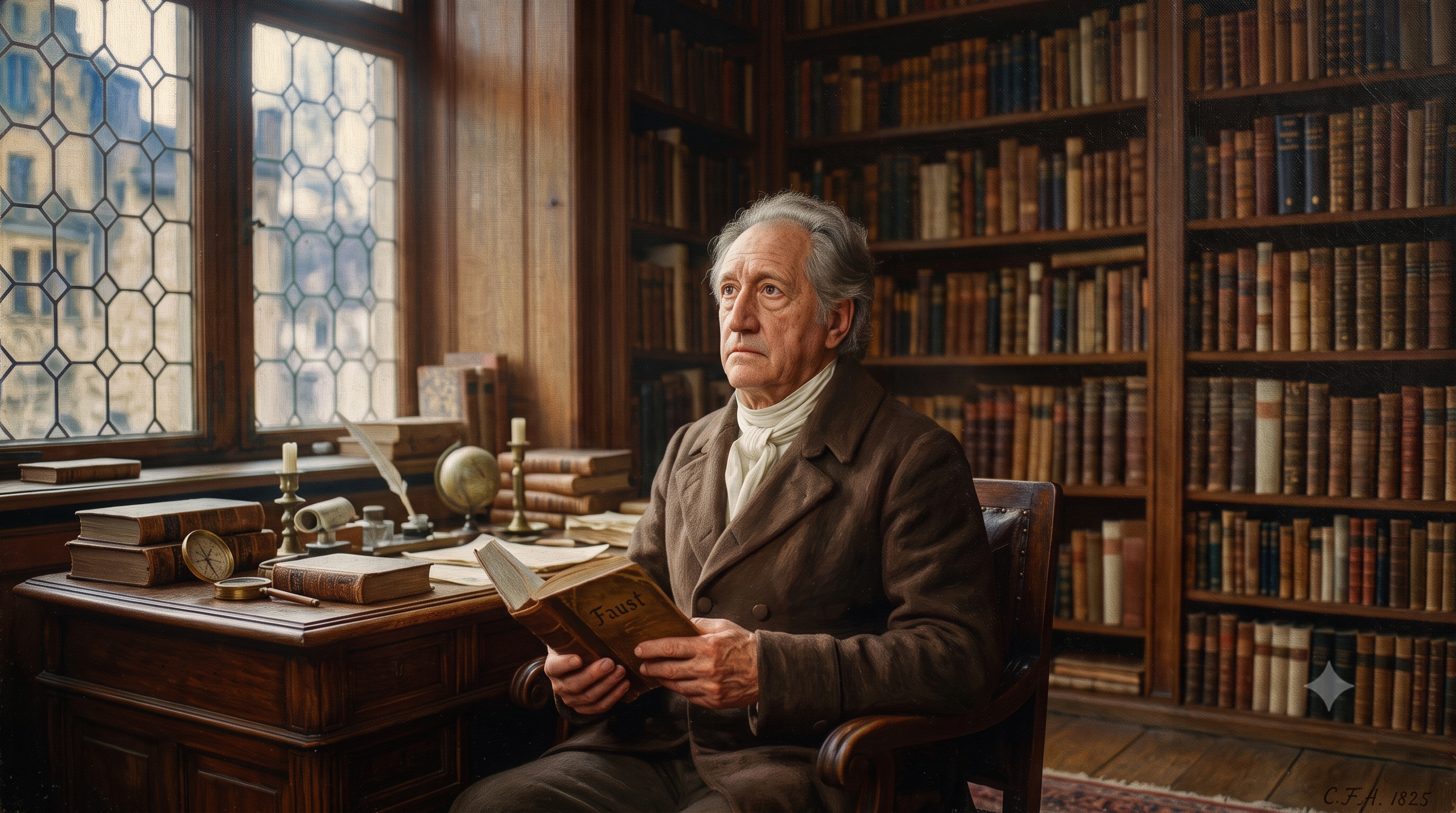
Goethe (1749–1832)
Johann Wolfgang von Goethe was a German polymath: a poet, playwright, novelist, scientist, statesman, and theater director. Widely considered the greatest literary figure of the modern German era, he spearheaded the Sturm und Drang movement and co-founded Weimar Classicism. His magnum opus, the two-part drama Faust, is recognized as a pinnacle of world literature.
Early Life and Education
Johann Wolfgang von Goethe was born on August 28, 1749, in Frankfurt am Main, Germany, into an affluent family.[1] His father, Johann Caspar Goethe, a wealthy man of leisure, meticulously directed his son's early education, envisioning a prestigious legal career for him.[1:1]
In 1765, Goethe departed for the University of Leipzig to study law.[1:2] Following a period of severe illness, he completed his legal studies in Strasbourg between 1770 and 1771.[1:3] It was during this period that Goethe began to transition from conventional legal aspirations toward his true calling in literature.
The Sturm und Drang Movement
Goethe became a leading voice in Sturm und Drang ("Storm and Stress"), a proto-Romantic movement characterized by intense emotion, individualism, and rebellion against Enlightenment rationalism.
In 1774, he published The Sorrows of Young Werther (Die Leiden des jungen Werthers). This epistolary novel, detailing the fatal, unrequited love of a highly sensitive artist, resonated deeply across Europe.[2] It brought Goethe instantaneous international fame and heavily influenced early Romanticism.
The Sorrows of Young Werther initiated a phenomenon known as "Werther Fever," profoundly impacting fashion, literature, and European youth culture in the late 18th century.
The Weimar Years and Italian Journey
In 1775, Goethe moved to Weimar at the invitation of Duke Karl August. For the next decade, Goethe devoted himself largely to administrative and political duties, serving in various governmental capacities, including the War Commission and the Mines and Highways commissions.[3] He was ennobled in 1782, becoming "von Goethe," and practically acted as the duchy's prime minister.[3:1]
Feeling stifled by his administrative duties and creatively drained, Goethe slipped away in September 1786 for a transformative journey through Italy.[4] Exploring Venice, Rome, Naples, and Sicily, he immersed himself in Classical antiquity and Renaissance art.[4:1]
The "Italian Journey" (1786–1788) marked a definitive turning point in Goethe's life. He abandoned the emotional turbulence of Sturm und Drang in favor of the symmetry, objectivity, and restraint of Neoclassicism.
Weimar Classicism and Friendship with Schiller
Upon returning to Weimar in 1788, Goethe found himself somewhat isolated, feeling alienated from the burgeoning French Revolution, which he viewed with horror.[5]
However, his intellectual isolation ended in 1794 when he forged a close friendship with the playwright and philosopher Friedrich Schiller.[6] Their decade-long collaboration formed the core of Weimar Classicism, a cultural movement that synthesized Romantic, Classical, and Enlightenment ideals. Together, they sought to bridge the tension between human striving and classical perfection.[7] Their partnership lasted until Schiller's death in 1805, a period Goethe considered one of the happiest and most productive of his life.[6:1]
Scientific Pursuits
Goethe was not merely a man of letters; he considered his scientific research to be of equal importance to his poetry.
-
Botany: In 1790, he published Essay in Elucidation of the Metamorphosis of Plants, a foundational text in plant morphology that later influenced Charles Darwin.[5:1]
-
Color Theory: He authored the Theory of Colours (Zur Farbenlehre), challenging Newtonian physics by arguing that color was not merely a physical phenomenon but an interaction between light, darkness, and human perception.[2:1]
Later Years and Faust
Goethe's crowning literary achievement was Faust, a dramatic poem he worked on for roughly 60 years.[8]
-
Part One (1808): Focuses on Faust's pact with the devil (Mephistopheles) and the tragic fate of Gretchen.
-
Part Two (1832): A sprawling, allegorical exploration of politics, classical mythology, and human striving, sealed by Goethe shortly before his death for posthumous publication.[8:1]
Goethe died of a heart attack on March 22, 1832, in Weimar, at the age of 82.[8:2]
References
Nicholas Boyle / Johann Wolfgang von Goethe - Early Life / Britannica ↩︎ ↩︎ ↩︎ ↩︎
Goodreads / Johann Wolfgang von Goethe / Goodreads ↩︎ ↩︎ ↩︎ ↩︎
Nicholas Boyle / Johann Wolfgang von Goethe - First Weimar period / Britannica ↩︎ ↩︎
Nicholas Boyle / Johann Wolfgang von Goethe - Italian journey / Britannica ↩︎ ↩︎
Nicholas Boyle / Johann Wolfgang von Goethe - Return to Weimar / Britannica ↩︎ ↩︎
Nicholas Boyle / Johann Wolfgang von Goethe - Friendship with Schiller / Britannica ↩︎ ↩︎
Encyclopedia Britannica / Weimar Classicism / Britannica ↩︎
Nicholas Boyle / Johann Wolfgang von Goethe - Last years / Britannica ↩︎ ↩︎ ↩︎