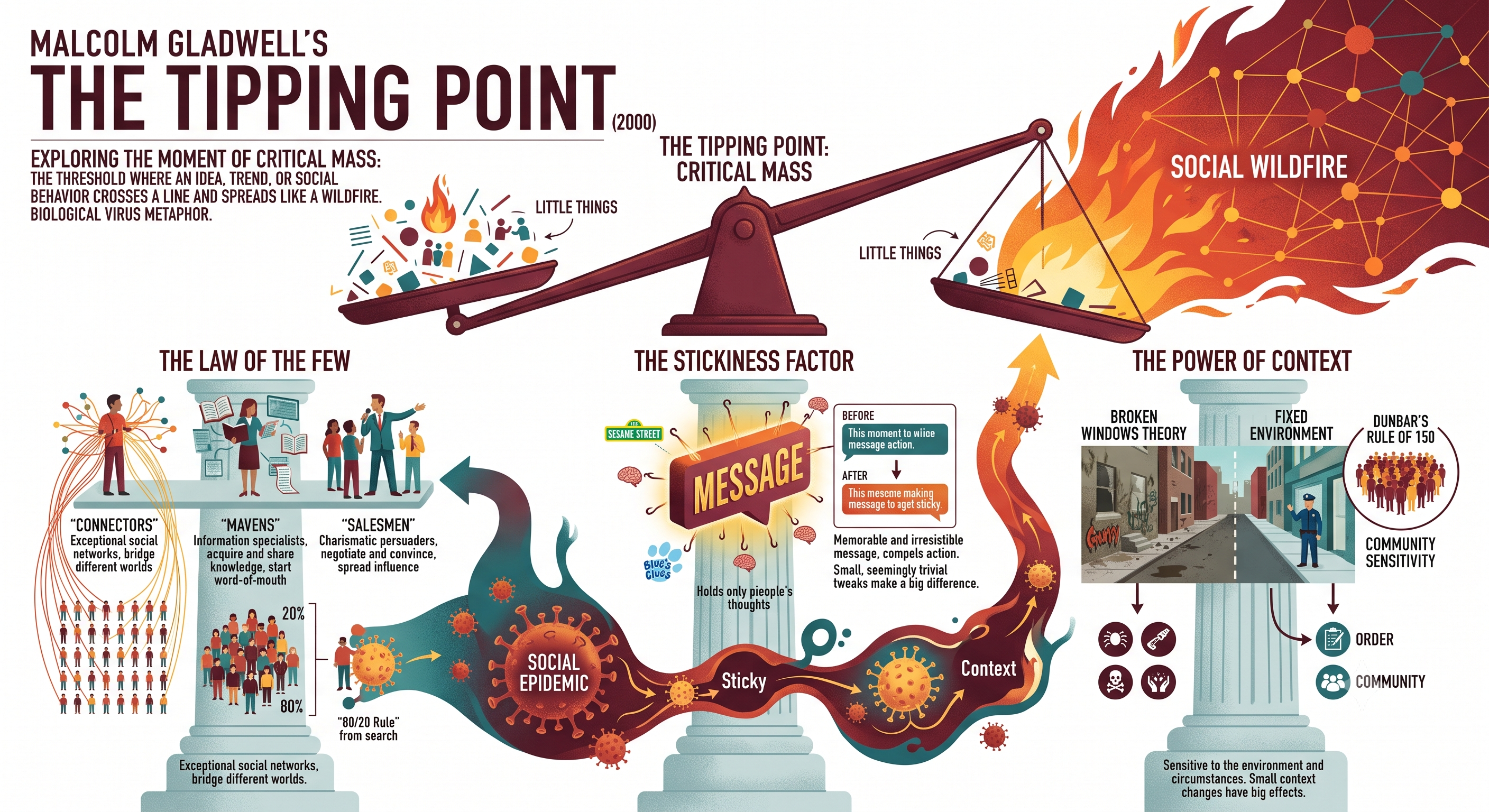
Malcolm Gladwell's The Tipping Point: How Little Things Can Make a Big Difference (2000) explores the moment of critical mass—the threshold where an idea, trend, or social behavior crosses a line and spreads like a wildfire. Gladwell posits that social epidemics behave exactly like biological viruses, driven by three core rules: The Law of the Few, The Stickiness Factor, and The Power of Context.
The Three Rules of Epidemics
Gladwell identifies three main variables that dictate whether a phenomenon will "tip" into a full-blown social epidemic.
1. The Law of the Few
The success of any kind of social epidemic is heavily dependent on the involvement of people with a particular and rare set of social gifts.[1] Gladwell divides these critical agents into three categories:
-
Connectors: Individuals with extraordinarily large social networks. They operate across many different social, cultural, and economic circles, acting as the hubs that link disparate groups together.
-
Mavens: Information brokers who accumulate knowledge and intensely desire to share it with others. They solve others' problems by sharing specialized data.
-
Salesmen: Charismatic individuals with powerful negotiation skills. They are the persuaders whose non-verbal cues and contagious energy convince others to adopt a new idea or behavior.
-
Paul Revere's Ride: When Paul Revere rode to warn the militia that the British were coming, the word spread instantly, and a massive militia mobilized. William Dawes rode a different route with the exact same message, yet almost no one mobilized. Gladwell attributes this to Revere being a Connector; he knew exactly which doors to knock on to trigger a chain reaction.[1:1]
-
The Resurgence of Hush Puppies: In the mid-1990s, the classic American shoe brand Hush Puppies was practically dead. Suddenly, sales skyrocketed. This occurred because a few hipsters in the East Village and Soho began wearing them ironically. These hipsters were Connectors and Mavens who inadvertently sparked a national fashion trend.[1:2]
2. The Stickiness Factor
While the Law of the Few dictates who spreads the message, the Stickiness Factor dictates what the message is. For an epidemic to tip, the message itself must be memorable enough to incite action. Small, seemingly trivial changes in the presentation of an idea can vastly increase its "stickiness."
-
Sesame Street: The creators of Sesame Street aimed to create an educational pandemic to increase literacy. They achieved this by endlessly testing combinations of Muppets and human actors to see exactly what held children's attention (e.g., integrating Big Bird into scenes with humans rather than keeping educational and fantasy segments separate).[1:3]
-
Blue's Clues: Building on Sesame Street's foundation, Blue's Clues increased stickiness by making the show highly repetitive (airing the exact same episode five days in a row) and interactive, pausing to allow children to shout the answers at the screen. This seemingly minor format change revolutionized children's television retention.[1:4]
3. The Power of Context
Human behavior is deeply sensitive to and strongly influenced by its environment. Epidemics are sensitive to the conditions and circumstances of the times and places in which they occur. Gladwell suggests that changing the immediate physical or social environment can radically alter behavior.
"Epidemics are sensitive to the conditions and circumstances of the times and places in which they occur." — Malcolm Gladwell[1:5]
Within the Power of Context, Gladwell highlights two major psychological concepts:
-
The Broken Windows Theory: The idea that visible signs of disorder (like a broken window or graffiti) encourage further crime and disorder.[2]
-
The Rule of 150: Based on Dunbar's Number, this is the cognitive limit to the number of people with whom one can maintain stable social relationships.[3]
-
New York City Subway Crime: In the 1980s, the NYC subway was incredibly dangerous. Rather than focusing immediately on violent crime, transit authorities focused on eradicating graffiti and aggressively cracking down on fare evasion (turnstile jumping). By fixing the "broken windows" of the environment, violent crime rates spontaneously plummeted. The context shifted from lawlessness to order.[2:1]
-
W.L. Gore & Associates (Gore-Tex): The manufacturing company intentionally caps the size of its factories at 150 employees. When a branch grows larger than 150 people, they build another building. By respecting the Rule of 150, the company ensures that peer pressure and social cohesion govern behavior, eliminating the need for rigid middle management.[3:1]
References
Malcolm Gladwell / The Tipping Point: How Little Things Can Make a Big Difference / Little, Brown and Company ↩︎ ↩︎ ↩︎ ↩︎ ↩︎ ↩︎
George L. Kelling and James Q. Wilson / Broken Windows: The police and neighborhood safety / The Atlantic ↩︎ ↩︎
R.I.M. Dunbar / Neocortex size as a constraint on group size in primates / Journal of Human Evolution ↩︎ ↩︎