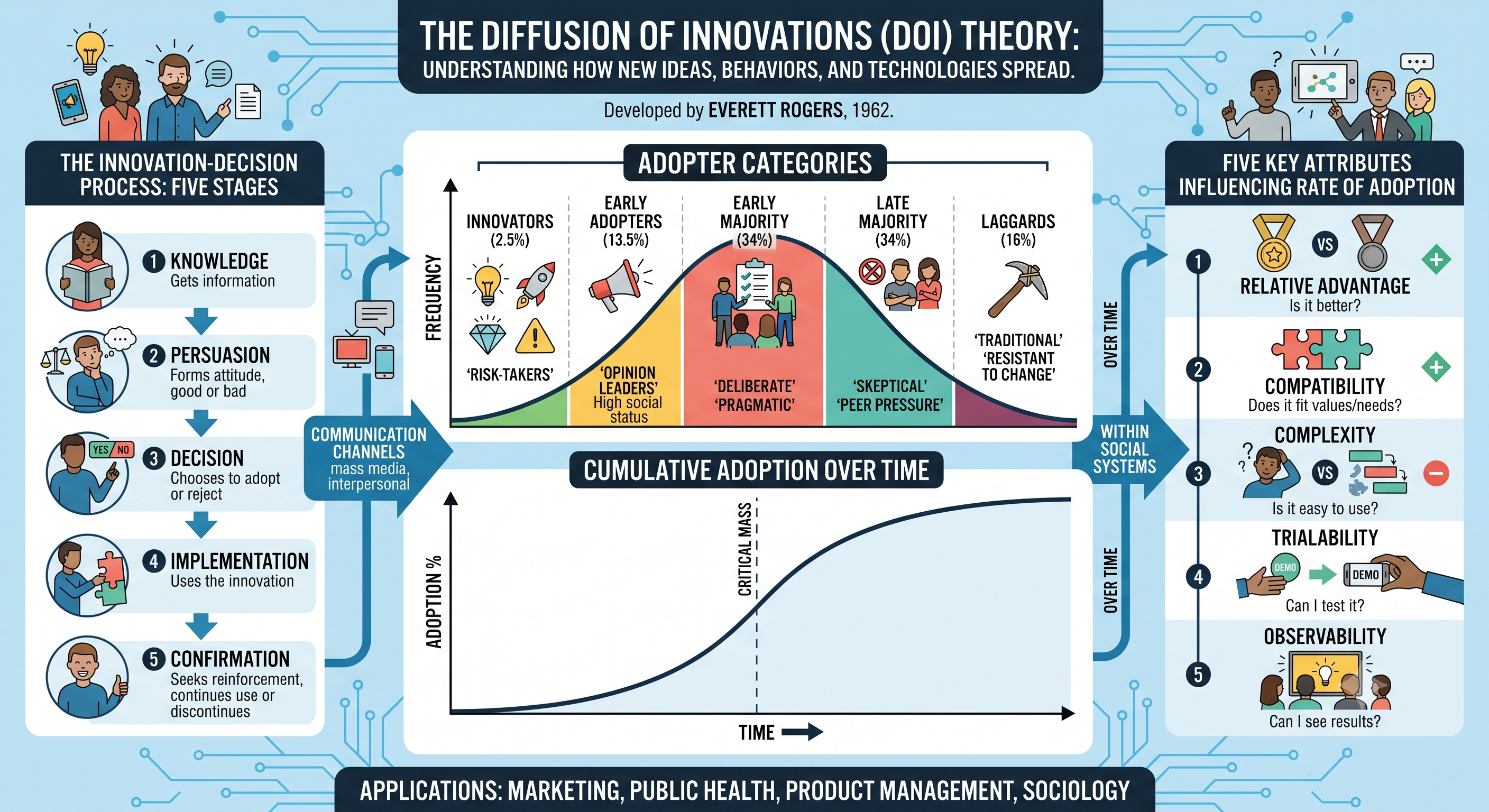
The Diffusion of Innovations (DOI) theory explains how, why, and at what rate new ideas, behaviors, and technologies spread through populations or social systems. Developed by Everett Rogers in 1962, it remains a foundational framework in sociology, marketing, product management, and public health.
Core Elements of the Theory
According to Everett M. Rogers, diffusion is the process by which an innovation is communicated over time among the participants in a social system.[1] The framework relies on four primary pillars:
-
The Innovation: An idea, practice, or object perceived as new by an individual or other unit of adoption.
-
Communication Channels: The means by which messages get from one individual to another (e.g., mass media, interpersonal networks).
-
Time: The speed and timeline over which an individual progresses from first knowledge of an innovation to forming an attitude, adopting, and implementing it.
-
The Social System: A set of interrelated units (individuals, groups, or organizations) engaged in joint problem-solving to accomplish a common goal.
The Five Adopter Categories
Rogers identified five distinct categories of adopters based on their willingness to embrace change. These categories typically follow a standard bell-curve distribution across a given population.[2]
-
Innovators (2.5%): The very first individuals to adopt an innovation. They are risk-takers, often have high social status, financial liquidity, and possess a high tolerance for failure. They are closely connected to scientific or developmental sources.
-
Early Adopters (13.5%): Visionaries and opinion leaders who embrace change early but are more calculated in their choices than innovators. They serve as role models within their social system and are critical to triggering mass adoption.
-
Early Majority (34%): Pragmatic individuals who adopt new innovations slightly before the average person. They are rarely leaders; they need to see concrete evidence and practical benefits before committing to a change.
-
Late Majority (34%): Skeptical and conservative individuals who adopt innovations only after the majority of society has already accepted them. Their adoption is typically driven by economic necessity or intense peer pressure.
-
Laggards (16%): Traditionalists who are highly resistant to change. They are the last to adopt an innovation, often only doing so when their previous tools or methods are entirely obsolete or unsupported.
Management consultant Geoffrey Moore expanded upon Rogers' categories for the tech sector. He identified a significant "chasm" between the Early Adopters (visionaries) and the Early Majority (pragmatists). Many tech startups fail because they cannot adapt their marketing to cross this chasm.[3]
Characteristics Influencing the Rate of Adoption
Not all innovations spread at the same speed. Rogers proposed five key attributes that determine how quickly an innovation is adopted by a social system:[1:1]
-
Relative Advantage: Is the innovation perceived as significantly better than the idea or tool it supersedes?
-
Compatibility: Does it align with the existing values, past experiences, and practical needs of potential adopters?
-
Complexity: Is it difficult to understand or use? Innovations that are simpler to grasp are adopted faster.
-
Trialability: Can it be experimented with on a limited basis without massive upfront investment or risk?
-
Observability: Are the results and benefits visible to others in the social system?
Real-World Examples
1. Hybrid Seed Corn in Iowa (Agriculture)
One of the foundational sociological studies that shaped the DOI theory was the 1943 research by Bryce Ryan and Neal Gross concerning the adoption of hybrid seed corn among Iowa farmers.[4]
-
Innovators/Early Adopters: A few wealthy, educated farmers tested the new seeds on a fraction of their land (Trialability).
-
The Spread: When local opinion leaders saw the massive increases in drought resistance and crop yield (Observability and Relative Advantage), they converted entirely.
-
Late Majority/Laggards: Traditional farmers initially resisted the high upfront cost of buying new seed every year. However, as neighbors consistently outperformed them economically, peer pressure and market necessity forced the laggards to adopt the new seed.
2. The Apple iPhone (Consumer Electronics)
The 2007 launch and subsequent spread of the iPhone is a textbook example of modern technological diffusion.[5]
-
Innovators: Tech enthusiasts who camped outside Apple stores on day one, willing to overlook missing features (like 3G connectivity) to own a breakthrough device.
-
Early Adopters: Professionals who saw its utility for mobile email, internet browsing, and early apps.
-
Majority: The launch of the App Store created an overwhelming Relative Advantage. As iPhones became a cultural status symbol (high Observability), the Early and Late Majorities abandoned their BlackBerries and flip phones.
-
Laggards: Older demographics or those resistant to touchscreens only adopted smartphones when cellular networks began retiring 2G/3G networks, rendering their old devices useless.
3. Electric Vehicles / EVs (Modern Transition)
The global electric vehicle market is currently navigating the diffusion curve.[6]
-
Current State: EVs have largely passed the Innovator and Early Adopter phases (spurred by early Tesla models) and are attempting to fully conquer the Early Majority.
-
Friction Points: Adoption speed is still occasionally bottlenecked by "Complexity" (range anxiety, calculating charging speeds) and "Compatibility" (shifting away from the habitual gas station model). However, high "Observability" (seeing EVs daily on local roads) continues to push the trend upward.
The Diffusion of Innovations theory has been criticized for exhibiting a "pro-innovation bias"—the assumption that all innovations are inherently good and should be adopted by everyone.[7] It sometimes ignores the fact that some innovations have disastrous negative consequences or that resisting an innovation might actually be a rational choice for certain groups.
References
Everett M. Rogers / Diffusion of Innovations, 5th Edition / Simon & Schuster ↩︎ ↩︎
Boston University School of Public Health / Diffusion of Innovation Theory / BU.edu ↩︎
Geoffrey A. Moore / Crossing the Chasm / HarperCollins ↩︎
Bryce Ryan and Neal Gross / The Diffusion of Hybrid Seed Corn in Two Iowa Communities / Rural Sociology Journal ↩︎
Harvard Business Review / The Pace of Technology Adoption is Speeding Up / HBR.org ↩︎
International Energy Agency (IEA) / Global EV Outlook 2023 / IEA.org ↩︎
Thomas W. Valente / Network Models of the Diffusion of Innovations / Hampton Press ↩︎