View Business English Lesson on StudyESL.ca
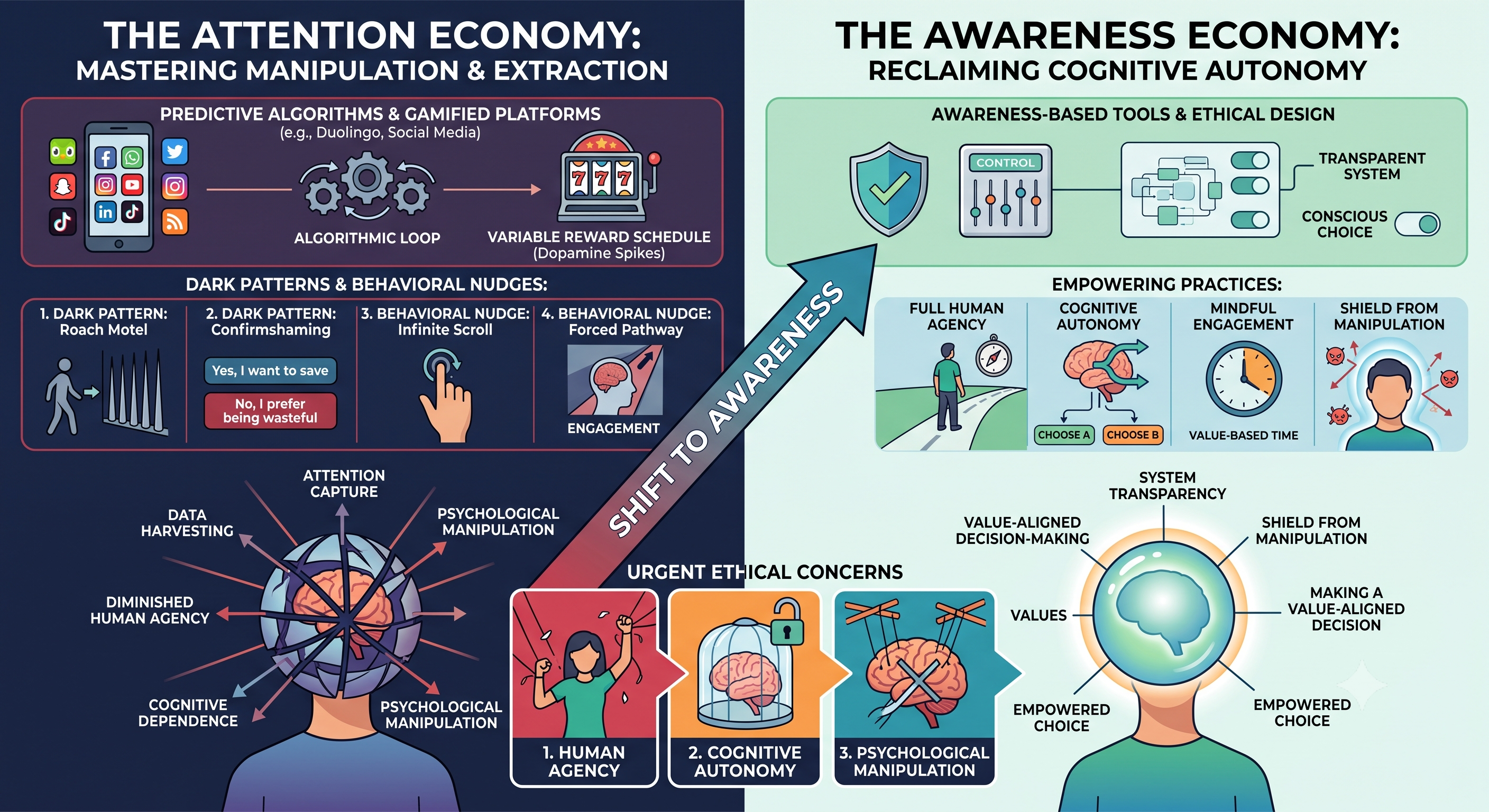
Predictive algorithms and gamified platforms—from Duolingo to mainstream social media—have mastered the "Attention Economy" by leveraging dark patterns, variable reward schedules, and behavioral nudges. However, as the digital landscape begins shifting toward an "Awareness Economy," urgent ethical concerns regarding human agency, cognitive autonomy, and psychological manipulation are coming to the forefront.
1. The Paradigm Shift: Attention vs. Awareness
For the past decade, the dominant business model of consumer technology has been the Attention Economy. In this model, platforms commodify human focus, optimizing for metrics like Daily Active Users (DAU), session length, and churn reduction.
The emerging concept of the Awareness Economy represents a fundamental pivot in digital ethics. Rather than competing for scarce cognitive resources (attention) to drive advertising revenue or artificial engagement, the awareness economy advocates for cognitive sovereignty, intentionality, and sustainable digital integration[1]. In an awareness-driven ecosystem, technology is designed to be "calm," delivering necessary utility without demanding continuous, active engagement or hijacking human behavioral loops[2].
-
Attention Economy: Measures success by time spent on screen and frequency of interaction. Uses friction and behavioral nudges to keep users trapped in the ecosystem.
-
Awareness Economy: Measures success by the seamless integration of technology into the user's life. Values the user's ability to easily disconnect.
2. The Behavioral Nudge Engine: Duolingo and Gamification
While social media platforms use infinite scrolls and algorithmic feeds to create dopamine loops, educational applications like Duolingo represent a more insidious form of behavioral design because they masquerade as pure utility.
Duolingo relies heavily on psychological mechanisms such as streak maintenance, leaderboards, and in-app currencies to drive user retention[3]. This aggressive gamification raises significant ethical questions regarding emotional manipulation.
Predictive Algorithms in Notification Design
Behind the seemingly innocuous push notifications is sophisticated predictive machinery. Duolingo's engineering teams have utilized complex multi-armed bandit models, specifically developing the "Recovering Difference Softmax Algorithm," to mathematically optimize the timing, tone, and delivery of millions of daily reminders[4].
The application uses these algorithms to execute what some critics describe as a psychological warfare campaign, escalating from friendly reminders to passive-aggressive guilt trips (often featuring the app's mascot, Duo the Owl, looking visibly disappointed)[5].
The "False Fluency" Dilemma
When an algorithm prioritizes engagement over true educational outcomes, it creates a misalignment of incentives. The dopamine hits provided by Duolingo's variable reward schedule often lead to "false fluency." Users feel a high degree of accomplishment because they are successfully navigating the game mechanics, even if they fail to retain the language skills necessary for real-world conversation[6].
3. The Erosion of Cognitive Autonomy
The most pressing ethical issue surrounding predictive algorithms is the erosion of human agency. When platforms deploy hyper-gamification and behavioral economic principles—such as positive reinforcement and loss aversion—they bypass the user's rational decision-making faculties[7].
Delegating habit-formation and daily routines to predictive algorithms generates deep moral concerns about human freedom, transparency, and cognitive autonomy[8].
When users interact with algorithm-intense environments daily, their worldviews and habits slowly adapt to the affordances provided by the machine[9]. If those affordances are built on "dark patterns"—UI/UX designs intentionally crafted to manipulate or guilt the user into specific actions—the platform is actively undermining the user's cognitive sovereignty.
4. Designing for the Awareness Economy
Transitioning away from the extractive practices of the attention economy requires structural changes in how software is designed and how success is measured. To build ethical, awareness-driven technology, platforms must adopt new behavioral standards:
-
De-weaponizing Notifications: Moving away from predictive models designed purely to maximize open rates, and instead allowing users to set strict, intentional boundaries for when and how they are interrupted.
-
Ethical Gamification: Ensuring that game mechanics align with genuine user goals (e.g., actual skill acquisition) rather than arbitrarily inflating platform metrics.
-
Transparent Algorithms: Providing users with clear insights into why they are being shown specific content or nudged toward a certain behavior, restoring their ability to consent.
Until these principles are widely adopted, ethical business practices in the tech sector will remain the responsibility of individual trailblazers who actively choose to prioritize the awareness economy over short-term growth[10].
References
Friedrich Glauner / Future Viability, Business Models, and Values / National Academic Digital Library of Ethiopia ↩︎
Abdullah Shah / The Silent Revolution: How Calm Technology Might Redefine Digital Life in 2026 / Medium ↩︎
Decalex / Duolingo Dark Patterns: How Gamification and Psychology Drive Engagement / Decalex ↩︎
Yancey et al. / A Sleeping, Recovering Bandit Algorithm for Optimizing Recurring Notifications / Duolingo Research ↩︎
Sohail Saifi / How Duolingo's Gamification Actually Manipulates Dopamine Receptors / Medium ↩︎
Sohail Saifi / How Duolingo's Gamification Actually Manipulates Dopamine Receptors / Medium ↩︎
Advances in Consumer Research / Gamification, Consumer Engagement, and Behavioral Economics: Insights from E-Commerce Platforms / ACR Journal ↩︎
Alan Rubel, Clinton Castro, Adam K. Pham / Algorithms and Autonomy / Berkeley Law ↩︎
Diva Portal / Human agency and autonomy in algorithm-intense environments / Uppsala University ↩︎
Friedrich Glauner / Future Viability, Business Models, and Values / National Academic Digital Library of Ethiopia ↩︎