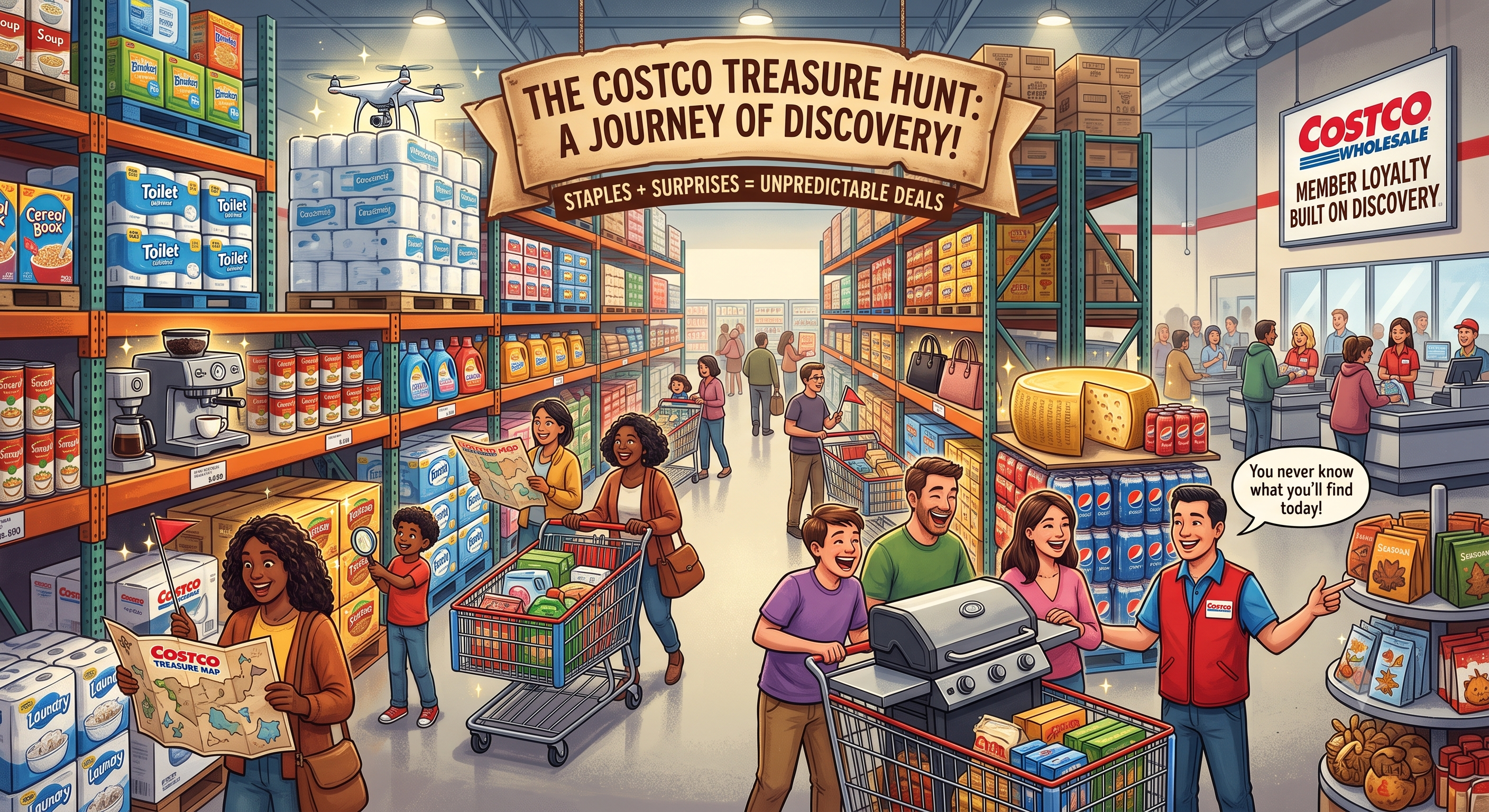
The Costco "Treasure Hunt" is a meticulously engineered retail merchandising strategy designed to drive impulse purchases, maximize customer dwell time, and foster intense brand loyalty. By mixing everyday household staples with a constantly rotating selection of high-quality, unpredictable goods, Costco transforms routine grocery shopping into an emotionally engaging game of discovery.
The Costco "Treasure Hunt"
1. The Anatomy of the Treasure Hunt
Unlike traditional supermarkets—which rely on predictable layouts and highly visible aisle markers so customers can shop efficiently—Costco’s warehouse environment is intentionally disorienting. The "Treasure Hunt" is built on a few core operational principles:
-
Intentional Unpredictability: Costco routinely moves essential staple items (like milk, paper towels, and peanut butter) to different locations. Because there are no overhead aisle signs, customers are forced to wander through multiple aisles to find what they need, exposing them to more merchandise.[1]
-
Hyper-Curation (Limited SKUs): While a typical grocery store carries between 40,000 and 50,000 distinct items (SKUs), a standard Costco warehouse only stocks roughly 3,700.[2] This intense curation means every item on the floor has "earned" its space, and customers implicitly trust the quality of the selection.[3]
-
The Mix of Mundane and Luxury: The strategy relies on juxtaposing bulk toilet paper with sudden, unexpected premium items—such as a $50 set of high-end kitchen knives, designer apparel, or even diamond rings.[1:1]
2. The Business Purpose: What Costco is Trying to Achieve
Costco operates on incredibly thin retail margins—marking up products by an average of just 11%, compared to the 25% to 50% seen in standard retail.[3:1] Because the company makes the vast majority of its profit from annual membership fees rather than product margins, the in-store experience must be designed to maximize volume and membership retention.
The primary goals of the Treasure Hunt experience are:
-
Increasing Basket Size: By forcing shoppers to navigate a "racetrack" layout to find essentials, Costco vastly increases the surface area of products a customer sees. This converts single-item trips into massive, impulse-driven hauls.[1:2]
-
Driving Repeat Foot Traffic: Because inventory rotates without warning, customers know they must visit the store frequently to see what new, limited-time items are available.[2:1]
-
Validating the Membership Fee: The thrill of finding an exceptional deal on a high-end item provides a psychological justification for the upfront cost of the annual membership card.[4]
Costco further amplifies this effect using "Roadshows"—temporary, weekend-only vendor pop-ups within the warehouse. These micro-events act as hyper-concentrated treasure hunts, driving high conversion rates because shoppers know the vendor will be gone by Monday.[2:2]
3. The Psychology Behind the Experience
The effectiveness of the Treasure Hunt model relies on heavily researched behavioral economics and cognitive psychology frameworks.
Variable Rewards and Dopamine
Humans are cognitively wired to respond strongly to unpredictable rewards. When a shopping outcome is entirely predictable, it feels like a chore. However, when a reward is possible but uncertain, it triggers anticipation. Finding an unexpected, high-value item at a steep discount causes a spike in dopamine (a neurotransmitter linked to reward and pleasure). Over time, members begin to associate the physical Costco warehouse with this positive chemical response, making the act of shopping mildly addictive.[2:3]
Authentic Scarcity and FOMO
Most retailers manufacture artificial urgency (e.g., "Flash Sale ends in 24 hours!"). Costco's scarcity, however, is structural and authentic. Because of the limited SKU count and pallet-drop supply chain, when an unexpected item sells through, it is often gone forever. This triggers severe Loss Aversion and the Fear Of Missing Out (FOMO). Perceived scarcity forces consumers to abandon long decision-making processes and buy on impulse, knowing they likely cannot return for the item tomorrow.[4:1]
The Gruen Effect
Store environments that are large, confusing, and overwhelming tend to induce "The Gruen Effect" (named after mall architect Victor Gruen). When shoppers become slightly disoriented, their primary intent (sticking to a shopping list) breaks down, making them highly susceptible to impulse purchases and emotional buying.[4:2]
While highly profitable, the psychological manipulation of the Treasure Hunt can create friction. Psychologists note that the combination of massive crowds, genuine scarcity, and FOMO can trigger "contagion theory"—causing normally polite shoppers to become irrational, overly competitive, and rude as they navigate the chaotic warehouse environment.[4:3]
References
Epirus VC / Costco's Treasure Hunt Shopping Model: Fun Adventure or Frustrating Maze? / epirus.vc ↩︎ ↩︎ ↩︎
MOJO Sales & Branding / Costco Treasure Hunt Strategy: The Retail Psychology Every Roadshow Brand Must Master / mojosalesandbranding.com ↩︎ ↩︎ ↩︎ ↩︎
TwinMind / Behind Costco's Treasure-Hunt Shopping Strategy / twinmind.com ↩︎ ↩︎
Inc. Magazine / Costco Brings Out the Worst in People. Psychology Explains Why / inc.com ↩︎ ↩︎ ↩︎ ↩︎