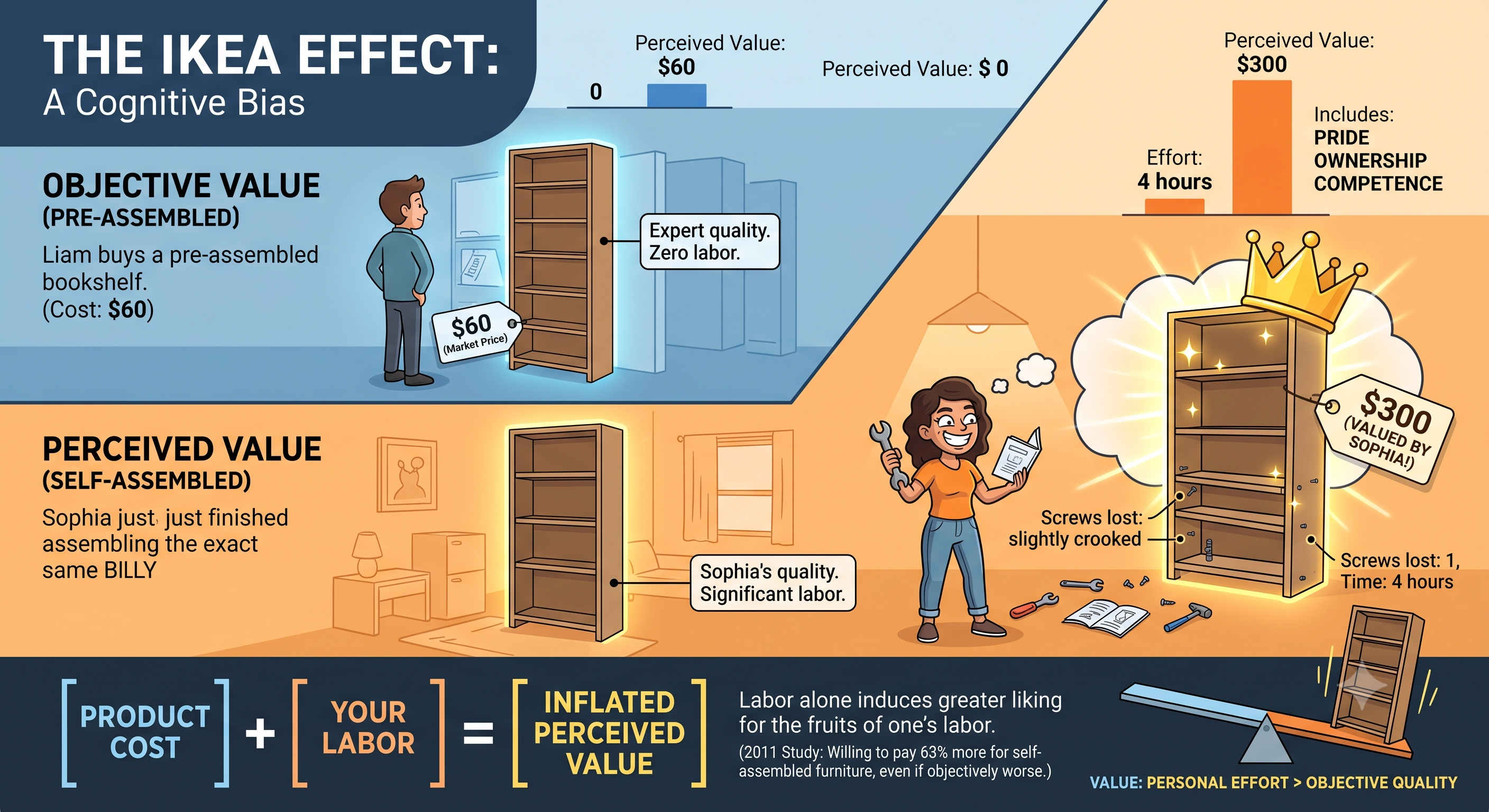
The IKEA effect is a cognitive bias in which consumers place a disproportionately high value on products they partially created or assembled themselves.[1] This psychological investment is often compounded by the consumer's physical journey—or wayfaring—through the retail environment before the product is even purchased.[2]
Origin and Discovery
The term was coined by researchers Michael I. Norton, Daniel Mochon, and Dan Ariely in a 2011 study.[1:1] The name references the Swedish furniture retailer, IKEA, which is famous for selling flat-pack products that require self-assembly. In their initial experiments, the researchers found that subjects were willing to pay 63% more for furniture they had assembled themselves compared to identical, pre-assembled items.[1:2]
The Role of Retail Wayfaring
To fully understand the IKEA effect in its native context, one must look at the consumer's experience prior to assembly: the physical navigation of the store. Wayfaring (the act of traveling on foot) and wayfinding (how people orient themselves in physical space) play crucial roles in priming the consumer for the cognitive bias.[2:1]
IKEA stores are famously designed as a "fixed-path" or one-way maze. This forced wayfaring achieves several psychological goals that amplify the IKEA effect:
-
Sunk Cost and Physical Investment: Before a customer even unboxes a flat-pack chair, they have already invested significant time and physical energy walking through the labyrinthine showroom. This forced wayfaring establishes a baseline of effort justification.[2:2]
-
The Gruen Effect: The disorienting, immersive journey through fully furnished rooms induces a state of mild psychological submission, often leading to impulse purchases. By the time the consumer reaches the warehouse to pull their heavy boxes, they are fully invested in the narrative of the product.[3]
-
The Journey Narrative: The combination of wayfaring through the store, physically transporting the flat-pack home, and assembling it transforms a simple transaction into an active, labor-intensive journey. The effort spent navigating the physical space directly compounds the value assigned to the final, built object.[2:3]
Psychological Mechanisms
Beyond the retail journey, why do humans overvalue things they build? The IKEA effect is driven by several overlapping psychological phenomena:[4]
-
Need for Effectance: Humans have a fundamental psychological need to feel competent and capable of successfully producing desired outcomes in their environment. Successfully completing a task, even a simple one like building flat-pack furniture, helps fulfill this need for control and capability.[1:3]
-
Effort Justification: When people invest time and physical effort into a task (including the wayfaring required to acquire it), they unconsciously rationalize that effort by attributing greater value to the final product. If the effort was high, the brain assumes the outcome must be highly valuable.[5]
-
Endowment Effect and Ownership: The IKEA effect is closely related to the endowment effect (valuing things more highly just because you own them), but it goes further by requiring the person to actively contribute labor. Personal involvement in creation generates a profound sense of psychological ownership.[4:1]
Business and Real-World Applications
Companies frequently leverage the IKEA effect to increase customer loyalty and perceived value, often while actively reducing their own production or assembly costs.[4:2]
-
The Food Industry: In the 1950s, General Mills struggled to sell Betty Crocker instant cake mixes because they were deemed "too easy." Psychologist Ernest Dichter advised them to remove the powdered eggs from the mix and require bakers to add fresh eggs themselves. Adding this small labor requirement increased the baker's sense of ownership and massively boosted sales.[5:1]
-
Customization Platforms: Brands like Build-A-Bear, or companies offering customizable electronics and sneakers, utilize the IKEA effect. By letting customers choose colors, patterns, and features, the customer feels they actively "designed" the product, increasing their willingness to pay a premium.[4:3]
-
Workplace Engagement: In organizations, the IKEA effect can be seen when employees are involved in bottom-up goal setting and problem-solving. When workers contribute to building a strategy or setting objectives, they show higher levels of ownership, pride, and commitment to executing those goals than if the strategies were handed down from the top.[1:4]
Limitations and Caveats
While powerful, the IKEA effect has specific psychological boundaries:
The IKEA effect only occurs if the assembly or creation process is ultimately successful. If a participant fails to complete the task, or if they are instructed to disassemble their creation immediately after building it, the cognitive bias disappears, and they do not overvalue the item.[1:5]
The required labor must hit a specific "sweet spot." It must be challenging enough to induce a sense of accomplishment and pride, but not so difficult that it causes extreme frustration or abandonment.[5:2]
References
Michael I. Norton, Daniel Mochon, Dan Ariely / The "IKEA Effect": When Labor Leads to Love / Harvard Business School ↩︎ ↩︎ ↩︎ ↩︎ ↩︎ ↩︎
Alan Penn / The Complexity of the Elementary Interface: Shopping Space / UCL Discovery ↩︎ ↩︎ ↩︎ ↩︎
The Decision Lab / The Gruen Effect / The Decision Lab ↩︎
Think Insights / The IKEA Effect / Think Insights ↩︎ ↩︎ ↩︎ ↩︎
Adcock Solutions / What is the IKEA Effect? / Adcock Solutions ↩︎ ↩︎ ↩︎