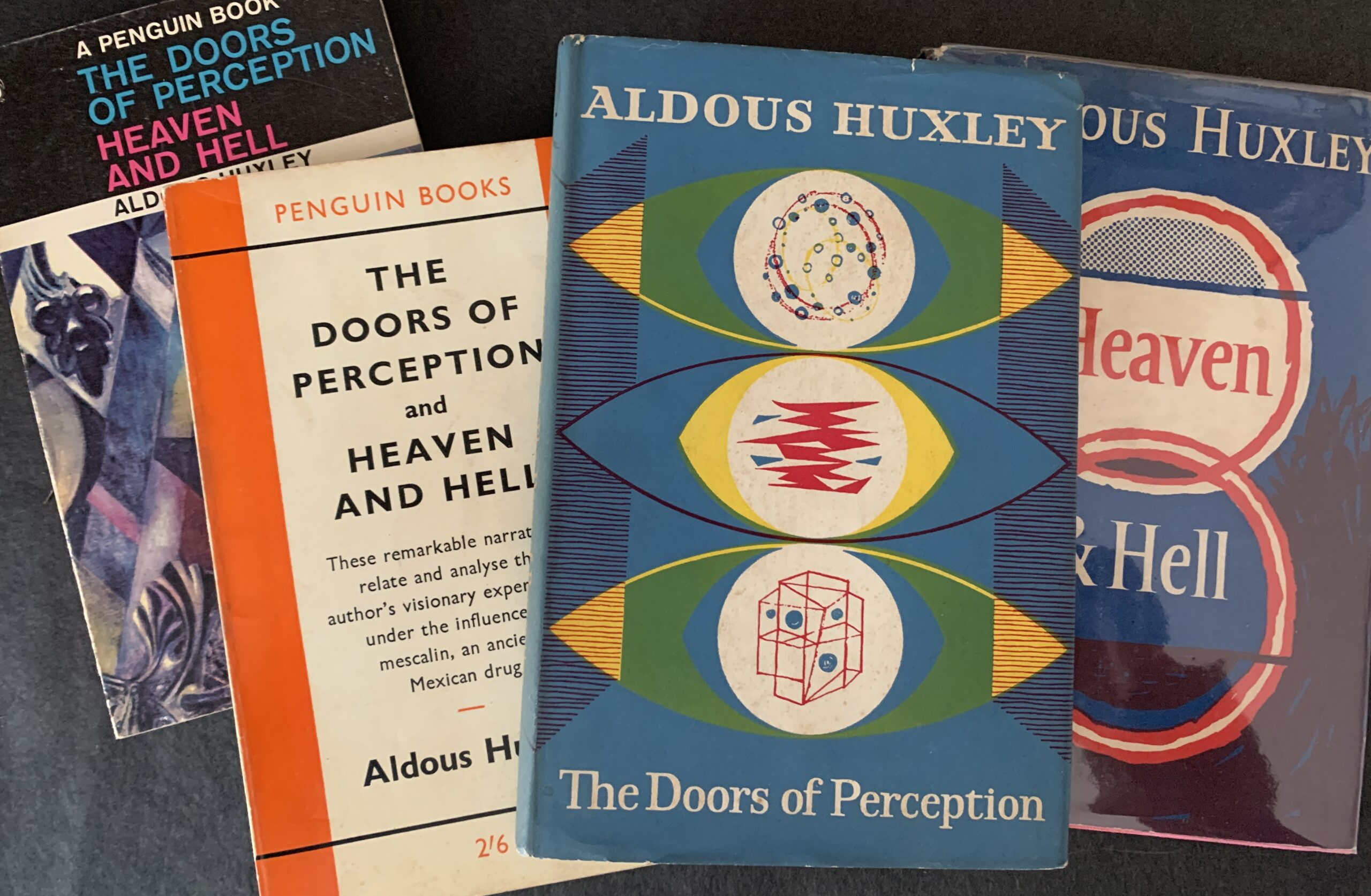
Aldous Huxley’s Heaven and Hell (1956) serves as the necessary, darker counterpart to his celebrated 1954 psychedelic treatise, The Doors of Perception.[1] While The Doors of Perception focused predominantly on the ecstatic, ego-dissolving radiance of mescaline, Heaven and Hell expands this theoretical framework to confront the terrifying, infernal dimensions of visionary experience.[2] Huxley asserts that the human mind contains vast, autonomous regions—the "Antipodes of the Mind"—capable of delivering not only divine beatitude ("Heaven"), but also nightmare-fueled alienation and psychological torment ("Hell").[1:1]
In Heaven and Hell, Aldous Huxley maps the dual polarity of altered consciousness. Drawing on art history, biochemistry, and ascetic traditions, he argues that the brain acts as a biological "reducing valve." When this filter fails—whether through psychedelics, starvation, or psychosis—the individual enters the "Mind's Antipodes." Here, visionary experience can manifest either as self-luminous, gem-like splendor or as a terrifying "negative transfiguration" characterized by claustrophobia, eternal stagnation, and psychotic panic.[1:2][3]
The Antipodes of the Mind: Beyond Biological Utility
To describe the unmapped territories of the subconscious, Huxley turns to geographical exploration.[3:1] Just as 18th-century European naturalists traveled to Australia and encountered improbable fauna like the kangaroo and platypus, a psychological explorer venturing past normal waking consciousness encounters autonomous mental phenomena that exist independently of the personal self.[1:3][3:2]
The "Old World" vs. The "Mind's Antipodes"
-
The Old World: The mundane, self-conscious ego driven by biological survival, personal memory, and utilitarian logic.[1:4]
-
The Antipodes: Remote regions of the psyche inhabited by autonomous, non-human visionary forms that do not reflect personal trauma or Freudian symbolism, but exist purely in their own right.[1:5][3:3]
The Brain as a Reducing Valve
Integrating Henri Bergson’s philosophy with neurochemistry, Huxley argues that the primary function of the brain and nervous system is biological survival.[1:6][4] The brain operates as a "reducing valve," filtering out the infinite sea of unmediated sensory data—what Huxley terms Mind at Large—so that humans can focus on practical everyday tasks like gathering food and avoiding danger.[1:7][4:1]
When the biological efficiency of this reducing valve is impaired, the unfiltered contents of the Antipodes flood conscious awareness.[1:8] Huxley notes several primary catalysts for this breakdown:
-
Exogenous Chemicals: Mescaline, psilocybin, and LSD.[1:9][2:1]
-
Physiological Stress: Fasting, vitamin deficiencies (particularly B and C), illness, and fever.[1:10]
-
Sensory Deprivation: Confinement in complete darkness, silence, or isolation tanks.[1:11]
-
Psychological Trances: Deep hypnosis and rhythmic chanting.[1:12]
The Topography of Heaven: Preternatural Light and Luminous Gems
In the "heavenly" quadrant of the Antipodes, perception is transfigured by preternatural light, hyper-saturated colors, and self-luminous geometries.[1:13] Objects in this realm do not represent abstract concepts; their meaning is identical to their existence.[3:4]
               [ Biological Reducing Valve ]
                            │
              ┌─────────────┴─────────────┐
              ▼                           ▼
     [ Heavenly Antipodes ]      [ Infernal Antipodes ]
     • Preternatural Light       • Negative Transfiguration
     • Gem-like Luminous Forms   • Spatial & Temporal Agony
     • Serene Ego-Dissolution     • Psychotic Schizoid Panic
Why Gems and Stained Glass Captivate Human Consciousness
Huxley addresses a long-standing aesthetic puzzle: why do human beings across cultures attribute immense spiritual and economic value to precious stones, fine metals, and stained glass?[1:14]
He argues that gems are physical earth-bound proxies for the self-luminous flora and fauna found within the Mind's Antipodes.[1:15] When an individual looks at a ruby, a diamond, or a medieval stained-glass window, it triggers a sub-conscious resonance with the luminous landscapes experienced in visionary states.[1:16] This explains why medieval Christian visions of the New Jerusalem or Eastern depictions of Sukhavati (the Pure Land) are invariably constructed of gold, pearls, and lapis lazuli.[1:17][2:2]
Visionary Art as a Portal
Huxley highlights artists who successfully transferred the geography of the Heavenly Antipodes onto canvas:[1:18]
-
Claude Lorrain and J.M.W. Turner: Masters of depicting unearthly, preternatural light sources that transfigure ordinary landscapes.[1:19]
-
Jan Vermeer: Works that capture a quiet, eternal significance in everyday objects, rendering prosaic scenes illuminated with quiet sanctity.[1:20]
-
Far Eastern Landscape Painters: Chinese and Japanese ink painters who utilized negative space to evoke the infinite, non-individualized nature of Mind at Large.[1:21]
The Descent into Hell: Negative Transfiguration and Infernal Vision
The central contribution of Heaven and Hell—distinguishing it from The Doors of Perception—is its examination of the dark side of visionary states.[1:22][5] Huxley warns that opening the doors of perception does not guarantee a heavenly passage; under unfavorable psychological or chemical conditions, transfiguration turns negative.[1:23]
Negative Transfiguration
If an individual enters the Antipodes while burdened by intense anxiety, unresolved guilt, or physiological distress, the loss of ego boundaries feels not like liberation, but like total annihilation.[1:24] The self-luminous light of Heaven transforms into an intolerable, glare-filled furnace or an inescapable, murky abyss.[1:25]
The Triad of Infernal Experience
Huxley identifies three structural markers that define the visionary Hell:[1:26]
-
Spatial Agony (Claustrophobia vs. Agoraphobia):
-
Claustrophobic Imprisonment: The subject feels crushed by encroaching walls, suffocating in dense, thick darkness, or trapped inside rigid, mechanical structures.[1:27]
-
Agoraphobic Void: The terrifying experience of being cast out into an infinite, desolate, and utterly meaningless void devoid of human warmth.[1:28]
-
-
Temporal Paralysis:
-
Ego-Disintegration Panic:
Schizophrenia and the Psychopathic Inferno
Huxley draws a direct parallel between the "bad trip" and the lived reality of chronic schizophrenia.[1:33][4:2] While the drug user or mystic eventually returns to normal waking consciousness as the chemical metabolizes or the trance breaks, the schizophrenic is permanently marooned in the Infernal Antipodes.[1:34]
"Most takers of mescalin experience only the heavenly part of schizophrenia. The drug brings hell and purgatory only to those who have had a recent case of jaundice, or who suffer from periodical depressions or a chronic anxiety." [1:35]
Physiological and Biochemical Catalysts
Huxley posits that dark visionary experiences are not purely psychological; they have concrete biological underpinnings:[1:36]
-
Metabolic Inhibitors: Conditions such as liver dysfunction or jaundice alter blood chemistry, impairing the body's ability to process stress hormones and converting visionary experiences into nightmare states.[1:37]
-
Adrenochrome Hypothesis: Citing contemporary research by Humphry Osmond and Abram Hoffer, Huxley notes that oxidized derivatives of adrenaline (such as adrenochrome) can act as endogenous hallucinogens, triggering psychotic panic in individuals under severe stress.[1:38]
-
Nutritional Deprivation: While mild fasting can induce heavenly visions by lowering blood glucose, severe vitamin deficiencies (such as pellagra or scurvy) destabilize the nervous system, plunging the mind into delirium and hellish hallucinations.[1:39]
Visionary Art: Mapping the Infernals
Just as certain artists capture the radiance of Heaven, others possess the dark gift of mapping the Infernal Antipodes.[1:40] Huxley provides a detailed critique of artists whose work reflects the terror of negative transfiguration:[1:41]
| Artist / Work | Infernal Characteristics Mapped |
|---|---|
| Hieronymus Bosch | Phantasmagoric landscapes populated by grotesque, hybrid chimeras, torturous machinery, and unnatural environments.[1:42] |
| Francisco Goya (Black Paintings) | Dark, visceral depictions of nightmare panic, demonic madness, and suffocating psychological dread (e.g., Saturn Devouring His Son).[1:43] |
| Giovanni Battista Piranesi (Carceri d'invenzione) | Imaginary prison etchings featuring endless, claustrophobic architecture, infinite staircases leading nowhere, and inescapable torturous machinery.[1:44] |
| Théodore Géricault | Clinical studies of insanity that capture the vacant, terrified, and profoundly alienated gaze of the mentally tormented.[1:45] |
Summary of the Appendices
Huxley attached eight detailed appendices to Heaven and Hell to elaborate on the physiological mechanisms and cultural manifestations of visionary states.[1:46]
Appendix I: Visionary Art, Stained Glass, and Pyrotechnics
Explores how theatrical lighting, pageantry, fireworks, and stained glass historically served as technological methods to recreate the luminous fauna of the Antipodes for the masses before the advent of modern cinema.[1:47]
Appendix II: The Physiology of Asceticism
Analyzes how historical religious practices—such as prolonged fasting, self-flagellation, sensory isolation, and repetitive chanting—deliberately altered body chemistry.[1:48] By inducing hypoglycemia, hypercapnia (excess carbon dioxide), and severe vitamin deficiencies, ascetics systematically disabled the brain's reducing valve to force entry into the visionary realm.[1:49]
Appendix III: Sensory Deprivation Experiments
Examines psychological studies involving restricted environmental stimulation (isolation tanks and dark rooms).[1:50] Huxley shows that removing external sensory input forces the mind to generate its own internal sensory landscape, rapidly pulling the subject into the Antipodes.[1:51]
Appendix IV: Chemical Correlates of Schizophrenia
Details the biochemical theories of mental illness, focusing on the similarities between mescaline/LSD molecules and endogenous neurotransmitters, suggesting schizophrenia is an inborn metabolic error.[1:52]
Legacy and Philosophical Implications
Huxley concludes Heaven and Hell by warning against confusing visionary experiences with spiritual enlightenment.[1:53] He classifies visionary states as a "gratuitous grace"—an aesthetic and psychological gift that opens the mind to the vastness of the cosmos, but not a substitute for ethical living or genuine mystical realization.[1:54]
True enlightenment, according to Huxley's Perennial Philosophy, requires charity, selflessness, and moral action in the prosaic "Old World." [1:55] Visionary trips to the Antipodes—whether they reveal the unbearable radiance of Heaven or the claustrophobic terrors of Hell—are ultimately temporary journeys into the far reaches of human consciousness.[1:56][3:5]
References
Aldous Huxley / Heaven and Hell / Huxley Archive ↩︎ ↩︎ ↩︎ ↩︎ ↩︎ ↩︎ ↩︎ ↩︎ ↩︎ ↩︎ ↩︎ ↩︎ ↩︎ ↩︎ ↩︎ ↩︎ ↩︎ ↩︎ ↩︎ ↩︎ ↩︎ ↩︎ ↩︎ ↩︎ ↩︎ ↩︎ ↩︎ ↩︎ ↩︎ ↩︎ ↩︎ ↩︎ ↩︎ ↩︎ ↩︎ ↩︎ ↩︎ ↩︎ ↩︎ ↩︎ ↩︎ ↩︎ ↩︎ ↩︎ ↩︎ ↩︎ ↩︎ ↩︎ ↩︎ ↩︎ ↩︎ ↩︎ ↩︎ ↩︎ ↩︎ ↩︎ ↩︎
Valentin Baltadzhiev / Aldous Huxley on the Exploration of the Mind / Medium ↩︎ ↩︎ ↩︎ ↩︎ ↩︎ ↩︎
Bernie Gourley / Book Review: Doors of Perception & Heaven and Hell by Aldous Huxley / Bernie Gourley ↩︎ ↩︎ ↩︎
Max Nova / Book Review: The Doors of Perception & Heaven and Hell / Max Nova Reviews ↩︎