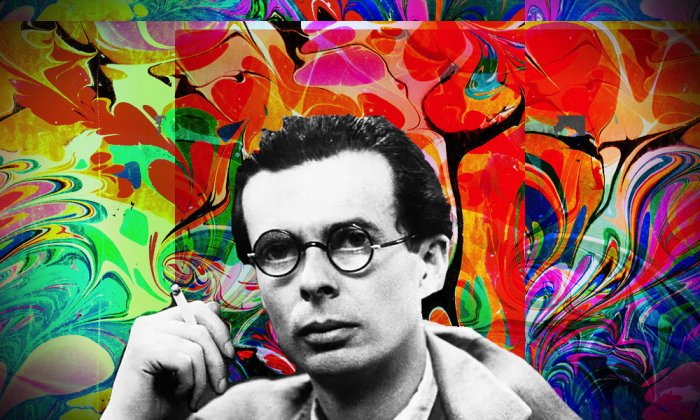
Aldous Huxley's The Doors of Perception
The Doors of Perception (1954) is a seminal philosophical essay by Aldous Huxley documenting his May 1953 experience with mescaline.[1] Moving beyond mere drug experimentation, Huxley uses his experience to formulate a profound epistemological theory of consciousness, drawing on Henri Bergson’s "reducing valve" concept and C.D. Broad's "Mind-at-Large".[2] The text profoundly impacted psychiatric research, art history, and the 1960s counterculture, ultimately serving as the catalyst for coining the term "psychedelic".[3][4]
Biographical and Historical Context
The Catalyst: May 1953
By 1953, Aldous Huxley was a widely read novelist, social critic, and a dedicated student of comparative mysticism, having published his synthesis of spiritual traditions, The Perennial Philosophy, in 1945.[5] His growing interest in the biochemical origins of mystical states led him to correspond with Dr. Humphry Osmond, a British psychiatrist based in Saskatchewan, Canada.[6] Osmond was at the forefront of psychiatric research, investigating whether schizophrenia was caused by a chemical imbalance related to adrenaline, and noting its structural similarities to the mescaline molecule.[3:1][4:1]
In May 1953, Osmond traveled to Los Angeles and administered a clinical dose of four-tenths of a gram of mescaline to Huxley at his home.[1:1][3:2] Osmond supervised the eight-hour experience, which became the empirical basis for The Doors of Perception, published the following year by Chatto & Windus (UK) and Harper & Brothers (US).[1:2]
The title is a direct homage to the English visionary poet William Blake, who wrote in his c. 1790 masterwork The Marriage of Heaven and Hell:
"If the doors of perception were cleansed every thing would appear to man as it is: infinite."[1:3]
Theoretical Core: The Reducing Valve and Mind-at-Large
Huxley’s primary contribution in the essay is not a mere description of drug-induced imagery, but a robust philosophical framework detailing how the human brain processes reality.[7]
1. Mind-at-Large
Huxley asserts that human consciousness is fundamentally capable of perceiving the totality of existence.[2:1] Drawing on both Western philosophy and Eastern mysticism, he calls this undifferentiated, infinite state of awareness Mind-at-Large.[2:2][5:1]
2. The Brain as a "Reducing Valve"
To prevent our physical bodies from being overwhelmed and paralyzed by the sheer volume of "Mind-at-Large," Huxley argues that the brain and nervous system function as a biological filter.[2:3][5:2] He integrates the metaphysics of French philosopher Henri Bergson to build this thesis:
-
Evolutionary Utility: The brain's primary job is not to find absolute truth, but to keep us physically alive.[5:3] It acts as a reducing valve, compressing the infinite spectrum of reality into a narrow, highly filtered trickle of utilitarian information (symbols, language, and spatial-temporal coordinates) necessary for physical survival.[2:4][5:4]
-
The Psychedelic Mechanism: Mescaline temporarily bypasses this "reducing valve."[3:3][2:5] Without damaging the physical organism, the substance disables the biological filter, allowing the individual to experience "Mind-at-Large" in its raw, unfiltered splendor.[2:6][5:5]
In a striking validation of Huxley's 1954 thesis, contemporary neuroimaging studies led by Dr. Robin Carhart-Harris in 2014 demonstrated that classic psychedelics quiet the Default Mode Network (DMN).[5:6] The DMN functions as the brain's centralized hub for ego-preservation and sensory filtering—functioning exactly like Bergson and Huxley’s metaphorical "reducing valve."[5:7]
The Nature of the Visionary Experience
Huxley notes that the mescaline experience is characterized not by dramatic visual hallucinations, but by a radical shift in meaning and aesthetics.[5:8] He outlines several key characteristics of this state:
From "What" to "Is-ness" (Istigkeit)
Instead of looking at objects for their utility or spatial relation, Huxley perceived their raw existence, or "Is-ness" (a term he borrowed from the medieval mystic Meister Eckhart).[5:9]
-
The Vase of Flowers: Gazing at a small glass vase containing three carnations, Huxley did not see a floral arrangement; he saw the "miracle, moment by moment, of naked existence."[5:10]
-
The Grey Flannel Trousers: He spent a significant portion of his experience staring at the folds of his flannel trousers, seeing in their complex geometry a profound aesthetic majesty reminiscent of drapery in classical paintings or the art of Vermeer.[6:1]
The Transgression of Space and Time
During the experience, the concepts of three-dimensional space and linear time became completely secondary:[2:7]
-
Space was no longer measured in distance but in "intensity of existence."
-
Time was perceived as a perpetual present, aligning with the "eternal now" described in classical mystical literature.[2:8][5:11]
Cultural Impact and Legacy
Coining the Term "Psychedelic"
The collaboration and correspondence between Huxley and Osmond directly birthed the term used to describe these substances.[4:2] In their subsequent letters, they debated what to call them, searching for a word that didn't carry the pathological connotations of "hallucinogen" or "psychotomimetic."[3:4][4:3]
Huxley famously proposed phanerothyme (from the Greek for "to show soul") with the couplet:
"To make this mundane world sublime, / Take half a gram of phanerothyme."[4:4]
Osmond countered with psychedelic (from psyche [mind/soul] and deloun [to manifest/reveal]) with his own couplet:
"To fathom Hell or soar angelic, / Just take a pinch of psychedelic."[4:5]
Osmond's term ultimately won out, entering the global lexicon permanently.[4:6]
Influence on the Counterculture and Art
-
The Doors: The legendary American rock band The Doors, fronted by Jim Morrison, took their name directly from the title of Huxley's book (and by extension, Blake's poem).[1:4][3:5]
-
The Psychedelic Movement: Along with figures like Timothy Leary and Alan Watts, Huxley’s essay became a philosophical sacred text for the 1960s counterculture, legitimizing drug experimentation as a pathway to genuine mystical realization.[3:6]
Backlinks
-
Henri Bergson (1859–1941): Explores the "filter/transmission" theory of consciousness that directly informs Huxley's "reducing valve" model.
-
Cognitive Filters in Buddhism: Discusses how cognitive filters are necessary for navigation but become prisons when mistaken for reality, paralleling Huxley's view.
-
The Generative Eye (McGilchrist and Buddhism): Analyzes how conceptual elaboration (papañca) blocks immediate experience, resonating with Huxley's desire to bypass symbolic cages.
-
Reflexive Loop-Attention and Intention in McGilchrist and Buddhism: Details the attention-intention loop that shapes reality, providing the neurological architecture behind Huxley's "Mind-at-Large."
-
William James and the Landscape of Eastern Thought: Contrasts "sciousness" (pure awareness) with "con-sciousness" (ego-driven), mirroring the distinction between "Mind-at-Large" and filtered perception.
-
Epistemology of Preference-Avijjā, Māna, and the Emptiness of Aesthetic Taste in Buddhist Philosophy: Deconstructs consciousness as a process rather than an entity, aligning with the non-substantialist view of the visionary experience.
-
Neuroproductivity: Connects the "reality-generative" nature of attention to the need to protect cognitive sovereignty from the "reducing valve" of modern work.
References
Wikipedia / The Doors of Perception / wikipedia.org ↩︎ ↩︎ ↩︎ ↩︎ ↩︎
ResearchGate / The Bergsonian Metaphysics Behind Huxley's Doors / researchgate.net ↩︎ ↩︎ ↩︎ ↩︎ ↩︎ ↩︎ ↩︎ ↩︎ ↩︎
Ovid Addiction / Aldous Huxley's The Doors of Perception / ovid.com ↩︎ ↩︎ ↩︎ ↩︎ ↩︎ ↩︎ ↩︎
PMC NIH / Humphry Osmond / pmc.ncbi.nlm.nih.gov ↩︎ ↩︎ ↩︎ ↩︎ ↩︎ ↩︎ ↩︎
Quantum Awareness / Reducing Valve — Huxley, Bergson, and the Neuroscience of Consciousness / quantumawareness.net ↩︎ ↩︎ ↩︎ ↩︎ ↩︎ ↩︎ ↩︎ ↩︎ ↩︎ ↩︎ ↩︎ ↩︎
History of the Human Sciences / Month: September 2021 / histhum.com ↩︎ ↩︎
Aldous Huxley / The Doors of Perception / fadedpage.com ↩︎