- #media — Core subject: media bias, time-biased vs. space-biased media
- #communication — Central theme of the Toronto School of Communication
- #philosophy — Hegel's Minerva's Owl, historical reflection, cultural critique
- #history — Analysis of empires from ancient Greece to Byzantium to modern West
- #technology — Material properties of clay, papyrus, parchment, radio, digital networks
- #sociology — Knowledge monopolies, institutional power, elite consolidation
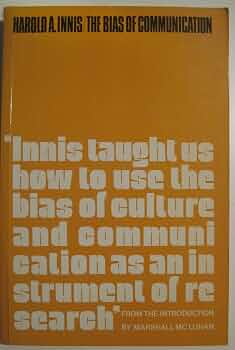
The Bias of Communication (1951) by Canadian political economist Harold Adams Innis establishes that media technologies are not neutral channels for information.[1] Instead, the physical and material characteristics of a dominant medium inherently bias a society toward either durability across time or administrative reach across geographic space, dictating how knowledge is monopolized and how empires rise and fall.[2]
Historical Context and Intellectual Evolution
Before authoring his foundational communication works, Harold Adams Innis established the Staples Thesis in political economy, analyzing how Canada's socio-political development was shaped by raw commodity exports (such as fur, timber, and cod) to imperial centers.[3] In the late 1940s, Innis recognized that physical trade goods constituted only half of imperial infrastructure; the media used to transport administrative directives, laws, and cultural values were equally decisive.[2:1]
This intellectual shift culminated in Empire and Communications (1950) and The Bias of Communication (1951). Experiencing the devastation of World War I and witnessing the rise of industrial mass propaganda, radio broadcasting, and commercial news print, Innis sought to map how communication structures dictate cultural survival and institutional power.[1:1]
Innis shifted his research framework from the transportation of physical commodities to the transmission of media, arguing that the material properties of communication tools shape the longevity and geographic boundaries of human institutions.[2:2]
Core Theoretical Framework
Innis's communication theory centres on the interplay between the physical attributes of media, the creation of knowledge monopolies, and societal stability.[4]
Time-Biased vs. Space-Biased Media
Innis categorized communication media into two distinct types based on their physical character.[2:3]
| Dimension | Time-Biased Media | Space-Biased Media |
|---|---|---|
| Physical Materials | Clay tablets, stone, parchment, heavy architecture, oral traditions | Papyrus, paper, newsprint, radio, digital signals |
| Key Characteristics | Durable, heavy, difficult to transport, long-lasting | Light, ephemeral, highly portable, rapidly transmitted |
| Institutional Focus | Religious authority, sacred rituals, historical memory, tradition | Secular administration, military command, trade, codification of law |
| Societal Trajectory | Continuity across generations; smaller, localized populations | Rapid territorial expansion; large imperial domains across vast space |
-
Time-Biased Media: Durable materials that are difficult to transport favor historical continuity across generations.[4:1] Because these media are heavy, societies that depend on them tend to focus on religious hierarchy, tradition, ancestor reverence, and decentralized or localized governance.[2:4]
-
Space-Biased Media: Lightweight and easily transportable materials facilitate expansion across physical territory.[4:2] These media support secular states, administrative efficiency, military coordination over vast distances, and price-based trade, though they often sacrifice long-term cultural permanence.[2:5]
A civilization's dominant medium shapes its collective consciousness: time-biased media foster historical continuity, whereas space-biased media prioritize rapid administration and spatial control.[2:6]
Monopolies of Knowledge
Central to Innis's framework is the concept of a Monopoly of Knowledge.[2:7] When a specific communication technology dominates a culture, a specialized elite emerges that controls the skills, tools, and institutions necessary to create and interpret that medium.[4:3]
-
Elite Consolidation: Ancient Egyptian scribes (hieroglyphics on papyrus and stone) and medieval European monks (Latin illuminated manuscripts on parchment) derived immense political power from their exclusive mastery of the dominant media.[2:8]
-
Institutional Rigidity: As the ruling class consolidates power around its medium, the society becomes culturally rigid and slow to adapt to external technological or economic changes.[2:9]
-
Peripheral Disruption: Challenges to established monopolies rarely emerge from the center. Excluded groups or peripheral cultures introduce or adopt simpler, alternative media (such as the Phoenicians creating a simplified phonetic alphabet to bypass complex Egyptian scripts) to disrupt the standing elite.[2:10]
The Balance of Media and Imperial Survival
Innis argued that enduring civilizations maintain a balance between time-biased and space-biased media.[4:4] An over-reliance on either bias creates instability:
-
Over-emphasis on Time: Leads to rigid traditionalism, political fragmentation, and vulnerability to external military conquest.
-
Over-emphasis on Space: Leads to imperial over-extension, loss of historical identity, administrative decay, and internal collapse.[1:2]
For Innis, ancient Greece during the 5th century BC represented an ideal balance: the time-biased oral tradition (dialogue, philosophy, epic poetry) intersected with the space-biased written alphabet, sparking a major flourish of culture and thought.[4:5] Similarly, the Byzantine Empire sustained itself by balancing papyrus for administrative governance with parchment for religious continuity.[4:6]
Key Essays in The Bias of Communication
The volume consists of several landmark essays delivered as lectures or academic addresses.[1:3]
"Minerva's Owl"
Borrowing Georg Wilhelm Friedrich Hegel's statement that "the owl of Minerva spreads its wings only with the falling of the dusk," Innis demonstrates that a civilization's major reflection on its communication systems usually occurs right as that civilization enters a period of decline.[1:4]
Analyzing Western historical epochs from antiquity to the modern era, Innis illustrates how knowledge monopolies expand and overreach until peripheral innovations trigger cultural disruption.[3:1]
"A Plea for Time" and Modern "Present-Mindedness"
In "A Plea for Time," Innis presents a critique of modern Western civilization, particularly industrial North America.[1:5] He argues that modern electronic and print media (newspapers, telegraph, radio, and advertising) are overwhelmingly space-biased.[1:6]
Modern Western culture suffers from extreme "present-mindedness"—a continuous, systematic destruction of cultural permanence and historical memory driven by real-time media, commercial advertising, and instant communications.[1:7]
Because modern media prioritize speed and immediate commercial throughput, deep historical reflection is replaced by short-term sensationalism and political crisis management.[2:11]
Legacy and Impact
Innis's work founded the Toronto School of Communication.[2:12] His ideas directly influenced Marshall McLuhan, who translated Innis's political-economic framework into media ecology with his famous phrase, "The medium is the message."[2:13] While McLuhan focused on psychological perception and sensory extensions, Innis remained focused on political economy, institutional power, and long-term historical cycles.[2:14]
For a deeper synthesis of Innis's framework within the broader Toronto School tradition, see Media Theory Concept Research.
In contemporary media analysis, Innis's theoretical model continues to be applied to digital networks:
-
Algorithmic Ephemerality: Modern social feeds represent an extreme form of space bias, maximizing immediate real-time interaction while eroding historical context.
-
Digital Knowledge Monopolies: Big Tech platforms, proprietary algorithms, and centralized AI infrastructures represent modern monopolies of knowledge, concentrating control over information flow in privatized technological hubs.[2:15]
References
Book Review: Harold A. Innis, Bias of Communications
This review offers a clear structural breakdown of Harold Innis's key concepts, helping to contextualize how his media bias framework applies across historical empires and modern media systems.
Harold A. Innis / The Bias of Communication / University of Toronto Press ↩︎ ↩︎ ↩︎ ↩︎ ↩︎ ↩︎ ↩︎ ↩︎
Journalism University / Harold Innis: Unpacking the Theory of Media Bias / Journalism University ↩︎ ↩︎ ↩︎ ↩︎ ↩︎ ↩︎ ↩︎ ↩︎ ↩︎ ↩︎ ↩︎ ↩︎ ↩︎ ↩︎ ↩︎ ↩︎
Faded Page / The Bias of Communication - Book Overview / Faded Page ↩︎ ↩︎
Wikipedia / Harold Innis's Communications Theories / Wikipedia ↩︎ ↩︎ ↩︎ ↩︎ ↩︎ ↩︎ ↩︎