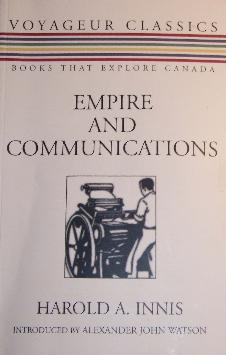
Empire and Communications (1950)
Published in 1950 and originating from the 1948 Beit Lectures delivered at Oxford University, Harold Innis's Empire and Communications establishes a foundational framework for media ecology. Innis argues that communication media are not neutral carriers of information, but active economic and physical staples whose material qualities impart a bias toward time or space. The long-term survival of any empire depends on maintaining a dynamic balance between time-biased media (which preserve tradition and moral authority) and space-biased media (which facilitate administrative expansion and secular rule).
Theoretical Framework
Harold Adams Innis, a Canadian political economist, derived his media theory from his earlier "staples thesis," which demonstrated how primary raw resources like fur and timber dictated Canadian settlement patterns and institutions. In Empire and Communications, Innis extended this economic logic to information media, arguing that media function as communication staples that structure political power and social hierarchies.
Time-Biased vs. Space-Biased Media
Innis categorizes dominant communication media according to their physical weight, durability, and transportability:
-
Time-Biased Media: Constructed from durable, heavy materials such as stone, clay, and parchment. Because these materials are difficult to transport, they encourage localized governance, historical continuity, religious ritual, and long-term cultural stability.
-
Space-Biased Media: Constructed from lightweight, portable materials such as papyrus, newsprint, paper, and broadcast signals. Because they move rapidly across distances, these media enable centralized military coordination, administrative bureaucracy, legal codification, and territorial expansion.
| Media Dimension | Time-Biased Media | Space-Biased Media |
|---|---|---|
| Material Form | Stone, clay tablets, parchment codices | Papyrus scrolls, paper, newsprint, radio signals |
| Physical Traits | Heavy, durable, scarce, labor-intensive | Lightweight, ephemeral, portable, scalable |
| Institutional Axis | Monasteries, priesthoods, customary law | Centralized bureaucracy, military, secular monarchies |
| Societal Focus | Temporal continuity, tradition, sacred memory | Spatial control, trade expansion, present-mindedness |
Monopolies of Knowledge: Innis observed that dominant media give rise to specialized elites—such as scribes, priests, or technocrats—who master the complex skills needed to operate them. These monopolies concentrate political power until a new, competing medium emerges from the geographic or social margins to break the monopoly and decentralize control.
Historical Trajectories Across Civilizations
Innis sweeps across five millennia of history to illustrate how media shifts precipitated the rise, restructuring, and fall of major imperial powers.
Ancient Egypt: From Stone to Papyrus
Early Egyptian civilization depended on monumental stone carving, cementing absolute monarchy and a divine order focused on eternity. The transition to papyrus streamlined record-keeping and administrative taxation. However, the extreme complexity of hieroglyphics empowered a specialized scribal and priestly class, shifting power away from the pharaoh toward religious monopolies.
Mesopotamia: Clay Tablets and Cuneiform
In Babylonia and Assyria, heavy clay tablets provided a durable record for legal systems like the Code of Hammurabi. While clay preserved administrative and commercial accounts, the difficulty of mastering cuneiform protected the authority of temple priests until simpler scripts and lighter media enabled military conquerors to centralize rule.
Ancient Greece: The Oral Tradition and Alphabet
Innis identified classical Greece as a rare historical moment of equilibrium. The rich oral tradition—a supreme time-binding medium—fostered dialectic debate, civic engagement, and creative philosophical inquiry. The introduction of the flexible phonetic alphabet from Phoenician traders initially enhanced this oral culture, giving rise to Athenian democracy. However, as written prose gained dominance over dialogue, oral cohesion decayed, contributing to political fragmentation.
The Roman Empire: Papyrus and Bureaucracy
The Roman Republic and Empire mobilized vast quantities of Egyptian papyrus to coordinate military legions, maintain trade networks, and enforce unified legal codes across the Mediterranean basin. Papyrus gave Rome extraordinary space-binding capability. When trade routes fractured and papyrus supplies were disrupted, centralized imperial control collapsed, paving the way for localized feudalism.
Medieval Europe: Parchment and Papal Hegemony
Following Rome's decline, Western Europe shifted to parchment—a durable, labor-intensive material derived from animal hides. Hand-copied in monastic scriptoria, parchment fostered a decentralized feudal structure dominated by the Roman Catholic Church. The ecclesiastical monopoly over parchment bound Western Europe to a unified temporal and spiritual framework for centuries.
Modern Era: Print, Press, and Present-Mindedness
The introduction of paper from China and the invention of the moveable type printing press broke the monastic parchment monopoly. Print fueled the Protestant Reformation, promoted national vernacular languages, and accelerated the rise of secular nation-states. By the 20th century, mass-circulation newspapers and electronic broadcasting created an extreme space-bias, inducing what Innis called an obsession with "present-mindedness"—a continuous focus on immediate events that erases historical continuity.
Imperial Equilibrium and Theoretical Legacy
The Imperial Balance Principle: Polities that rely exclusively on space-biased media risk administrative overstretch and cultural decay; polities that rely solely on time-biased media risk military vulnerability and insular stagnation. Long-term stability requires balancing space-binding mechanisms (bureaucracy, military, trade) with time-binding institutions (religion, history, civic identity).
Intellectual Impact
-
Precursor to Marshall McLuhan: Innis's insights directly influenced his University of Toronto colleague Marshall McLuhan, who translated Innis's structural economic media analysis into the famous dictum, "the medium is the message".
-
Founding Media Ecology: Together with McLuhan, Innis established the Toronto School of Communication, shifting media studies from simple content analysis to examining how technology alters social structure and human perception.
Resonant Notes
The following vault notes share deep thematic resonance with Innis's media ecology framework:
- Media Theory Concept Research — Provides an extensive analysis of Innis's time-bias/space-bias dichotomy and his influence on the Toronto School of Communication, including a detailed comparison table between Innis and McLuhan's methodologies.
- McLuhan's The Medium is the Message — Extends Innis's structural media analysis into the digital age, applying the Tetrad of Media Effects to social media, the attention economy, and cognitive sovereignty.
- Information Networks and the Architecture of Social Order — Examines how information networks are optimized for social order over objective truth, directly echoing Innis's concern that space-biased media produce "present-mindedness" and erode historical continuity.