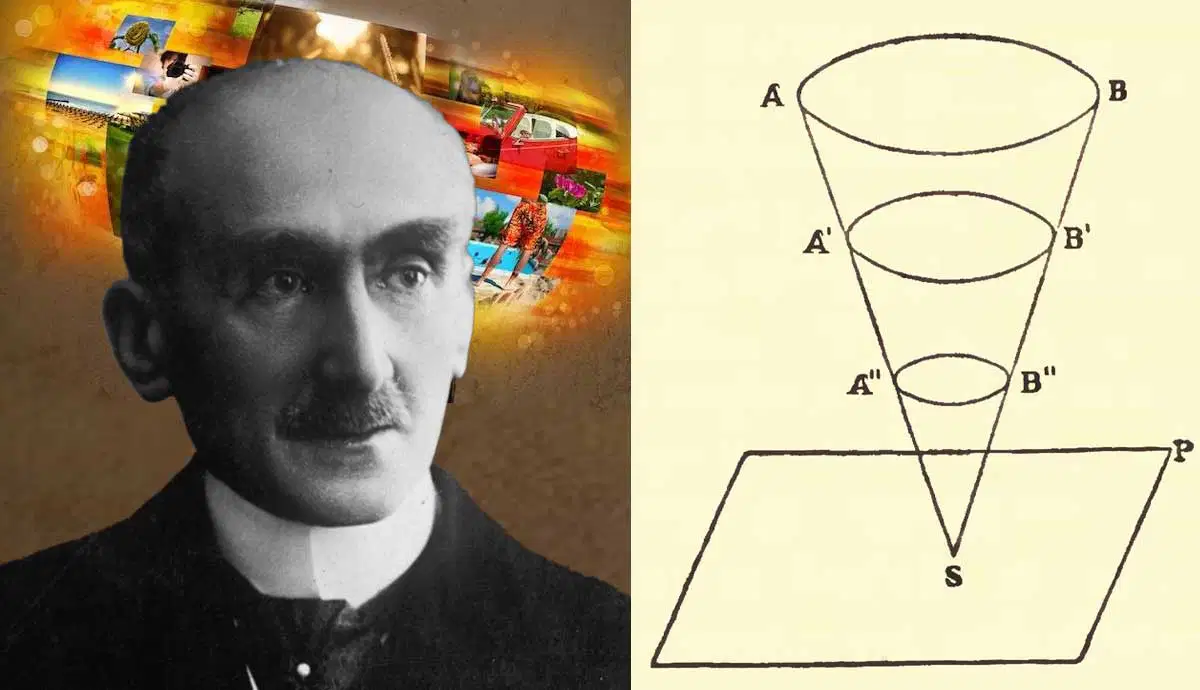
In his 1896 treatise Matter and Memory, French philosopher Henri Bergson proposed a radical biological thesis: the brain is not a generator of consciousness or a storage repository for memory, but an eliminative filter designed to suppress non-essential information for evolutionary survival.[1] Modern neuroscience has uncovered a striking functional candidate for this theoretical "reducing valve" in the Default Mode Network (DMN).[2] Acting as the top-level conductor of the cortical hierarchy, the DMN enforces rigid top-down predictive constraints, builds the egoic self-model, and actively gates sensory and episodic inputs to prevent cognitive overwhelm.[3][4]
Bergson’s Eliminative Model of Perception and Memory
Pure Memory vs. Practical Selection
In 19th-century psychology and contemporary materialist neuroscience alike, the prevailing paradigm views the brain as an accumulator of memory traces (engrams) and a producer of conscious experience. Henri Bergson inverted this model in Matter and Memory (1896), proposing that pure memory (souvenir pur) is inherently unlimited, complete, and continuously preserved in its entirety.[1:1]
For Bergson, the primary physiological challenge facing an organism is not how to store or recall memories, but how to exclude them.[1:2] If an organism were conscious of every past experience and every incoming sensory stimulus simultaneously, it would experience total cognitive paralysis.
"The brain is an organ of action, not of representation... Its function is to limit our mental life to what is useful for practical life, to eliminate unnecessary memories and sensory perceptions, and to keep our attention fixed on the present moment." [1:3]
The Brain as a "Solicitor of Action"
Bergson posited that perception is naturally wide, unbounded, and rich. The brain acts as an instrument of action (solliciteur d'action), filtering out any perceptual field or historical memory that does not offer a direct vector for bodily movement or survival.[1:4]
Decades later, novelist Aldous Huxley adopted Bergson’s philosophy in The Doors of Perception (1954), coining the famous metaphor of the brain as a "reducing valve" that compresses an infinite "Mind at Large" into a narrow trickle of pragmatic sensory data.[5]
[ Unfiltered Reality / Pure Memory ]
                │
                ▼
  ┌───────────────────────────┐
  │   Brain / Reducing Valve  │  ◄── (Filters out non-utilitarian input)
  └───────────────────────────┘
                │
                ▼
 [ Action-Oriented Consciousness ]
Neuroanatomy of the Default Mode Network
Discovered by Marcus Raichle and colleagues in 2001 via baseline positron emission tomography (PET) and functional magnetic resonance imaging (fMRI) studies, the Default Mode Network (DMN) is a set of interconnected high-level cortical regions.[2:1] It exhibits elevated metabolic activity when an individual is engaged in passive rest, daydreaming, or unconstrained self-reflection, and downregulates during externally focused, goal-directed tasks.[2:2][6]
                      ┌──────────────────────────┐
                      │ Medial Prefrontal (mPFC) │
                      └────────────┬─────────────┘
                                   │
                                   ▼
┌──────────────────────┐  ┌─────────────────┐  ┌───────────────────────┐
│ Inferior Parietal    │◄─┤ Posterior Cing. │─►│ Medial Temporal Lobe  │
│ Lobe / Angular Gyrus │  │ (PCC) / Precun. │  │ (MTL / Hippocampus)   │
└──────────────────────┘  └─────────────────┘  └───────────────────────┘
Key Anatomical Hubs
-
Posterior Cingulate Cortex (PCC) & Precuneus: The central structural core of the network. Integrates autobiographical memory, self-location, and temporal perspective (past/future projection).[6:1]
-
Medial Prefrontal Cortex (mPFC): Mediates self-referential cognition, meta-cognition, social valuation, and top-down emotional regulation.[6:2]
-
Angular Gyrus / Inferior Parietal Lobe (IPL): Serves as a semantic and multi-sensory integration hub, connecting self-concepts with language and perceptual categories.[6:3]
-
Medial Temporal Lobe (MTL / Hippocampal Formation): Controls episodic memory access and scene construction, supplying the raw historical narrative used by the PCC/mPFC to construct the ego.[2:3][6:4]
Topographical Isolation
Gradient-mapping studies show that the DMN sits at the maximal functional and anatomical distance from primary sensory and motor cortices.[6:5] This extreme topographical isolation allows the DMN to operate independently of real-time environmental input, enabling abstract thought, autobiographical narrative creation, and top-down cognitive modulation.[6:6]
The DMN as the Biological Reducing Valve
The convergence of modern neuroimaging and cognitive science provides a concrete bio-computational mechanism for Bergson’s filter model: top-down predictive processing orchestrated by the DMN.[4:1]
Formulated by Karl Friston, predictive coding posits that the brain is an active prediction machine rather than a passive sensory receiver.[4:2] High-level cortical hierarchies continuously project "top-down" predictions (priors) about the world to lower sensory cortices. Incoming "bottom-up" sensory signals are compared against these predictions; only the difference—the prediction error—is passed up the hierarchy to update the internal model.[4:3]
The REBUS Model and Top-Down Gating
In 2019, Robin Carhart-Harris and Karl Friston introduced the REBUS model (Relaxed Beliefs Under Psychedelics), explicitly identifying the DMN as the primary structural network enforcing high-level top-down priors.[4:4]
 Top-Down Constraints (DMN)          Bottom-Up Signal Flow
┌──────────────────────────┐        ┌──────────────────────────┐
│ High-Level Egoic Priors  │        │ Raw Sensory Inputs &     │
│ (mPFC / PCC / Precuneus) │        │ Limbic Memory Signals    │
└────────────┬─────────────┘        └────────────┬─────────────┘
             │                                   │
             │ [Suppression / Filtering]         │ [Escapes Gating]
             ▼                                   ▼
┌──────────────────────────┐        ┌──────────────────────────┐
│ Ordinary Waking State:   │        │ Psychedelic / Altered:   │
│ Reality compressed to    │        │ High cortical entropy,   │
│ functional survival model│        │ unconstrained richness   │
└──────────────────────────┘        └──────────────────────────┘
-
Egoic Narrative as a Filter: The DMN encodes deeply entrenched beliefs regarding identity, cause-and-effect, and spatial temporal boundaries.[4:5] By applying strong prior beliefs downward, it suppresses raw, unconstrained neural noise from lower-level sensory regions and the limbic system.[3:1][4:6]
-
Gating Limbic Memory: The DMN regulates access to the hippocampal formation. By modulating hippocampal firing, the DMN filters out non-utilitarian, hyper-detailed episodic memories, bringing forward only those memories that fit the immediate action context—exactly as Bergson described.[1:5][4:7]
Empirical Evidence of Filter Disruption
When the structural integrity or functional coupling of the Default Mode Network is disrupted, the brain's "reducing valve" opens, revealing the unconstrained perceptual and memory states Bergson theorized.[1:6][3:2]
Psychedelic Neuroimaging
Neuroimaging studies using fMRI on subjects under the influence of psilocybin, LSD, and DMT have demonstrated marked decreases in blood flow and functional connectivity within primary DMN hubs (mPFC and PCC).[3:3]
Classical physicalist models predict that decreased metabolic activity in a master network should lead to cognitive impairment or unconsciousness. Instead, DMN deactivation produces an expansion of subjective conscious experience—including ego dissolution, hyper-vivid sensory perception (synesthesia), and the surfacing of long-suppressed autobiographical memories.[3:4][4:8]
With the DMN downregulated:
-
Cross-Network Hyper-Connectivity: Primary visual, auditory, and motor networks establish direct, unmediated communication channels, bypassing top-down DMN gating.[3:5]
-
Cortical Entropy: Brain activity shifts toward a state of higher entropy, increasing signal diversity and unlocking latent perceptual bandwidth.[4:9]
Neurological Pathologies and Lesions
-
Frontotemporal Dementia (FTD): In patients suffering from localized degeneration of frontal lobe inhibitory networks, researchers have observed the sudden emergence of extraordinary artistic, musical, or visual abilities (acquired savant syndrome).[7] As the frontal filtering apparatus degrades, raw perceptual processing networks become uninhibited.[7:1]
-
Terminal Lucidity: Transient episodes of profound cognitive clarity, memory recall, and ego restoration in late-stage dementia or Alzheimer's patients immediately prior to death challenge simple "production" models of mind.[1:7][7:2] From a filter perspective, as the damaged biological apparatus collapses, its restrictive filtering mechanism weakens, briefly granting uninhibited access to latent memory structures.[1:8][7:3]
Contemplative Practice and Meditation
Neuroimaging of expert meditators (e.g., long-term practitioners of Theravada or Zen traditions) shows significant functional downregulation of mPFC and PCC nodes during meditation.[8]
Downregulating the DMN attenuates self-referential narrative loops, leading to reports of "pure awareness"—a state closely matching Bergson’s concept of "pure perception" (perception pure), where reality is experienced directly without the filter of utility.[1:9][8:1]
Comparative Matrix: Neuro-Physicalism vs. Filter Theory
| Feature | Standard Neuro-Physicalism | Bergson-Huxley Filter Theory (DMN Alignment) |
|---|---|---|
| Brain Role | Generator: Creates consciousness and stores memories as physical traces.[1:10] | Transducer/Filter: Constrains, translates, and selects action-relevant mind states.[1:11][5:1] |
| DMN Function | Creates the self, organizes higher cognition, and integrates brain regions.[2:4][6:7] | Enforces top-down constraints, compresses reality, and gates non-utilitarian input.[1:12][4:10] |
| DMN Suppression | Causes neural disorganization, cognitive deficits, and hallucinations.[3:6] | Relaxes top-down priors, allowing uninhibited sensory and memory flow.[3:7][4:11] |
| Memory Storage | Physical engram complexes stored in cortical-hippocampal networks.[1:13] | Non-local / unbounded (souvenir pur); brain only selects motor-relevant traces.[1:14] |
| Predictive Processing | Top-down predictions minimize energy and optimize internal simulation.[4:12] | Top-down predictions act as the biological mechanism of the reducing valve.[1:15][4:13] |
Philosophical Synthesis: Interface vs. Generator
The neuroscience of the Default Mode Network provides empirical grounding for Henri Bergson's intuition.[1:16][3:8] Whether consciousness is ultimately generated by physical brain structures or filtered through them, the functional architecture of the brain is demonstrably eliminative.[1:17][4:14]
The Default Mode Network serves as the biological conductor of this elimination.[2:5][4:15] By maintaining top-down priors, maintaining temporal continuity, and gating lower-level sensory and limbic signals, the DMN compresses the vast complexity of reality into a narrow, ego-driven model optimized for physical survival.[1:18][4:16][5:2] When this central hub is downregulated—whether through pharmacology, meditation, or structural disruption—the reducing valve opens, offering a glimpse into the unconstrained perceptual landscape that lies beneath waking awareness.[1:19][3:9][5:3]
Resonant Notes in the Vault
- Aldous Huxley's The Doors of Perception (1954): Directly adopts Bergson's "reducing valve" model to explain how psychedelics temporarily disable the neural filter, allowing raw "Mind-at-Large" to flood in.
- Cognitive Filters in Buddhism: Discusses how cognitive filters are necessary for navigation but become prisons when mistaken for reality, paralleling the eliminative model.
- Henri Bergson (1859–1941): Provides foundational context on Bergson's philosophy and his influence on the filter theory of consciousness.
- Boltzmannian Coarse-Graining and Nagarjunian Emptiness: Connects the idea of lossy, coarse-grained projections of reality to the brain's filtering mechanisms.
Henri Bergson / Matter and Memory / Internet Archive ↩︎ ↩︎ ↩︎ ↩︎ ↩︎ ↩︎ ↩︎ ↩︎ ↩︎ ↩︎ ↩︎ ↩︎ ↩︎ ↩︎ ↩︎ ↩︎ ↩︎ ↩︎ ↩︎ ↩︎
Marcus E. Raichle et al. / A default mode of brain function / PNAS ↩︎ ↩︎ ↩︎ ↩︎ ↩︎ ↩︎
Robin L. Carhart-Harris et al. / Neural correlates of the psychedelic state as determined by fMRI studies with psilocybin / PNAS ↩︎ ↩︎ ↩︎ ↩︎ ↩︎ ↩︎ ↩︎ ↩︎ ↩︎ ↩︎
Robin L. Carhart-Harris & Karl J. Friston / REBUS and the anarchic brain: toward a unified model of the brain action of psychedelics / Pharmacological Reviews ↩︎ ↩︎ ↩︎ ↩︎ ↩︎ ↩︎ ↩︎ ↩︎ ↩︎ ↩︎ ↩︎ ↩︎ ↩︎ ↩︎ ↩︎ ↩︎ ↩︎
Aldous Huxley / The Doors of Perception / Harper & Row ↩︎ ↩︎ ↩︎ ↩︎
Jonathan Smallwood et al. / The default mode network in cognition: a topographical perspective / Nature Reviews Neuroscience ↩︎ ↩︎ ↩︎ ↩︎ ↩︎ ↩︎ ↩︎ ↩︎
Bruce L. Miller et al. / Emergence of artistic talent in frontotemporal dementia / Neurology ↩︎ ↩︎ ↩︎ ↩︎
Judson A. Brewer et al. / Meditation experience is associated with differences in default mode network activity and connectivity / PNAS ↩︎ ↩︎