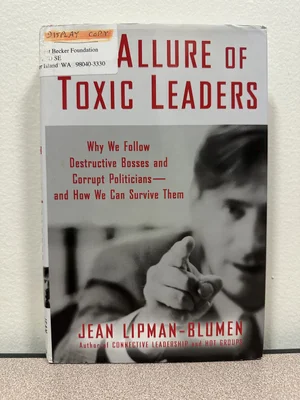
Jean Lipman-Blumen’s framework in The Allure of Toxic Leaders reframes toxic leadership from an individual pathology to a symbiotic relationship between destructive leaders and vulnerable followers.[1] Toxic leaders exploit fundamental human anxieties—such as fear of chaos, isolation, and death—by offering grand illusions of security and noble purpose, ultimately leaving their constituents decidedly worse off than they found them.[2]
Core Premise: The Follower-Centric Paradigm Shift
Traditional leadership literature historically focused on the personality traits and tactics of authoritarian figures. Lipman-Blumen shifts this paradigm by positioning the follower's psychological vulnerability as the primary engine driving toxic leadership.[1:1]
Toxic leaders cannot operate in isolation; they require followers who tolerate, prefer, or actively enable toxic dynamics.[2:1] The fundamental diagnostic benchmark of toxic leadership—what Lipman-Blumen defines as its "quick and dirty" telltale mark—is that toxic leaders leave their followers and organizations in a demonstrably worse condition than they found them.[1:2]
┌─────────────────────────────────────────────────────────┐
│                    THE TOXIC DYNAMIC                    │
├──────────────────────────┬──────────────────────────────┤
│      TOXIC LEADER        │     SUSCEPTIBLE FOLLOWER     │
│ • Destructive Behaviors  │ • Existential Anxiety        │
│ • Dysfunctional Traits   │ • Need for Security/Order    │
│ • Grand Illusions        │ • Fear of Ostracism/Loss     │
└────────────┬─────────────┴──────────────┬───────────────┘
             │                            │
             └─────────────┬──────────────┘
                           ▼
             TOXIC LEADERSHIP RELATIONSHIP
             (Leaves followers worse off)
Architecture of Toxicity: Behaviors and Trait Dimensions
Lipman-Blumen categorizes toxic leadership along two primary dimensions: destructive behaviors and dysfunctional personal qualities.[2:2]
Destructive Behaviors
Toxic leaders execute distinct behavioral patterns that systematically erode agency and institutional durability:[1:3]
-
Manipulation of Fear and Illusions: Feeding followers comforting myths that submission to the leader will safeguard them from chaos or external enemies.
-
Suppression of Dissent: Demands for absolute compliance, criminalizing criticism, and imposing harsh penalties on whistleblowers or dissenters.
-
Divide-and-Conquer Tactics: Setting constituents against one another to foster internal rivalry, scapegoating out-groups, and preventing collective solidarity.
-
Subversion of Governance: Undermining established checks and balances, institutional protocols, and objective truth-seeking mechanisms to centralize power.
-
Misappropriation and Neglect: Diverting shared organizational resources for personal enrichment while neglecting constituent needs during operational crises.
-
Entrenchment Mechanics: Structuring the financial or political cost of their departure so high that removing them risks collapsing the entire organization.
Dysfunctional Personal Qualities
These destructive behaviors stem from deep-seated personality flaws:[2:3]
-
Ego and Narcissism: An insatiable demand for adulation and authority combined with an inability to engage in self-criticism.
-
Arrogance and Deflection: Inability to acknowledge errors, leading to a habitual pattern of blaming followers for systemic failures.
-
Amorality: Cynical disregard for ethical standards, human rights, and truthfulness.
-
Avarice and Recklessness: Prioritizing personal accumulation of wealth and power over institutional stability.
-
Cowardice: Avoiding accountable, high-risk decision-making while deflecting blame when crises emerge.
The Psychological Allure: Why Followers Settle for Toxicity
The core innovation of Lipman-Blumen's framework is identifying why individuals willingly remain in destructive leadership environments.[1:4] He categorizes six foundational psychological needs that drive follower susceptibility:[2:4]
Periods of acute instability—such as corporate restructuring, economic recessions, or geopolitical crises—heighten existential dread, prompting followers to trade autonomy for perceived security.[3]
-
Need for Authority, Security, and Certainty: Humans possess an innate dread of chaos. Toxic leaders project absolute conviction, promising stability in exchange for compliance.[1:5]
-
Need to Feel Chosen and Special: Toxic leaders cultivate exclusive "in-group" dynamics, convincing followers that they belong to an elite tier superior to external groups.[2:5]
-
Need for Significance and Self-Esteem: Followers long to feel important. Toxic leaders frame routine organizational activities as vital, heroic struggles.[1:6]
-
Need for Noble Purpose and Immortality: Toxic leaders offer visions of symbolic or legacy-based immortality, soothing subconscious fears of mortality and insignificance.[2:6]
-
Fear of Ostracism and Isolation: The desire to remain an "insider" prevents individuals from speaking out, as dissent carries the risk of social expulsion.[3:1]
-
Fear of Personal Powerlessness: Followers often doubt their ability to navigate complex environments, leading them to delegate agency to an authoritarian surrogate.[1:7]
Control Myths and Mechanisms of Seduction
To maintain psychological control over time, toxic leaders rely on internalized control myths that followers adopt to justify their compliance:[1:8]
-
The Myth of Leader Omniscience: The belief that the leader possesses secret knowledge, which discourages critical evaluation.
-
The Myth of Unavoidability: The conviction that no viable alternative leadership exists, making the current leader seem indispensable.
-
The Myth of Disloyalty: The belief that questioning executive authority is equivalent to betraying the entire organization.
Toxic leaders reinforce these myths by projecting Grand Illusions—promising effortless solutions, absolute protection from failure, and moral superiority over competitors.[2:7]
Follower Resistance Strategies
Lipman-Blumen provides a structured progression for individuals seeking to counter or escape toxic dynamics:[1:9]
Confronting toxic leadership carries significant professional risk. Resistance should move systematically from low-risk individual tactics to high-leverage collective actions.[3:2]
                     ┌─────────────────────────┐
                     │    6. Extrication       │
                     │    (Exit Environment)   │
                     └────────────▲────────────┘
                                  │
                     ┌────────────┴────────────┐
                     │    5. Removal / Ouster  │
                     │    (Governance Action)  │
                     └────────────▲────────────┘
                                  │
                     ┌────────────┴────────────┐
                     │    4. Coalition Building│
                     │    (Safety in Numbers)  │
                     └────────────▲────────────┘
                                  │
                     ┌────────────┴────────────┐
                     │    3. Whistleblowing    │
                     │    (External Exposure)  │
                     └────────────▲────────────┘
                                  │
                     ┌────────────┴────────────┐
                     │    2. Micro-Resistance  │
                     │    (Quiet Undermining)  │
                     └────────────▲────────────┘
                                  │
                     ┌────────────┴────────────┐
                     │    1. Direct Counseling │
                     │    (Private Feedback)   │
                     └─────────────────────────┘
-
Direct Counseling: Confronting the leader privately with concrete feedback regarding their harmful behaviors.[1:10]
-
Quiet Micro-Resistance: Delaying or undermining toxic directives to minimize harm to peers and operations.[2:8]
-
Whistleblowing: Documenting ethical violations and escalating them to external regulatory bodies or governance channels.[3:3]
-
Coalition Building: Forming alliances with peers to challenge toxic policies collectively.[1:11]
-
Systemic Removal: Leveraging board oversight, shareholder actions, or legal mechanisms to force leadership turnover.[2:9]
-
Extrication: Leaving the organization to safeguard personal health and ethical integrity.[1:12]
References
Related Notes
- Analyzing the Lululemon Brand Controversy - A case study in how a leader's philosophy (Landmark Forum) can create a "culture of no complaining" that blinds the organization to objective failures, mirroring Lipman-Blumen's concept of "Grand Illusions" and the suppression of dissent.
- Motivation Theories Comparison - Explores the "self-fulfilling prophecy" of control-based management (Theory X), which aligns with Lipman-Blumen's analysis of how toxic leaders create environments where followers feel powerless and dependent.
- Travis Bickle - Identity Fragmentation and The Savior Complex - Examines how social isolation and ego fragility lead to the construction of a "mythic identity" to rationalize destructive behavior, resonating with Lipman-Blumen's psychological needs for significance and noble purpose.
Jean Lipman-Blumen / The Allure of Toxic Leaders: Why We Follow Destructive Bosses and Corrupt Politicians—and How We Can Survive Them / Oxford University Press ↩︎ ↩︎ ↩︎ ↩︎ ↩︎ ↩︎ ↩︎ ↩︎ ↩︎ ↩︎ ↩︎ ↩︎ ↩︎
Jean Lipman-Blumen / Toxic Leadership: A Conceptual Framework / Connective Leadership Institute ↩︎ ↩︎ ↩︎ ↩︎ ↩︎ ↩︎ ↩︎ ↩︎ ↩︎ ↩︎
Public Relations Society of America / An Examination of Toxic Leadership / PRSA ↩︎ ↩︎ ↩︎ ↩︎