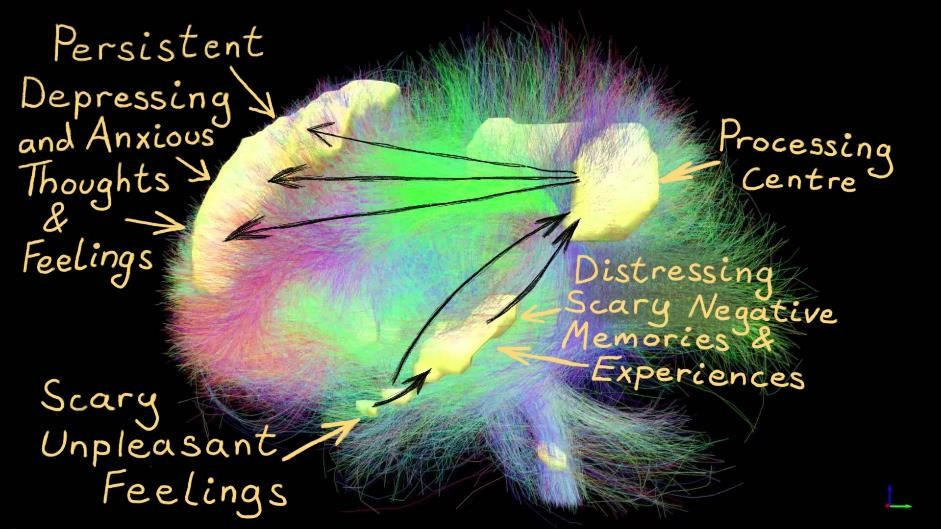
The Default Mode Network (DMN) is a large-scale interconnected brain network that exhibits high metabolic activity during resting, unconstrained states and deactivates during externally oriented, goal-directed tasks. Discovered by Marcus Raichle and colleagues in 2001, the DMN functions as the brain's internal simulator, supporting self-referential thought, autobiographical memory recall, prospective planning, and social cognition.
Anatomical Organization and Key Nodes
The DMN is composed of functionally coupled anatomical hubs distributed across cortical and subcortical regions [1]. These hubs coordinate via low-frequency intrinsic functional connectivity during passive cognitive states [2].
-
Ventromedial Prefrontal Cortex (vmPFC): Processes emotional valuation, affective self-relevance, and personal decision-making.
-
Dorsomedial Prefrontal Cortex (dmPFC): Specialized in social processing, theory of mind, and inferring others' mental states.
-
Posterior Cingulate Cortex (PCC) & Precuneus: Acts as the central structural and metabolic hub, integrating memory, spatial orientation, and self-awareness.
-
Inferior Parietal Lobule (IPL) / Angular Gyrus: Integrates multisensory input and supports language-based semantic processing.
-
Medial Temporal Lobe (MTL) & Hippocampus: Supplies episodic memory retrieval and contextual detail required for mental simulation.
Cognitive Functions and Everyday Examples
The DMN shifts into an active state whenever cognitive processing turns inward rather than toward immediate perceptual stimuli [2:1].
1. Autobiographical Memory & Retrospection
The DMN retrieves past personal experiences to reconstruct narrative history.
- Example: While folding laundry, you mentally relive a trip from three years ago, recalling the smell of rain in the city and the conversation you had at a cafe.
2. Prospective Thinking & Future Simulation
The network synthesizes stored memories to construct synthetic future scenarios.
- Example: Before an upcoming job interview, you sit quietly and mentally rehearse how you will introduce yourself, anticipating potential questions and visualizing the interviewer's reactions.
3. Theory of Mind & Social Cognition
The dmPFC subsystem allows individuals to infer the inner states, feelings, and motivations of others.
- Example: After noticing a coworker's sudden silence in a meeting, you reflect: "Is she feeling overwhelmed by the deadline, or did my feedback come across as critical?"
4. Self-Referential Processing & Moral Reasoning
The vmPFC evaluates information specifically in relation to personal identity, moral values, and self-worth.
- Example: Reading an article about environmental conservation and evaluating how your personal lifestyle choices align with your self-conception as an eco-conscious person.
5. Mind-Wandering & Unconstrained Thought
When no external task requires focus, the DMN generates spontaneous, associative streams of consciousness.
- Example: While washing dishes or sitting in traffic, your mind drifts into an unprompted sequence—jumping from dinner ideas to a childhood memory to a song stuck in your head.
Network Dynamics and Switching Mechanisms
The brain operates through dynamic competition between large-scale functional networks [3]. The operational state of the DMN is defined by its relationship with two main systems:
-
Central Executive Network (CEN / Task-Positive Network): Composing the dorsolateral prefrontal cortex (dlPFC) and posterior parietal cortex, the CEN engages during externally focused, attention-demanding cognitive tasks [4].
-
Salience Network (SN): Centered on the anterior insula and dorsal anterior cingulate cortex (dACC), the SN acts as a dynamic switchboard [3:1]. It detects salient internal or external cues and coordinates the shift between the internal focus of the DMN and the external focus of the CEN [3:2].
In healthy neurotypical brains, the DMN and CEN exhibit an anti-correlated relationship [4:1]. When a task requires external problem-solving (e.g., writing code or executing a math proof), the Salience Network suppresses DMN activity and activates the CEN. Once the task finishes, the CEN deactivates, allowing the DMN to re-emerge.
Clinical Significance and Neuropsychiatric Relevance
Dysregulation or structural degradation of the DMN is a core biomarker across several neurological and psychiatric conditions.
Major Depressive Disorder (MDD)
-
Pathophysiology: MDD is characterized by DMN hyperconnectivity and hyperactivation, along with a failure to down-regulate DMN activity during task execution [1:1][5].
-
Clinical Presentation: This hyperconnectivity locks the patient into a rumination loop, generating repetitive, negative self-referential thought patterns.
Alzheimer's Disease (AD)
-
Pathophysiology: The PCC and hippocampal nodes of the DMN are among the first regions to display amyloid-beta plaque accumulation and metabolic hypometabolism [2:2].
-
Clinical Presentation: Disrupted functional connectivity between the posterior cingulate and hippocampus manifests early in Alzheimer's as progressive deficits in episodic memory retrieval [2:3].
Attention-Deficit/Hyperactivity Disorder (ADHD)
-
Pathophysiology: ADHD involves an inability of the Salience Network to effectively suppress DMN activity during task demands.
-
Clinical Presentation: Involuntary DMN intrusions occur during tasks requiring sustained attention, leading to sudden mind-wandering and distractibility.
Functional neuroimaging studies demonstrate that classic psychedelics (such as psilocybin and LSD) significantly decrease intra-network synchronization and disintegrate the modular organization of the DMN [6].
Because the DMN maintains the continuous narrative construct of "self" (the ego), suppressing its integrity causes ego dissolution—a state where the subjective boundary between the observer and the external environment temporarily dissolves [6:1]. Resetting DMN hyperconnectivity via psychedelic-assisted therapy is currently a major focus of clinical research for treatment-resistant depression and PTSD [5:1].
Resonant Notes in the Vault
- Bergson’s Eliminative Model of Perception and Memory — Highlights the DMN's topographical isolation from sensory and motor cortices, enabling abstract thought and autobiographical narrative independent of real-time sensory input.
- Reflexive Loop-Attention and Intention in McGilchrist and Buddhism — Maps DMN-driven narrative self-construction against the left/right hemisphere asymmetry framework.
- Neuroproductivity — Frames attention as foundational to cognition; the DMN's mind-wandering tendency is the key mechanism neuroproductivity strategies seek to manage.
- The Digital Mirror and the Lotus — Explicitly names the DMN in its contemplative antidotes to digital delusion, describing meditation practices that "rewire the DMN back to a state of baseline peace."
- The Core Instruction - Turning the Gaze Inward — Non-dual reflexive awareness practices directly counteract the DMN's default mode of self-referential narrative construction.
- Right Intention - The Volitional Engine of the Eightfold Path — The Dvedhāvitakka Sutta (MN 19) provides a proto-cognitive-behavioral framework for restructuring the mind — an analog to volitional regulation of DMN activity.
- The Architecture of Intention-Cetanā and the Karmic Loop in Vasubandhu's Psychology — Vasubandhu's model of cetanā as an omnipresent mental factor parallels the DMN's constant background activity and narrative continuity generation.
- McLuhan's The Medium is the Message — Explores how digital media hijack the brain's attentional systems via the DMN's vulnerability to mind-wandering and narrative capture.
- The Generative Eye (McGilchrist and Buddhism) — Explores hemispheric asymmetry underlying the DMN's role in self-narrative versus present-moment awareness, bridging neuroscience and contemplative philosophy.
Backlinks
- Mindfulness Meditation and DMN Activity — Mindfulness meditation is the most extensively validated non-pharmacological intervention for DMN suppression; the note maps how focused attention and open monitoring practices down-regulate PCC and mPFC activity while increasing CEN-DMN coupling, providing the mechanistic basis for contemplative DMN regulation.
References
Marcus E. Raichle et al. / A default mode of brain function / PNAS ↩︎ ↩︎
Randy L. Buckner, Jessica R. Andrews-Hanna, Daniel L. Schacter / The Brain's Default Network: Anatomy, Function, and Relevance to Disease / Annals of the New York Academy of Sciences ↩︎ ↩︎ ↩︎ ↩︎
Michael D. Greicius et al. / Functional connectivity in the resting brain: A network analysis of the default mode hypothesis / PNAS ↩︎ ↩︎ ↩︎
Michael D. Fox et al. / The human brain is intrinsically organized into dynamic, anticorrelated functional networks / PNAS ↩︎ ↩︎
J. Paul Hamilton et al. / Default-Mode Network Activity in Major Depressive Disorder / Biological Psychiatry ↩︎ ↩︎
Robin L. Carhart-Harris et al. / Neural correlates of the psychedelic state as determined by fMRI studies with psilocybin / PNAS ↩︎ ↩︎