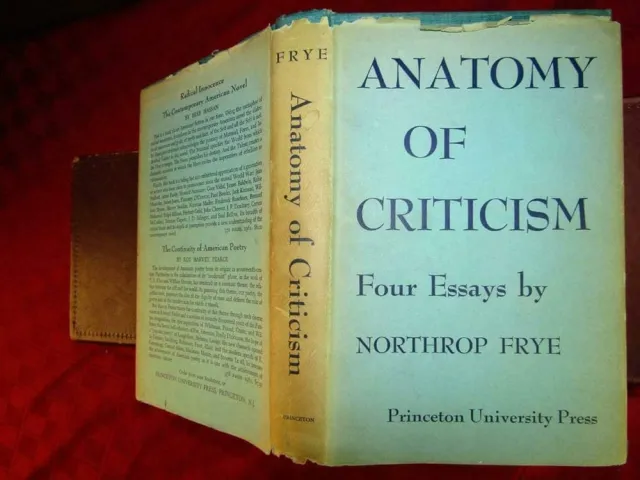
Published in 1957 by Princeton University Press, Northrop Frye’s Anatomy of Criticism: Four Essays remains a foundational text in twentieth-century literary theory.[1] Frye seeks to establish literary criticism as an autonomous, inductive science rather than a derivative mix of biography, history, or political ideology.[2] By mapping literature into a systematic taxonomy of modes, symbols, myths, and genres, Frye demonstrates how all imaginative writing forms an interconnected structural framework centered on human desire and archetypal imagination.[3]
The Polemical Introduction: Criticism as an Autonomous Science
Before presenting his four core essays, Frye lays out a "Polemical Introduction" to challenge the state of mid-century literary studies.[1:1] He argues that contemporary criticism suffers from two major defects: subjective value judgments based on transient taste and the "deterministic fallacy," where literature is reduced to external disciplines like Marxism, Freudian psychoanalysis, or theology.[3:1]
Frye compares literary criticism to natural sciences: physics studies nature, history studies human action, and literary criticism studies the structure of human imagination expressed through literature.[3:2]
First Essay: Historical Criticism (Theory of Modes)
In the first essay, Frye categorizes literature into five historical fictional modes.[1:3] These modes are classified by the power of action possessed by the central protagonist relative to other human beings and their environment.[2:2]
Power of Protagonist
  ▲
  │  1. Mythic (Godlike / Absolute)
  │  2. Romantic (Superior in degree to environment)
  │  3. High Mimetic (Superior in degree to peers, subject to environment)
  │  4. Low Mimetic (Equal to peers and environment)
  ▼  5. Ironic (Inferior in power/awareness)
The Five Fictional Modes
-
Mythic Mode: The hero is a divine being, superior in kind both to other humans and to their natural environment.[2:3] Classical mythologies and religious scriptures belong to this mode.
-
Romantic Mode: The hero is human but superior in degree to other humans and to the environment.[1:4] They possess extraordinary capabilities or operate under magical laws (e.g., chivalric romances, fairy tales, folk legends).
-
High Mimetic Mode: The hero is superior in degree to other humans but bound by the physical laws of the environment.[3:3] This character is typically a leader, king, or tragic figure whose fall impacts society (e.g., Classical and Elizabethan tragedy, national epics).
-
Low Mimetic Mode: The hero is superior neither to other humans nor to the environment; they are an "everyman" operating on the same level as the reader.[2:4] This mode characterizes realistic fiction, comedy, and domestic drama from the eighteenth century onward.
-
Ironic Mode: The protagonist is inferior in power or awareness to the average human, trapped in bondage, frustration, or absurdity.[3:4] Modern satire and existentialist literature exemplify this mode.
Frye observes a historical trajectory in Western literature, moving sequentially from the mythic mode of antiquity down to the ironic mode of the twentieth century.[1:5] Once the ironic mode reaches its absolute extreme, literature circles back toward mythic reinterpretation.
Second Essay: Ethical Criticism (Theory of Symbols)
The second essay presents a theory of symbolism organized into five distinct levels or phases of interpretation.[1:6] Frye defines a symbol broadly as "any unit of any literary structure that can be isolated for critical attention".[2:5]
Phases of Meaning
-
Literal Phase (Motif): The text is viewed internally as an autonomous pattern of verbal signs. The symbol functions as a motif, valued for its place within the work's verbal structure.[1:7]
-
Descriptive Phase (Sign): The text is viewed externally as a representation of reality. Here, the symbol functions as a sign pointing to external facts, objects, or ideas.[3:5]
-
Formal Phase (Image): The work is evaluated as an artwork that harmonizes form and content. The symbol functions as an image, reflecting a state of mind or aesthetic experience.[2:6]
-
Mythic Phase (Archetype): The text is examined in relation to the entire body of literature.[1:8] The symbol functions as an archetype—a recurring image, association, or pattern that connects individual works to a universal literary tradition.[4]
-
Anagogic Phase (Monad): Literature is viewed as the total expression of human desire and imagination.[4:1] In this phase, the symbol acts as a monad, containing within itself the entire human universe.
Third Essay: Archetypal Criticism (Theory of Myths)
The third essay is widely considered the cornerstone of Frye’s theoretical apparatus.[1:9] Frye presents a narrative taxonomy built upon four core mythoi (singular: mythos), which correspond directly to the four seasons of the natural cycle.[3:6]
Literature forms a cyclical movement mirroring nature's death and rebirth. Each mythos represents a narrative category defining human experience.[3:7]
| Mythos | Season | Archetypal Genre | Core Theme |
|---|---|---|---|
| Spring | Spring | Comedy | Movement from an old rigid order to a new integrated society; rebirth |
| Summer | Summer | Romance | The heroic quest, adventure, triumph over danger, and restoration |
| Autumn | Autumn | Tragedy | The fall of the hero, decline, isolation, and inevitable doom |
| Winter | Winter | Satire & Irony | Unmasking of illusions, absurdity, and the triumph of experience over idealism |
Polarities of Imagery
Frye maps literary imagery across two primary emotional and symbolic poles:[2:7]
-
Apocalyptic Imagery: Represents the world of fulfilled human desire (Heaven, Eden, the Promised Land, Jerusalem).[1:10] Humans are unified, animals are gentle (e.g., lamb, dove), vegetation is a garden or tree of life, and minerals are precious gems or golden cities.
-
Demoniac Imagery: Represents the world of rejected desire and nightmare (Hell, the labyrinth, wasteland, dystopia).[2:8] Humans are isolated or enslaved, animals are monsters or predators (e.g., dragon, wolf), vegetation is a dark forest or swamp, and minerals are barren rocks or prisons.
Between apocalyptic and demoniac poles lies the analogical world, which reflects the everyday human experience of conflict, moral choice, and natural mortality.[3:8]
Fourth Essay: Rhetorical Criticism (Theory of Genres)
In the final essay, Frye redefines literary genres based on what he calls the radical of presentation—the conditions under which a work is presented to its audience.[1:11]
              ┌─────────────────────────────────────┐
              │      Radicals of Presentation       │
              └──────────────────┬──────────────────┘
                                 │
     ┌──────────────────┬────────┴─────────┬──────────────────┐
     ▼                  ▼                  ▼                  ▼
   Epos              Fiction             Drama              Lyric
(Spoken/Recited)   (Printed Text)   (Acted Onstage)  (Overheard Speech)
The Four Major Genres
-
Epos: The spoken word addressed directly to an assembled listening audience (e.g., oral epics, recited poetry).[1:12]
-
Fiction: The printed word written for an individual reader (e.g., modern novels, prose narratives).[4:2]
-
Drama: The enacted word presented by actors on a stage to a physically present audience.[2:9]
-
Lyric: The overheard word, where the poet speaks as if turned away from the audience, addressing themselves, a deity, or a loved one.[3:9]
Frye also introduces three fundamental acoustic and visual elements operating within poetic diction: Melos (rhythm/hearing), Opsis (visual patterns/seeing), and Lexis (verbal texture).[1:13]
Legacy, Critical Reception, and Structural Influence
Anatomy of Criticism established Northrop Frye as one of the preeminent theorists of the twentieth century.[5] His systematic approach provided a powerful alternative to the New Criticism that dominated mid-century American universities.[1:14]
By demonstrating that literature is not an aggregate of isolated works but a coherent symbolic system, Frye paved the way for North American Structuralism and archetypal criticism.[5:1] Scholars like Harold Bloom adapted Frye’s focus on literary continuity, while Fredric Jameson drew upon Frye’s multi-tiered interpretive schema for Marxist hermeneutics.[4:3]
While later post-structuralist and deconstructivist theorists criticized Frye’s schematization as overly rigid or universalist, Anatomy of Criticism remains an irreplaceable map of literary archetypes and structural form.[5:2]
Resonant Notes
The following notes in the vault resonate with Frye's Anatomy of Criticism and its systematic taxonomy of literature:
🔗 Strong Resonance
-
Herman Northrop Frye (1912–1991) — The biographical companion note that directly elaborates on Frye's life, intellectual context, and the four mythoi (Spring/Comedy, Summer/Romance, Autumn/Tragedy, Winter/Satire) that form the core of Anatomy of Criticism. This is the most directly connected note in the vault.
-
Joseph Campbell and the Hero's Journey — Campbell's Monomyth shares Frye's ambition to map universal narrative structures. Both thinkers sought to uncover archetypal patterns underlying all storytelling — Campbell through the hero's quest cycle, Frye through his seasonal mythoi. Their parallel but divergent approaches (Campbell's Jungian psychology vs. Frye's purely structural method) make this a rich comparative pair.
-
Romantic Literature Themes Analysis — Frye's Romantic Mode (the hero superior in degree to others and the environment) and his Summer mythos (Romance/Quest) directly inform the analysis of Romantic literature. The note's exploration of the Gothic as the "shadow of the Enlightenment" resonates with Frye's dialectic between apocalyptic and demonic imagery.
🏗️ Structural & Formal Resonance
-
Beyond the Macabre - Edgar Allan Poe's Rationalist Gothic — Poe's "Unity of Effect" — the insistence that every word in a story must serve a single premeditated design — is a practical application of Frye's insistence on literature as an autonomous, internally coherent system. Both reject external biographical or historical reductionism in favour of structural analysis.
-
Don DeLillo Major Themes Analysis — DeLillo's fiction operates within what Frye would call the Winter mythos of Satire and Irony: unmasking illusions, exposing the absurdity of systems, and depicting a world where the hero is helpless. The note's focus on language as both control and ritual echoes Frye's theory of symbols across literal, descriptive, and formal phases.
-
Henry James - Psychological Realism and the William James Dynamic — James's movement from accessible social realism to dense psychological probing mirrors Frye's progression from Low Mimetic to Ironic modes. James's formal experimentation with the "central consciousness" aligns with Frye's theory of genres based on the "radical of presentation."
🧠 Theoretical & Philosophical Resonance
-
Theory of the Subject - Jacques Lacan — Lacan's Symbolic Order (language, law, kinship structures) parallels Frye's conception of literature as an autonomous "verbal universe" governed by internal structural logic. Both thinkers treated cultural products as systems governed by underlying codes and symbolic exchange networks.
-
The Existential Paradox of Annie Hall's Opening Monologue — Alvy Singer as a Low Mimetic/Ironic hero trapped in the Winter mythos of disillusionment is a perfect case study for Frye's framework. The Byronic Hero archetype and Keats's Negative Capability — both discussed in this note — slot neatly into Frye's taxonomy of modes and mythoi.
-
Analytic Philosophy — While not literary, this note's engagement with systematic classification, logical analysis, and the demarcation problem mirrors Frye's project of establishing criticism as an "inductive science" derived from the total body of literature rather than external ideologies.
References
Northrop Frye / Anatomy of Criticism: Four Essays / Princeton University Press ↩︎ ↩︎ ↩︎ ↩︎ ↩︎ ↩︎ ↩︎ ↩︎ ↩︎ ↩︎ ↩︎ ↩︎ ↩︎ ↩︎ ↩︎
Wikipedia / Anatomy of Criticism / Wikipedia ↩︎ ↩︎ ↩︎ ↩︎ ↩︎ ↩︎ ↩︎ ↩︎ ↩︎ ↩︎
GradeSaver / Anatomy of Criticism Study Guide / GradeSaver ↩︎ ↩︎ ↩︎ ↩︎ ↩︎ ↩︎ ↩︎ ↩︎ ↩︎ ↩︎
EBSCO Research Starters / Anatomy of Criticism by Northrop Frye / EBSCO ↩︎ ↩︎ ↩︎ ↩︎
A. C. Hamilton / Northrop Frye: Anatomy of his Criticism / University of Toronto Press ↩︎ ↩︎ ↩︎