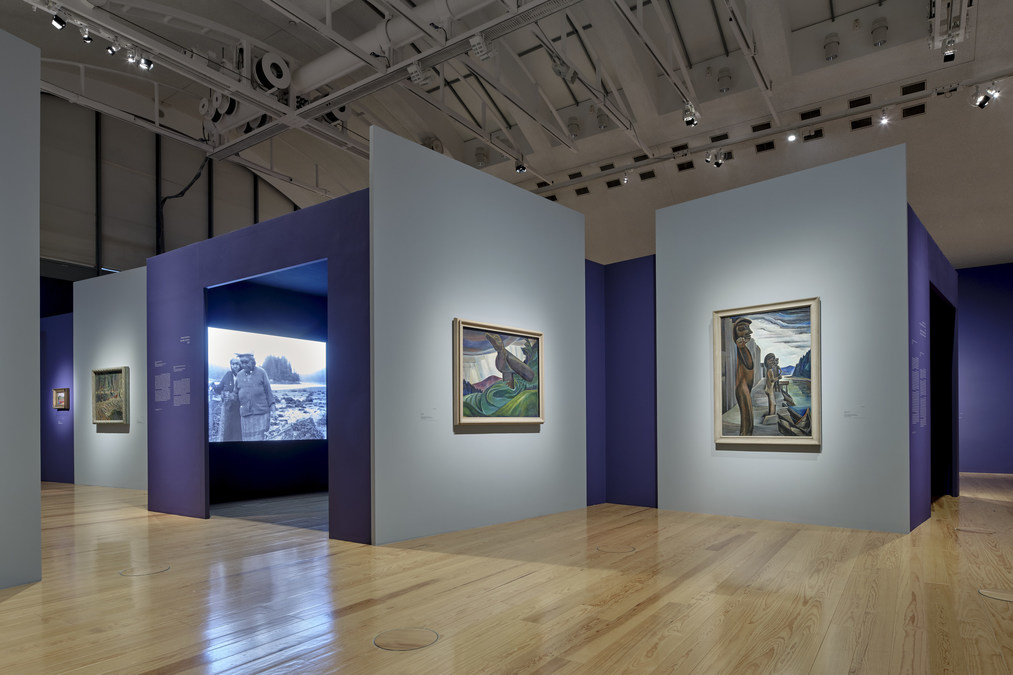
The Group of Seven (also known as the Algonquin School) was a collective of Canadian landscape painters active between 1920 and 1933. By rejecting European academic traditions in favor of bold colors, dramatic forms, and direct engagement with the wilderness, they forged a distinct national visual identity that forever reshaped Canadian art.
Historical Genesis and Origins
Between 1911 and 1913, a group of commercial artists working at the Toronto graphic design firm Grip Ltd. began meeting regularly at the Arts and Letters Club of Toronto [1]. Disillusioned with the conservative, European-influenced visual style that dominated Canadian galleries, these artists sought a new visual language suited to the Canadian terrain [1:1].
World War I temporarily interrupted their momentum as several members served overseas or worked as official war artists. A tragic loss struck the group in July 1917 when Tom Thomson, the artistic catalyst and outdoorsman who introduced the artists to Northern Ontario's Algonquin Park, drowned under mysterious circumstances in Canoe Lake [1:2].
Reuniting after the war, the artists officially formed the Group of Seven in March 1920, holding their inaugural exhibition at the Art Gallery of Toronto (now the Art Gallery of Ontario) in May 1920 [1:3].
Core Aesthetic and Artistic Philosophy
The Group of Seven rejected the muted, pastoral conventions of 19th-century academic landscape painting [1:6]. Drawing influence from Post-Impressionism, Art Nouveau, and contemporary Scandinavian landscape exhibitions, they developed a technique characterized by:
-
Direct Wilderness Engagement: Members embarked on canoeing, hiking, and rail boxcar trips through the Canadian Shield, sketching directly onto small wooden panels (plein-air sketchboards) before translating them to large canvases in their Toronto studios [1:7].
-
Bold Color and Expressive Brushwork: They used rich impasto, heightened colors, and rhythmic brushwork to capture the rugged texture of rocks, weather, and northern light [1:8].
-
Symbolic Modernism: Topography was simplified into stylized, expressive forms to convey the spiritual force of nature rather than literal photographic representation [1:9].
While the Group promoted their work as capturing pristine, untamed wilderness, many of their chosen landscapes—such as Algoma and the Nickel Belt—were working industrial, mining, or logged regions undergoing active human transformation.
Membership and Roster Evolution
The collective expanded beyond its original seven members to widen its geographic representation across Canada [1:10].
Founding Members (1920)
-
Lawren Harris (1885–1970): The intellectual leader and financial patron of the group whose work shifted from vibrant forest landscapes to rhythmic, abstracted depictions of Lake Superior, the Rockies, and the Arctic [1:11].
-
J.E.H. MacDonald (1873–1932): A designer and senior figure whose dramatic compositions in Algoma set the benchmark for the group's early exhibitions [1:12].
-
A.Y. Jackson (1882–1974): The group's primary champion and avid traveler, known for sweeping, atmospheric canvases of Quebec, Ontario, and the Arctic [1:13].
-
Franklin Carmichael (1890–1945): The youngest founding member, celebrated for his dynamic watercolors and industrial landscape depictions of Northern Ontario [1:14].
-
Arthur Lismer (1885–1969): English-born graphic designer and educator who emphasized expressive, textured brushwork and pioneered art education in Canada [1:15].
-
Frederick Varley (1881–1969): A master portraitist and landscape painter who focused on intense color theory and the rugged coastal terrain of British Columbia [1:16].
-
Franz Johnston (1888–1949): A prolific painter who resigned from the group in 1920 to pursue commercial art and independent gallery sales [1:17].
Later Official Members
-
A.J. Casson (1898–1992): Joined in 1926 to fill the vacancy left by Franz Johnston, specializing in crisp, graphic depictions of rural Southern Ontario villages [1:18].
-
Edwin Holgate (1892–1977): Joined in 1930, bringing a Montreal perspective and expertise in figure painting and wood engraving [1:19].
-
Lionel LeMoine FitzGerald (1890–1956): Joined in 1932 from Winnipeg, expanding the group's geographical footprint to Western Canada [1:20].
Key Associated Artists
-
Tom Thomson (1877–1917): The group's precursor and peer whose iconic works (The Jack Pine, The West Wind) defined early Canadian wilderness art [1:21].
-
Emily Carr (1871–1945): Deeply influenced by Lawren Harris after meeting the Group in 1927 [1:22]. Though never an official member, she was embraced as a peer in her depiction of Pacific Northwest coastal forests and Indigenous heritage sites [1:23].
Geographic Focus and Key Masterworks
| Region | Primary Artists | Iconic Works | Key Characteristics |
|---|---|---|---|
| Algonquin Park | Tom Thomson, A.Y. Jackson, J.E.H. MacDonald | The West Wind (Thomson), The Red Maple (Jackson) [2] | Vibrant fall colors, wind-bent pine trees, northern lakes. |
| Algoma & Lake Superior | Lawren Harris, J.E.H. MacDonald, Frank Johnston | Solemn Land (MacDonald), North of Lake Superior (Harris) | Boxcar sketching trips, dramatic topography, stylized light beams. |
| Canadian Arctic | Lawren Harris, A.Y. Jackson | Icebergs, Davis Strait (Harris), Labrador Coast (Jackson) | Bare, geometric forms, stark lighting, expansive isolation. |
| Rocky Mountains | Lawren Harris, F.H. Varley | Mt. Lefroy (Harris) [2:1], Dead Tree, Garibaldi Park (Varley) [2:2] | Monumental pyramid shapes, cool color palettes, spiritual abstraction. |
Disbandment and Lasting Legacy
Following the death of J.E.H. MacDonald in 1932, the surviving members decided that the original framework had fulfilled its initial objective [1:24]. In 1933, they officially disbanded the Group of Seven and established a broader, national organization called the Canadian Group of Painters, which welcomed modern artists across the country [1:25].
Today, the Group of Seven's legacy is preserved in major institutions across Canada, notably the Art Gallery of Ontario in Toronto and the McMichael Canadian Art Collection in Kleinburg, Ontario—where six of the original members and four of their wives are buried on the gallery grounds [2:3].
Resonant Notes
The following notes in the vault resonate with the themes, historical context, and artistic philosophy of the Group of Seven:
Primary Resonance
- English-language Canadian Literature (English CanLit) — The most direct counterpart to the Group of Seven. Both movements emerged in the same cultural moment, seeking to define a distinctly Canadian identity through engagement with the rugged northern landscape. The Group's bold depictions of the Canadian Shield parallel CanLit's "garrison mentality"—the view of nature as an indifferent, powerful force that shapes the national psyche.
Thematic & Philosophical Resonance
-
American Transcendentalism — While the Group of Seven and American Transcendentalists both found spiritual significance in nature, they offer contrasting perspectives. Where Transcendentalism often celebrates nature as a source of direct spiritual revelation, the Canadian tradition (as seen in the Group and CanLit) historically depicts nature as a more hostile, isolating, and vast force that demands survival and endurance.
-
Don DeLillo Major Themes Analysis — Offers a comparative foil. While the Group of Seven sought to capture the "pristine" wilderness (often masking industrial transformation), DeLillo's work—specifically the artist Klara Sax—explores the aesthetic and spiritual redemption of industrial waste and the physical remnants of history, providing a modern, critical perspective on how artists interact with the landscape.
-
Aldous Huxley's Heaven and Hell (1956) — Huxley discusses how certain artists, such as Far Eastern landscape painters, utilized negative space to evoke the infinite, non-individualized nature of "Mind at Large." This resonates with the Group of Seven's own efforts to move beyond literal representation toward a more symbolic, spiritualized depiction of the Canadian terrain.
Sociological & Cultural Frameworks
-
Durkheimian Sociology — Provides a framework for understanding the Group of Seven as a project of cultural nationalism. Just as the CanLit Renaissance sought to construct a shared symbolic order to bind a vast nation, the Group of Seven's work functioned as a visual project to create a unified, distinct Canadian identity.
-
Innis (1950) - Empire and Communications — Harold Innis's intellectual tradition, rooted in Canadian economic history and the tension between colonial inheritance and national identity, shares the same foundational concerns that drove the Group of Seven to reject European academic traditions in favor of a new, indigenous visual language.
Backlinks
-
Herman Northrop Frye (1912–1991) — The Group of Seven's project of forging a distinctly Canadian visual identity by rejecting European academic traditions parallels Frye's analysis of Canadian cultural identity in The Bush Garden. Both represent attempts to articulate an indigenous cultural language against colonial inheritance.
-
English-language Canadian Literature (English CanLit) — The Group of Seven is the visual arts counterpart to CanLit's literary nationalism. Both movements emerged seeking to define a distinctly Canadian identity through engagement with the rugged northern landscape, and both rejected European conventions in favor of a direct encounter with the Canadian wilderness.
-
English-language Canadian Literature (English CanLit) — The Group of Seven is the visual arts counterpart to CanLit's literary nationalism. Both movements emerged seeking to define a distinctly Canadian identity through engagement with the rugged northern landscape, and both rejected European conventions in favor of a direct encounter with the Canadian wilderness.