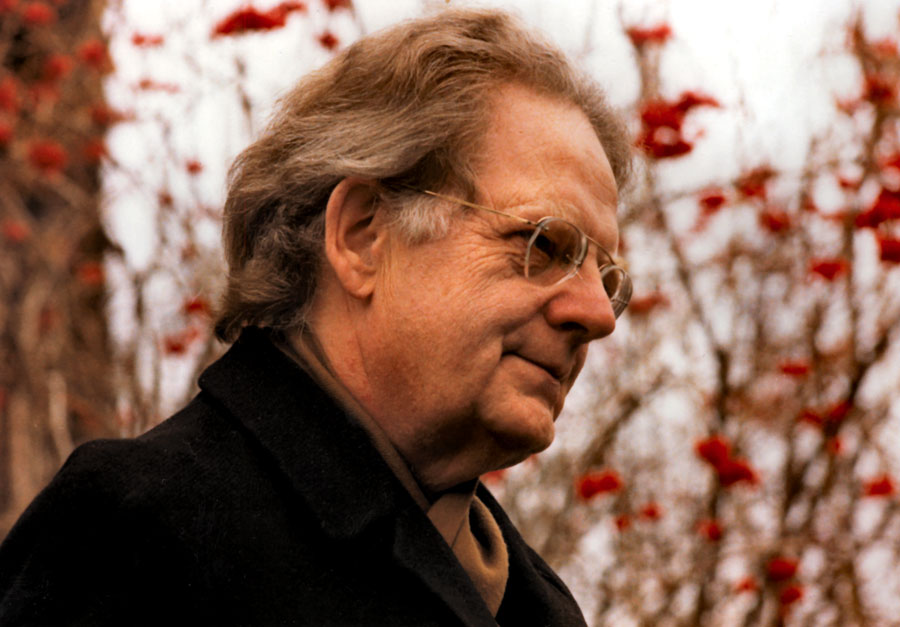
Herman Northrop Frye (1912–1991) was an influential 20th-century Canadian literary critic and theorist whose work established the foundations of archetypal criticism and structural literary analysis. Best known for Anatomy of Criticism (1957), Frye systematized the study of literature by mapping universal symbolic patterns, seasonal narrative frameworks (mythoi), and historical fictional modes. His theoretical framework transformed literary criticism from subjective evaluation into an autonomous, systematic discipline.
Biography and Intellectual Context
Herman Northrop Frye was born in Sherbrooke, Quebec, in 1912 and spent the majority of his academic career at Victoria College at the University of Toronto.[1] Ordained as a minister in the United Church of Canada in 1936, his theological background deeply informed his understanding of Western mythic patterns, narrative archetypes, and biblical typology.[2]
Frye’s critical breakthrough arrived with the publication of Fearful Symmetry (1947), a landmark study of William Blake.[3] At a time when Blake’s visionary poetry was frequently dismissed as eccentric or erratic, Frye demonstrated that Blake’s work operated within a coherent, highly structured system of mythic symbols rooted in the Bible and Western art.[4] This insight led Frye to hypothesize that all Western literature shared an underlying, interconnected architecture.[5]
Prior to Frye's work, mid-20th-century literary studies were dominated by New Criticism, which favored isolated "close readings" of individual texts, and traditional historical-biographical approaches. Frye sought to unify the discipline by proposing that individual literary works are expressions of an autonomous, larger "verbal universe."[6]
Core Theoretical Frameworks
Archetypal Criticism and the Verbal Universe
Frye argued that literature does not directly imitate life; rather, it imitates other literary forms.[7] Literature exists as a unified, self-contained system—a "verbal universe"—composed of recurring symbols, themes, and narrative patterns called archetypes.[8]
Unlike Carl Jung, who viewed archetypes as psychological remnants stored in the human collective unconscious, Frye treated archetypes as purely structural and communicable units within literature itself.[9]
The Four Mythoi (Seasonal Narrative Cycle)
In Anatomy of Criticism, Frye mapped all literary narrative structures into four fundamental cyclical forms, or mythoi, aligning each with a season of the natural world:[10]
-
Spring: Comedy
-
Movement: Rebirth, renewal, and the victory of life over inertia or social rigidity.
-
Narrative Arc: A hero and heroine overcome social barriers—often imposed by older authority figures—to establish a new, harmonious social order, typically culminating in a wedding.[11]
-
-
Summer: Romance
-
Movement: Ideal vision, adventure, and the fulfillment of human potential.
-
Narrative Arc: A quest involving a heroic journey, a perilous descent into darkness or subterranean realms, a central conflict (such as dragon-slaying), and eventual exaltation.[12]
-
-
Autumn: Tragedy
-
Movement: Decline, isolation, and the downfall of human greatness.
-
Narrative Arc: A protagonist of exceptional standing disturbs the moral or natural order, resulting in unavoidable fall, sacrifice, or death as the world transitions toward coldness.[13]
-
-
Winter: Satire and Irony
-
Movement: Disillusionment, cold realism, and the dissolution of ideal values.
-
Narrative Arc: The dismantling of myths and conventions. Satire ridicules human folly, while irony depicts a rigid world of experience where the hero is helpless or absent.[14]
-
| Season | Mythos | Central Motif | Typical Outcome |
|---|---|---|---|
| Spring | Comedy | Rebirth & Social Harmony | Integration, New Order |
| Summer | Romance | Quest & Heroic Ideal | Transformation, Victory |
| Autumn | Tragedy | Downfall & Sacrifice | Isolation, Nemesis |
| Winter | Satire / Irony | Exposure & Bondage | Realism, Disillusionment |
Historical Modes of Literature
Frye classified narrative fiction into five distinct fictional modes based on the hero’s power of action relative to other human beings and their environment:[15]
-
Mythic: The hero is divine and superior in kind to both other people and their environment.
-
Romantic: The hero is superior in degree to other people and their environment (possessing magical or superhuman traits).
-
High Mimetic: The hero is superior in degree to other people, but constrained by the natural environment (classic epic leaders and tragic heroes).
-
Low Mimetic: The hero is superior neither to other people nor to their environment; equal to the reader (realistic novels and domestic drama).
-
Ironic: The hero is inferior in power or intelligence to the reader, trapped in a world of frustration or social bondage.
Frye observed that Western literary history followed a chronological progression downward through these modes, shifting from ancient myth toward modern irony.[16]
Major Published Works
Fearful Symmetry (1947)
This foundational study reinterpreted William Blake's poetry, establishing that Blake was consciously engaging with the central imaginative narrative of Western culture: the fall and redemption of human consciousness.[17]
Anatomy of Criticism (1957)
Considered Frye's magnum opus, this volume consists of four interconnected essays:
-
Historical Criticism: Theory of Modes
-
Ethical Criticism: Theory of Symbols
-
Archetypal Criticism: Theory of Myths
-
Rhetorical Criticism: Theory of Genres
The work provided a comprehensive taxonomy for literary study, attempting to establish a systematic, scientific basis for critical inquiry.[18]
Within his essay on symbol theory, Frye outlined the "anagogic phase" of literature. At this level, individual texts transcend literal boundaries and merge into a single, totalizing vision of the human imagination containing all of nature and human experience.[19]
The Bush Garden (1971) & Canadian Cultural Theory
Frye applied his structural insights to Canadian literature in The Bush Garden, famously formulating the concept of the Garrison Mentality.[20]
He argued that early Canadian identity was shaped by small, isolated communities huddled together in fear of an immense, formidable, and indifferent wilderness.[21] This environment cultivated a collective psychology marked by defensive conformity, moral anxiety, and a preference for order over individual expression.[22] In later writings, Frye observed that modern urbanization was shifting Canadian culture from a "garrison mentality" toward a "condominium mentality."[23]
The Great Code (1982) and Words with Power (1990)
In his final major period, Frye produced extensive studies examining the Bible as the foundational mythic text of Western literature. The Great Code analyzed how biblical typology—prefiguration and fulfillment—provided the primary imaginative framework for Western literary narrative.[24]
Legacy and Intellectual Influence
Literary theorist Harold Bloom remarked that at his height, Frye was "the most important living student of Western literature," acknowledging his peerless ability to map the architecture of narrative form.[25]
Critical Impact
-
Precursor to Structuralism: Operating independently in North America, Frye's identification of universal narrative codes anticipated European Structuralism as championed by Claude Lévi-Strauss and Roland Barthes.[26]
-
Influence on Canadian Criticism: Frye deeply influenced generations of Canadian writers and scholars, including Margaret Atwood, whose landmark thematic survey Survival built directly upon Frye’s garrison thesis.[27]
Criticisms and Counter-Arguments
Following the rise of post-structuralism and cultural materialism, Frye's theoretical model encountered major critiques:
-
Historical Decontextualization: Marxist and historicist critics argued that Frye detached literature from material, political, and economic contexts, treating texts as closed, timeless constructs.[28]
-
Universalizing Assumptions: Feminist and post-colonial scholars criticized his assumption that Western biblical and classical archetypes represented "universal" human psychological patterns.[29]
Resonant Notes
The following notes in this vault resonate with Frye's ideas and frameworks:
Strong Resonance
-
English-language Canadian Literature (English CanLit) — Frye's garrison mentality is directly cited in this note as a key critical framework for understanding early Canadian literature: the defensive psychological stance of isolated communities against a hostile wilderness. This is the most direct resonance in the vault.
-
Joseph Campbell and the Hero's Journey — Both Frye and Campbell were engaged in the same mid-century project of mapping universal narrative structures. While Campbell (influenced by Jung) saw archetypes as psychological remnants of the collective unconscious, Frye treated them as purely structural units within literature itself. Their parallel but divergent approaches to archetypal criticism make this a rich comparative pair.
-
Arnold van Gennep (1873–1957) — Van Gennep's tripartite rites of passage structure (Separation, Transition, Incorporation) directly informed Campbell's Monomyth and resonates with Frye's seasonal mythoi — both thinkers sought cyclical, universal patterns underlying cultural expression.
Medium Resonance
-
Beyond the Macabre - Edgar Allan Poe's Rationalist Gothic — Poe's Unity of Effect — the insistence that every word in a story must serve a single premeditated design — parallels Frye's structuralist conviction that literature is a unified, self-contained system where every element derives meaning from its place within the whole.
-
Theory of the Subject - Jacques Lacan — Lacan's synthesis of Saussurean linguistics and Lévi-Strauss's structural anthropology mirrors Frye's own structuralist approach to literature. Both thinkers treated cultural products as systems governed by underlying codes and symbolic exchange networks.
-
Don DeLillo Major Themes Analysis — DeLillo's exploration of language as a structured system of both control and awe resonates with Frye's concept of the "verbal universe" — the idea that literature (and language) constitutes a self-referential system that shapes human consciousness.
-
Group of Seven (also known as the Algonquin School) — The Group of Seven's project of forging a distinctly Canadian visual identity by rejecting European academic traditions parallels Frye's analysis of Canadian cultural identity in The Bush Garden. Both represent attempts to articulate an indigenous cultural language against colonial inheritance.
Peripheral Resonance
-
Romantic Literature Themes Analysis — Frye's Summer mythos (Romance) — the quest, heroic ideal, and transformation — provides a structural framework for understanding the Byronic Hero and Romantic archetypes discussed in this note.
-
Information Networks and the Architecture of Social Order — The note's discussion of narrative as a social bonding mechanism (Dunbar's gossip theory, shared fictions) resonates with Frye's view of literature as a unified system that binds communities through shared archetypal patterns.
-
Innis (1951) - The Bias of Communication — Both Frye and Innis are foundational figures in Canadian intellectual history, each analyzing how cultural forms (literature for Frye, communication media for Innis) shape civilization. Innis's "Minerva's Owl" thesis parallels Frye's cyclical view of literary modes.
References
The Editors of Encyclopaedia Britannica / Northrop Frye | Canadian Literary Critic / Britannica ↩︎
Victoria University in the University of Toronto / Northrop Frye Biography / Victoria University ↩︎
Northrop Frye / Fearful Symmetry: A Study of William Blake / Princeton University Press ↩︎
Literary Theory and Criticism / Myth Criticism of Northrop Frye / Literariness ↩︎
EBSCO Research Starters / Anatomy of Criticism by Northrop Frye / EBSCO ↩︎
Literary Theory and Criticism / Myth Criticism of Northrop Frye / Literariness ↩︎
EBSCO Research Starters / Anatomy of Criticism by Northrop Frye / EBSCO ↩︎
Literary Theory and Criticism / Myth Criticism of Northrop Frye / Literariness ↩︎
McMaster University / Northrop Frye and Critical Method: Theory of Myths / McMaster University Fryeblog ↩︎
McMaster University / Northrop Frye and Critical Method: Theory of Myths / McMaster University Fryeblog ↩︎
Literary Theory and Criticism / Myth Criticism of Northrop Frye / Literariness ↩︎
EBSCO Research Starters / Anatomy of Criticism by Northrop Frye / EBSCO ↩︎
EBSCO Research Starters / Anatomy of Criticism by Northrop Frye / EBSCO ↩︎
EBSCO Research Starters / Anatomy of Criticism by Northrop Frye / EBSCO ↩︎
Princeton University Press / Fearful Symmetry: A Study of William Blake / Princeton University Press ↩︎
EBSCO Research Starters / Anatomy of Criticism by Northrop Frye / EBSCO ↩︎
The Canadian Encyclopedia / Garrison Mentality / The Canadian Encyclopedia ↩︎
The Canadian Encyclopedia / Garrison Mentality / The Canadian Encyclopedia ↩︎
The Canadian Encyclopedia / Garrison Mentality / The Canadian Encyclopedia ↩︎
Indiana University Press / The Great Code: The Bible and Literature / Indiana University Press ↩︎
Harold Bloom / The Western Canon: The Books and School of the Ages / Internet Archive ↩︎
Literary Theory and Criticism / Myth Criticism of Northrop Frye / Literariness ↩︎
The Canadian Encyclopedia / Garrison Mentality / The Canadian Encyclopedia ↩︎
Literary Theory and Criticism / Myth Criticism of Northrop Frye / Literariness ↩︎
The Canadian Encyclopedia / Garrison Mentality / The Canadian Encyclopedia ↩︎