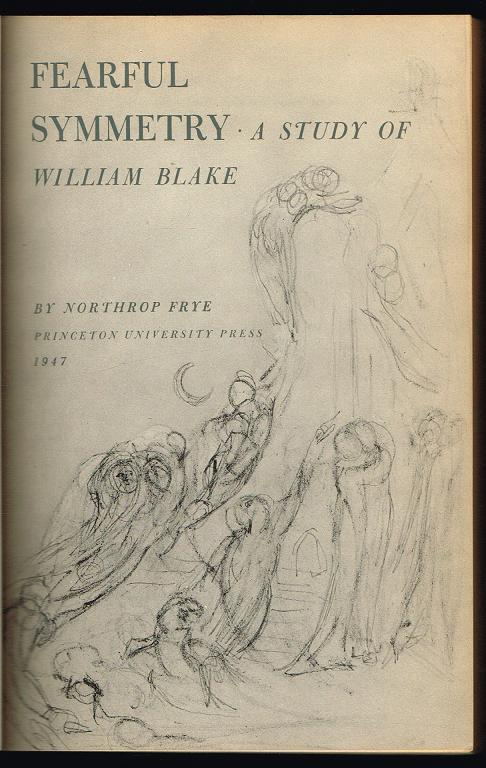
Published in 1947 by Princeton University Press, Northrop Frye's Fearful Symmetry: A Study of William Blake transformed 20th-century literary studies.[1] By demonstrating that William Blake's complex and obscure "Prophetic Books" were not the unhinged ramblings of an eccentric mystic, but a rigorous and unified mythological system, Frye unlocked Blake's visionary art and laid the groundwork for archetypal literary criticism.[2]
Overview and Historical Context
Prior to the publication of Fearful Symmetry, mainstream literary criticism treated William Blake's shorter lyrics (such as Songs of Innocence and of Experience) with praise, while largely dismissing his major prophetic works—including The Four Zoas, Milton, and Jerusalem—as chaotic, private enigmas or evidence of madness.[1:1]
Northrop Frye wrote Fearful Symmetry during the Second World War.[3] Frye argued that the global conflict and totalitarian psychoses of the 1940s provided a direct historical mirror to Blake's own era, illuminating Blake's radical critique of empire, moralism, and state tyranny.[3:1] Rather than viewing Blake's symbolism as a set of isolated riddles to be decoded, Frye demonstrated that Blake spoke a coherent literary "grammar" rooted in the Bible, classical mythology, and Western literature.[1:2]
Core Philosophical Foundations
The Critique of Empiricism
A central premise of Frye's analysis is Blake's fierce rejection of 18th-century rationalism and Lockeian empiricism.[1:3] Blake opposed the view of John Locke and Isaac Newton, which positioned human perception as a passive receptor of external, physical reality.[1:4] To Blake, reducing existence to material objects perceived by physical senses bound humanity to a dead, mechanistic universe.
The Divine Imagination
For Blake, as interpreted by Frye, the supreme reality is not material nature, but the Divine Imagination (Poetic Genius). Reason is merely the bounded circumference of energy; true perception requires seeing through the eye rather than with the eye.[1:5] Art and imaginative vision are not mere entertainments, but the primary means through which humanity participates in the divine nature.[4]
The Law of Contraries
Frye emphasizes Blake’s fundamental rule: "Without contraries is no progression."[4:1] Frye distinguishes between two key concepts in Blake's philosophy:
-
Contraries: Interdependent, opposing forces necessary for growth, creativity, and human experience (e.g., Innocence and Experience, Reason and Energy, Creation and Destruction).[4:2]
-
Negations: Stagnant, destructive dogmas that attempt to smother one half of a contrary pair (e.g., orthodox moral codes that label physical energy as "evil" and passive restraint as "good").[4:3]
                  [ Universal Creation ]
                            │
            ┌───────────────┴───────────────┐
            ▼                               ▼
       [ Energy ]                      [ Reason ]
  (Creative Dynamic)              (Form & Restraint)
            │                               │
            └───────────────┬───────────────┘
                            ▼
             [ Progressive Advancement ]
Blake's Fourfold Cosmology
Frye mapped Blake's metaphysical universe into a structured hierarchy known as the Four States of Existence.[1:6]
1. Eden
The highest realm of human existence, defined by uninhibited imaginative vision, divine unity, and continuous creative activity.[1:7] In Eden, humanity exists in full realization of its divine nature.
2. Beulah
A tranquil, lower paradise of rest, subconscious dreaming, and maternal care.[1:8] Beulah serves as a gentle refuge for spirits exhausted by the intense, fiery creative energy of Eden.
3. Generation
The realm of physical nature, time, space, and biological reproduction.[1:9] It is the ordinary world of human history, marked by struggle, dualities, and the ongoing tension between potential imaginative awakening and spiritual decay.
4. Ulro
The lowest realm—a spiritual wasteland of pure materialism, cold abstraction, isolation, and spiritual death.[1:10] Ulro is the world created when rationalism isolates itself from imagination, reducing existence to mere physical matter and rigid natural laws.
The Cosmic Fall in Blake's Mythos
Unlike orthodox Christian theology, where humanity falls within an already created universe, Blake's mythos posits that the Fall is the creation of the physical universe.[1:11] When the universal man (Albion) falls asleep and fragments into competing aspects, the divine spiritual body breaks apart into the material realm of Generation and Ulro.[1:12]
Key Mythic Archetypes
Frye provides a comprehensive key to the dominant figures in Blake's pantheon:
-
Albion: The Primordial Universal Man who embodies total humanity. His fall into spiritual slumber causes the cosmic fracture.[4:4]
-
Urizen (Your Reason): The Zoa representing cold rationality, legalism, and oppressive order.[4:5] He creates moral codices, natural science, and tyrannical social systems, ruling over the wasteland of Ulro.
-
Los: The archetype of time, prophecy, and creative imagination.[1:13] As a divine blacksmith working at his forge, Los builds form out of chaotic time to prevent humanity from falling into absolute non-entity.
-
Orc: The spirit of violent, youthful revolution and physical desire.[4:6] Frye identified the Orc Cycle, wherein a revolutionary hero rises against Urizenic tyranny, only to age, harden, and gradually turn into a new Urizen himself.[4:7]
-
Enitharmon: The emanation of Los representing space, inspiration, and spiritual beauty.
Structural Organization of Fearful Symmetry
Frye divided his 462-page study into three primary thematic units:[1:14]
| Unit | Title | Core Focus |
|---|---|---|
| Unit I | The Argument | Examines Blake's epistemology, his critique of Locke and Newton, and the role of the visionary artist in society.[1:15] |
| Unit II | The Development of Symbolism | Maps the symbolic grammar of Blake's mythology, contrasting figures like Orc and Urizen with biblical archetypes.[1:16] |
| Unit III | The Final Synthesis | Integrates Blake's epic prophecies (The Four Zoas, Milton, Jerusalem) with biblical typology and literary history.[1:17] |
Legacy and Impact on Literary Theory
Fearful Symmetry did far more than resurrect interest in William Blake; it fundamentally reshaped 20th-century literary criticism.[5]
By demonstrating that Blake's poetry operated on a system of recurring archetypes, Frye demonstrated that literature itself could be analyzed as a unified, self-contained system of symbols.[5:1] This insight became the direct blueprint for Frye’s subsequent masterwork, Anatomy of Criticism (1957), which formalized archetypal critical theory.[5:2]
While later scholars—such as David Erdman—emphasized Blake's immediate political and historical context over Frye's universal mythic system, Fearful Symmetry remains the indispensable cornerstone of Blake studies and structural literary analysis.[5:3][3:2]
Resonant Notes
The following notes in this vault resonate with the ideas and frameworks developed in Fearful Symmetry:
🔥 Strong Resonance
-
Northrop Frye’s - Anatomy of Criticism — The direct successor to Fearful Symmetry. Frye's 1957 masterwork formalizes the archetypal critical method he first developed while decoding Blake's mythology. It extends the project of treating literature as an autonomous, self-contained symbolic system — the very insight Fearful Symmetry pioneered.
-
Herman Northrop Frye (1912–1991) — The biographical overview note that contextualizes Fearful Symmetry as Frye's foundational study, establishing that Blake was "consciously engaging with the central imaginative narrative of Western culture: the fall and redemption of human consciousness."
-
Romantic Literature Themes Analysis — Directly engages with Blake's philosophy of imagination and the limits of reason. Also explores Keats's Negative Capability and Shelley's view of poets as "unacknowledged legislators" — both of which share Blake's Romantic conviction that imaginative vision transcends empirical rationality.
⚡ Structural & Thematic Resonance
-
The Generative Eye (McGilchrist and Buddhism) — Explores the tension between left-hemisphere analytical reason and right-hemisphere holistic perception — a neurological parallel to Blake's critique of Urizenic rationality and his celebration of the Divine Imagination. The note's engagement with Goethe's critique of Newtonian mechanism directly echoes Blake's own rejection of Newton and Locke.
-
The Matter With Things Analysis — Engages with Iain McGilchrist's critique of left-hemisphere dominance and the tension of opposites (coincidentia oppositorum). This resonates with Frye's analysis of Blake's Law of Contraries — the idea that progression requires the dynamic interplay of opposing forces, not their suppression.
-
Joseph Campbell and the Hero's Journey — Campbell's monomyth and Frye's archetypal criticism share a common intellectual lineage: both derive universal narrative patterns from mythology. Frye's fourfold cosmology (Eden, Beulah, Generation, Ulro) maps onto the same structuralist approach to myth that Campbell applied to the hero's journey.
🌿 Peripheral Resonance
-
Dethroning the Ego - Rael’s Journey Through the Subterranean Mythos of Genesis — Applies Campbell's monomyth to Peter Gabriel's The Lamb Lies Down on Broadway, analyzing the shattering of the conscious ego by the unconscious — a psychological journey that mirrors Blake's myth of Albion's fall and redemption through imaginative awakening.
-
Don DeLillo Major Themes Analysis — Explores the tension between language as a tool of rational control versus language as a conduit for religious awe and wonder. This dichotomy parallels Blake's distinction between Urizenic codification and the liberating power of the Poetic Genius.
-
William James and the Landscape of Eastern Thought — James's resistance to absolute monism and his preference for a "concatenated union" resonates with Blake's Law of Contraries — the insistence that reality requires dynamic tension between distinct forces rather than absorption into undifferentiated oneness.
-
Beyond the Macabre - Edgar Allan Poe's Rationalist Gothic — Poe's Eureka — a "prose poem" that claims creative intuition can unlock cosmic truths — mirrors Blake's conviction that the Poetic Genius, not empirical science, reveals the deepest structure of reality.
References
Northrop Frye / Fearful Symmetry: A Study of William Blake / Princeton University Press ↩︎ ↩︎ ↩︎ ↩︎ ↩︎ ↩︎ ↩︎ ↩︎ ↩︎ ↩︎ ↩︎ ↩︎ ↩︎ ↩︎ ↩︎ ↩︎ ↩︎ ↩︎
Johansen Quijano / Book Review: Northrop Frye's Fearful Symmetry / Quijano: On Stuff ↩︎
Bookey / Fearful Symmetry Chapter Summary / Bookey.app ↩︎ ↩︎ ↩︎ ↩︎ ↩︎ ↩︎ ↩︎ ↩︎
Project MUSE / Fearful Symmetries: William Blake, Northrop Frye, and Archetypal Criticism / Project MUSE ↩︎ ↩︎ ↩︎ ↩︎